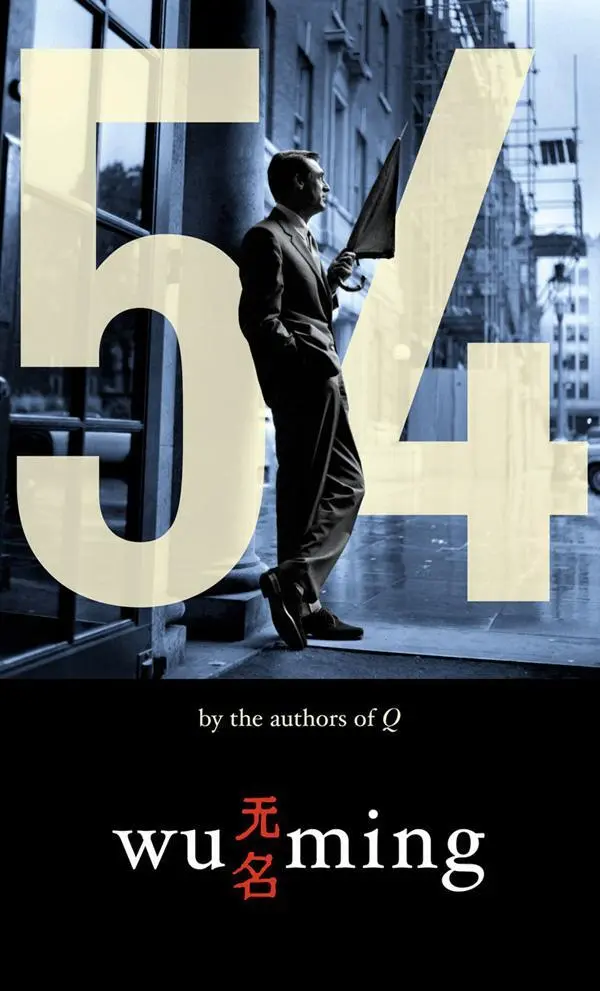
Wu Ming - 54
Здесь есть возможность читать онлайн «Wu Ming - 54» весь текст электронной книги совершенно бесплатно (целиком полную версию без сокращений). В некоторых случаях можно слушать аудио, скачать через торрент в формате fb2 и присутствует краткое содержание. Год выпуска: 2006, Издательство: Houghton Mifflin Harcourt, Жанр: Историческая проза, на английском языке. Описание произведения, (предисловие) а так же отзывы посетителей доступны на портале библиотеки ЛибКат.
- Название:54
- Автор:
- Издательство:Houghton Mifflin Harcourt
- Жанр:
- Год:2006
- ISBN:нет данных
- Рейтинг книги:5 / 5. Голосов: 1
-
Избранное:Добавить в избранное
- Отзывы:
-
Ваша оценка:
54: краткое содержание, описание и аннотация
Предлагаем к чтению аннотацию, описание, краткое содержание или предисловие (зависит от того, что написал сам автор книги «54»). Если вы не нашли необходимую информацию о книге — напишите в комментариях, мы постараемся отыскать её.
Set during the height of the Cold War-with the world divided into East and West-54 features Italian partisans, KGB agents, Parisian lowlifes, and cameos by David Niven, Marshal Tito, and Grace Kelly. Wu Ming brings us a cinematic romp that is by turns edgy social satire and modern comic send up.
54 — читать онлайн бесплатно полную книгу (весь текст) целиком
Ниже представлен текст книги, разбитый по страницам. Система сохранения места последней прочитанной страницы, позволяет с удобством читать онлайн бесплатно книгу «54», без необходимости каждый раз заново искать на чём Вы остановились. Поставьте закладку, и сможете в любой момент перейти на страницу, на которой закончили чтение.
Интервал:
Закладка:
Odoacre had a very fine way of life. A distinguished 38-year-old, and still a bachelor. Angela was a beautiful girl in poverty. He had started to court her, until their engagement and marriage in ’48, shortly before the elections. In the house in Via Castiglione, they had put poor Ferruccio in a little room on the ground floor. But Ferruccio didn’t like Odoacre, he responded badly to him, held his mouth when he was there, sometimes growing incandescent with fury, calling him ‘a criminal’, and saying that just because he had money he thought he could take advantage of his sister. Odoacre never lost patience, he tried to reason, to calm his brother-in-law, and sometimes he was successful, but there were some terribly uncomfortable moments for Angela. Before she too lost her mind, Odoacre had sent Ferruccio to Villa Azzurra, in the district of San Lazzaro, and from that day onwards he had taken care of him.
That had happened early in 1950. From then on, Ferruccio left the clinic only on Sunday, when Angela went to collect him and bring him to the cinema or take him for a walk. At Christmas and during the summer, Ferruccio stayed with Angela and Odoacre, for as much as a week or ten days in a row. His outbreaks of rage had grown rarer, because Odoacre gave him some new medicine with a complicated name, a very modern tablet that calmed him down.
Over the past three or four months, Angela had spent only two Sundays a month alone with her brother, because she spent the others with Pierre. So as not to arouse Odoacre’s suspicions, she went to pick up Ferruccio in a taxi, and then left him with a friend, Teresa Bedetti, who was for Angela what Brando was for Pierre, a friend and accomplice. Ferruccio had problems with his nerves, but he was not unintelligent, far from it. He knew everything, and he was also happy that Angela was cuckolding her husband. For some reason, he went on hating him, although he never attacked him verbally. On the other hand, Teresa, like Brando, didn’t really agree with what was happening, but she was also a friend.
Ferruccio went to the cinema with Teresa, and then they met up later and, all together, prepared the story they would tell Odoacre.
*
‘Oh, Brando, it’s not simple, you know. I really love Angela. It’s easy for you to make judgements from outside, but I know she doesn’t love Montroni. It’s gratitude on her part, and also it’s as you say, lack of choice. But what should I do, just give her up like that, without saying anything?’
‘And what would you say? You have no prospects. If you had the money you’d go to San Marino, but in Italy divorce isn’t even legal, and you know what they say about women who have separated from their husbands.’
Brando dipped his bread into some milk, sitting at the table on which Pierre and Angela had once made love. Pierre was standing by the window: outside it was already dark.
‘But even Togliatti married one woman and lives with another!’
‘Togliatti, Togliatti, what’s he got to do with it? Angela isn’t going to leave Montroni, she’s not going to just dump her brother, and she’s certainly not going to starve just because you satisfy her in bed and Montroni probably doesn’t.’
‘But they can’t even have children! She’s told me that Montroni is sterile. ’
Brando said nothing. He ran his hand over his prickly chin. Pierre bit his lips and felt like an idiot. He shouldn’t have revealed such a private detail. Brando was no different from the others, no different from the comrades in the Section or people like Melega: he respected Montroni, he put him on a pedestal, he considered him to be untouchable, and he really was, insofar as a big shot in the Party in the most left-wing city in Italy can be untouchable. That reference to his sexual life was sure to have wrong-footed or horrified Brando. Certainly no one had ever imagined Montroni in the intimacy of his bedroom; he was always so stylish and distinguished, perhaps a little gloomy, and he never showed his teeth when he smiled. Hard to imagine him in his pyjamas, or remember that he, too, like all ordinary mortals, shat and pissed every day.
It was Brando who, embarrassed, broke the silence: ‘Pierre, I repeat: you should break it off before something serious happens.’
Pierre looked into the distance beyond the window.
All he saw was a long black expanse stretching out ahead.
Chapter 21
Palm Springs, California, 15 February
His eyebrows were too thick, they almost met in the middle, and the cleft in his chin wasn’t very pronounced.
Jean-Jacques Bondurant strode across the drawing room. A forced smile, his right hand plunged into his pocket, he looked like a commercial traveller on his first business appointment. He tried to appear casual, as he would have done in the parochial little theatres of Montreal, but the Palm Springs house wasn’t the same thing. Neither was his audience.
Cary watched him walk as far as the library, on the other side of the room, and rose from the sofa to stop him.
‘Forgive me, Mr Bondurant, but with that walk you wouldn’t even look like a Cary Grant reconstructed from hearsay evidence. And sooner or later you’d have to throw your shoes away.’
‘What? My shoes? Mr Grant, I don’t understand.’
He spoke with an impossible accent, sharp and nasal, and the collar of his jacket covered his shirt collar.
‘You see,’ Betsy interrupted, despite her observer’s role, ‘to walk like my husband, you have to try and think like him. One major point: don’t ruin your shoes. The Grant method: avoid bending your feet.’
Bondurant’s arched eyebrow was almost perfect, the same scatterbrained expression as the original. Thin those eyebrows out a little and no one would notice the difference.
‘My wife means that you shouldn’t take your foot off the ground in two moves, heel then toe, but both at once, heel and toe at the same time. It stops your shoes wrinkling in the middle.’
Cary Grant’s walk: the prototype of casual elegance, a prelude to a thousand flirtations and other kinds of triumph. The double tried out a few different ways of walking, then came back to stand beside his model. His legs stiff, but agile and slender, flexible at the knee. Major point: the shoes. It wasn’t easy, he had to think about his feet without looking at them, glancing smugly around.
Betsy clapped her hands and encouraged the Canadian. ‘Fine, Mr Bondurant, you’re a fast learner.’
There was something overdone about the hand in his pocket, and his face was a little pale.
The double smiled. Bondurant’s smile.
‘You’re going to need a bit of training, Mr Bondurant. I suggest you work on your walk.’
‘Certainly, Mr Grant.’
‘Fine. Now satisfy some of my curiosity, Mr Bondurant. What do you think about your English?’
‘What? My English?’
‘Your accent. Do you think you’ll even manage to speak like me?’
The arched eyebrow performed its task. He would have to remember to use it sparingly.
‘I’ve been told I should hardly open my mouth. Just be seen, go for walks, ask for the paper, say goodbye to your wife as I leave the house. No one would notice the difference.’
The people in MI6 must have been crazy. Fine, the newspaper and the walk. And what if someone approached him for an autograph? And what if it was a journalist? What would the double do? He certainly couldn’t claim an infection of the vocal cords, that would only attract people’s attention, would prompt photographs and newspaper articles. Justifying his curious pronunciation by saying that he was preparing for a new character would be even worse. Curiosity about Grant’s return to the big screen would be multiplied ten times over.
Читать дальшеИнтервал:
Закладка:
Похожие книги на «54»
Представляем Вашему вниманию похожие книги на «54» списком для выбора. Мы отобрали схожую по названию и смыслу литературу в надежде предоставить читателям больше вариантов отыскать новые, интересные, ещё непрочитанные произведения.











Обсуждение, отзывы о книге «54» и просто собственные мнения читателей. Оставьте ваши комментарии, напишите, что Вы думаете о произведении, его смысле или главных героях. Укажите что конкретно понравилось, а что нет, и почему Вы так считаете.