Wu Ming - 54
Здесь есть возможность читать онлайн «Wu Ming - 54» весь текст электронной книги совершенно бесплатно (целиком полную версию без сокращений). В некоторых случаях можно слушать аудио, скачать через торрент в формате fb2 и присутствует краткое содержание. Год выпуска: 2006, Издательство: Houghton Mifflin Harcourt, Жанр: Историческая проза, на английском языке. Описание произведения, (предисловие) а так же отзывы посетителей доступны на портале библиотеки ЛибКат.
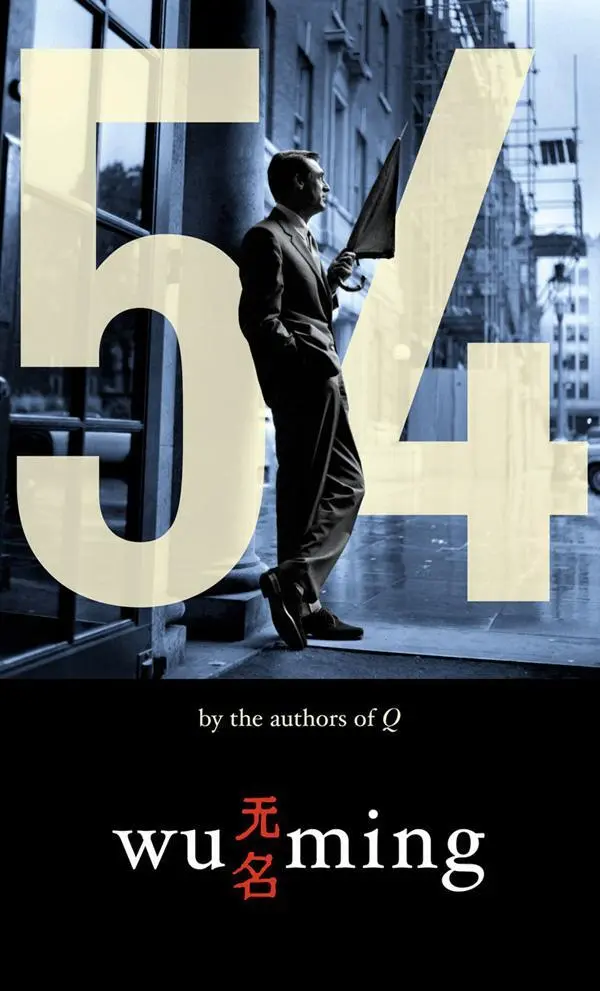
- Название:54
- Автор:
- Издательство:Houghton Mifflin Harcourt
- Жанр:
- Год:2006
- ISBN:нет данных
- Рейтинг книги:5 / 5. Голосов: 1
-
Избранное:Добавить в избранное
- Отзывы:
-
Ваша оценка:
54: краткое содержание, описание и аннотация
Предлагаем к чтению аннотацию, описание, краткое содержание или предисловие (зависит от того, что написал сам автор книги «54»). Если вы не нашли необходимую информацию о книге — напишите в комментариях, мы постараемся отыскать её.
Set during the height of the Cold War-with the world divided into East and West-54 features Italian partisans, KGB agents, Parisian lowlifes, and cameos by David Niven, Marshal Tito, and Grace Kelly. Wu Ming brings us a cinematic romp that is by turns edgy social satire and modern comic send up.
54 — читать онлайн бесплатно полную книгу (весь текст) целиком
Ниже представлен текст книги, разбитый по страницам. Система сохранения места последней прочитанной страницы, позволяет с удобством читать онлайн бесплатно книгу «54», без необходимости каждый раз заново искать на чём Вы остановились. Поставьте закладку, и сможете в любой момент перейти на страницу, на которой закончили чтение.
Интервал:
Закладка:
‘So, Gas,’ he begins all of a sudden, ‘weren’t you telling us to stock up on watches, telling us that if you buy them at ten today, in a few years you sell them on for at least fifty?’ The tone is accusatory. All other conversations stop abruptly and everyone listens.
‘Ah, calm down, now,’ he says defensively, his first glass of red wine already poured, ‘that depends on the type of watch, it doesn’t work for all of them, otherwise. you have to be able to tell which is which.’
‘You’re right there, you know, the other day in Vergato someone paid 50,000 lire for a piece of junk worth a thousand at the most. But maybe in a few years he’ll be able to sell it on for 100,000, what d’you think?’
‘Careful, Walterún,’ Bottone intervenes before Castelvetri can reply, ‘you lot should be able to make 121, because we played pretty well on the Big One.’
While Walterún sets down his point cards, and Castelvetri approaches the table to give a more thorough account of his views on watches, the door opens again, and in comes Melega with the latest news.
‘Have you seen Montroni? Is anybody still going to criticise him for working in the Villa Azzurra?’
‘So, what’s he done?’ Bortolotti asks immediately.
‘Haven’t you read L’Unità this morning? Has anybody read it?’
He has everyone’s undivided attention. Melega picks up the newspaper from the bar and flicks through it, licking his fingers. ‘Listen to this: “Dr Odoacre Montroni, vice-secretary of the Bolognese Federation, director of the Villa Azzurra Clinic, has organised a team of young voluntary medics who will join him in launching a programme of free vaccinations in our province. ‘There are many small hamlets and villages,’ explained Montroni, ‘remote from the main towns and most ambulances. In many of them there is a risk of infection,’” etcetera etcetera.’
‘Is there a photograph?’ asks Garibaldi, who has trouble reading without his glasses.
‘Montroni’s a good comrade, of course,’ Capponi observes from behind the bar.
In the billiard room, between the clicks of the balls, you can imagine Stefanelli nodding. ‘Eh, Montroni, Montroni. ’
The copy of L’Unità passes from hand to hand, amidst general chatter. And there is a photograph, Montroni with his little glasses, sitting behind a big desk covered with pieces of paper.
‘Well?’ Melega continues provocatively. ‘Where’s everyone who used to say that a doctor who’s a comrade shouldn’t work for a private hospital? Are you still there? Hey, Walterún, you used to say that a communist doesn’t make money out of people’s health, off you go, what a comrade, Odoacre Montroni!’
Walterún doesn’t reply, he’s not as young as he was, so he doesn’t tear into Melega, because if he was that bit younger he would have to leap up and have his say so as not to lose face. He turns towards Garibaldi and shakes his head. Bottone comforts him in a whisper. ‘We’re old, Walterún, don’t take it to heart. Not long ago if you wanted to be a comrade you had to go to Spain to get rid of the fascists, but now. ’
And you can be sure that if it wasn’t for Melega, who is strutting stiffly around the room, Bottone would be happy to drop his atom bomb.
Chapter 19
Bologna, Cinema Imperiale, 14 February
Less than a quarter of an hour after the start of the film, Pierre started to come out with a long stream of malevolent comments. Angela dug an elbow into his ribs, asking him not to make a spectacle of himself, saying that in there they were hidden from everybody. To tell the truth, there weren’t many people in the cinema who weren’t sniggering or calling out coarse comments in dialect, and throwing around lupin seeds, liquorice and banter, all well chewed.
Angela was embarrassed. Pierre was aware of that, but he could do nothing about it: the film was terrible, boring, stupid and reactionary as well. Two hours down the drain, because Brando had caught the flu at the last moment, which meant that they couldn’t use his flat. They had nowhere else to make love, and Angela had suggested, ‘Why don’t we go to the cinema?’ Fine, just to make her happy and just to be with her, then in the darkness of the Imperiale they could kiss and touch each other, sitting in the back row was enough to avoid indiscreet glances, and they would leave before everyone else.
But Angela had insisted on going to see Siamo Donne , of all things, because she’d been told she looked a little like the actress Alida Valli. Pierre couldn’t see it himself: Angela was more beautiful, with dark eyes and black hair.
Actresses playing themselves in everyday life. Wealthy, successful women pretending they missed the ‘simple life’ and envied the poor. Pierre couldn’t contain himself.
‘But this guy Zavattini who wrote the film, wasn’t he a comrade? What does that mean: “we were better off when we were worse off”?’
At the beginning, a girl called Anna was shown arguing with her mother and going to Cinecittà for a competition called ‘Four Actresses, One Hope’. Hundreds of girls from all over Italy were competing for four parts in a major film, which, as chance would have it, was this very same film, Siamo Donne .
Clearly the directors wanted to tug on the audience’s heartstrings. There was a girl from Mantua, by the name of Emma. It was her first visit to Rome, a note that was struck a few too many times: she missed her dad, she had never been so far from home, etcetera.
‘Oi, I’ve never been there either. Hardly anyone I know has ever been to Rome. So why does someone who’s never been to Rome have to be an innocent, somebody you have to feel sorry for? And that’s nothing like a Mantuan accent, either.’
Angela had been to Rome. With Odoacre, on their honeymoon. Odoacre went there at least two or three times a year, for the Central Committee. It almost turned Pierre’s stomach to hear talk of Odoacre, and he was mentioned in the bar day in and day out, worse luck: Montroni such a great comrade, Montroni has two great bollocks this size, and so on. The more time passed, the more cause for annoyance there was. He loved Angela, she certainly loved him, and the situation was getting difficult. If they had made love this afternoon, he might have tried to talk to her clearly about it, ask her what she really thought about things, how she felt, what she thought was the right thing to do. Instead they had come to the Imperiale.
What was that word that Fanti used to use? Oh, yes: ‘alienation’. In the first episode Alida Valli was feeling awfully alienated, poor thing, she never had time to do anything that made her happy, because she was forced to go charging from one posh party to another, meeting millionaires, what an effort it must have been, and how she complained, how unhappy she was in the world: she envied her masseuse, she envied the families of the proletariat, and so on and so on, until someone in the first few rows shouted, ‘Well go and work in a factory, then, off you go!’ and other people had suggested other trades typical of the ‘simple life’, from tomato-picking to tree-grafting, from labouring to street-walking.
The second episode was absolutely meaningless, it was unwatchable. It was directed by Rossellini, about whom Fanti had expressed a strong and clear judgement: ‘a dotard’. Ingrid Bergman was chasing a chicken that had eaten her roses. Pierre had seen hundreds of chickens, and never one that ate roses. Bergman called, ‘Come, come, little one, little one!’ caught the chicken and hid it in a chest of drawers, and then the owner found it and left her looking ridiculous.
‘What does that mean? What sort of nonsense is all this?’
Читать дальшеИнтервал:
Закладка:
Похожие книги на «54»
Представляем Вашему вниманию похожие книги на «54» списком для выбора. Мы отобрали схожую по названию и смыслу литературу в надежде предоставить читателям больше вариантов отыскать новые, интересные, ещё непрочитанные произведения.






Обсуждение, отзывы о книге «54» и просто собственные мнения читателей. Оставьте ваши комментарии, напишите, что Вы думаете о произведении, его смысле или главных героях. Укажите что конкретно понравилось, а что нет, и почему Вы так считаете.