Rodrigues Ottolengui - Final Proof - or, The Value of Evidence
Здесь есть возможность читать онлайн «Rodrigues Ottolengui - Final Proof - or, The Value of Evidence» — ознакомительный отрывок электронной книги совершенно бесплатно, а после прочтения отрывка купить полную версию. В некоторых случаях можно слушать аудио, скачать через торрент в формате fb2 и присутствует краткое содержание. Жанр: foreign_prose, на английском языке. Описание произведения, (предисловие) а так же отзывы посетителей доступны на портале библиотеки ЛибКат.
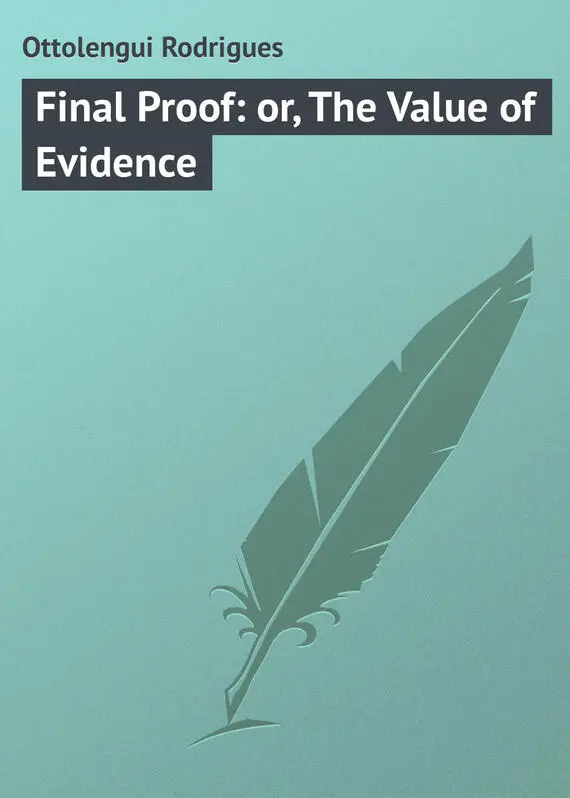
- Название:Final Proof: or, The Value of Evidence
- Автор:
- Жанр:
- Год:неизвестен
- ISBN:нет данных
- Рейтинг книги:3 / 5. Голосов: 1
-
Избранное:Добавить в избранное
- Отзывы:
-
Ваша оценка:
Final Proof: or, The Value of Evidence: краткое содержание, описание и аннотация
Предлагаем к чтению аннотацию, описание, краткое содержание или предисловие (зависит от того, что написал сам автор книги «Final Proof: or, The Value of Evidence»). Если вы не нашли необходимую информацию о книге — напишите в комментариях, мы постараемся отыскать её.
Final Proof: or, The Value of Evidence — читать онлайн ознакомительный отрывок
Ниже представлен текст книги, разбитый по страницам. Система сохранения места последней прочитанной страницы, позволяет с удобством читать онлайн бесплатно книгу «Final Proof: or, The Value of Evidence», без необходимости каждый раз заново искать на чём Вы остановились. Поставьте закладку, и сможете в любой момент перейти на страницу, на которой закончили чтение.
Интервал:
Закладка:
"Did your brother Rufus have any rings on his fingers when placed in the coffin?" asked Mr. Barnes, swiftly changing the subject.
"Yes – three: a diamond, a ruby, and a ring bearing his initial set in diamonds."
"These rings were not on the body at the Morgue."
"Neither was that scar," said Mr. Quadrant, with a suppressed laugh.
"But this is different," said Mr. Barnes. "I did not find the scar, but I have found the rings."
"Very clever of you, I am sure. But what does that prove?"
"It proves that your brother's body was taken from the coffin before the coffin was placed in the crematory furnace."
"Illogical and inaccurate," said Mr. Quadrant. "You prove by the recovery of the rings, merely that the rings were taken from the coffin."
"Or, from the body after it was taken out," interjected Mr. Barnes.
"In either case it is of no consequence. You have rooted up a theft, that is all. Catch the thief and jail him, if you like. I care nothing about that. It is the affair of my brother's death and burial that I wish to see dropped by the inquisitive public."
"Yes, but suppose I tell you that the theory is that the man who stole the rings was your accomplice in the main matter? Don't you see that when we catch him, he is apt to tell all that he knows?"
"When you catch him? Then you have not caught him yet. For so much I am grateful." He did not seem to care how incriminating his words might sound.
"One thing more, Mr. Quadrant. I understand that you retired at about ten o'clock on that night – the night prior to the first funeral, I mean. You left your brother Mark down here?"
"Yes."
"Later you came downstairs again."
"You seem to be well posted as to my movements."
"Not so well as I wish to be. Will you tell me why you came down?"
"I have not admitted that I came downstairs."
"You were seen in the hall very late at night, or early in the morning. You took the lamp out of the room where the casket was, and came in here and looked at your brother, who was asleep. Then you returned the lamp and went upstairs. Do you admit now that you had just come downstairs?"
"I admit nothing. But to show you how little you can prove, suppose I ask you how you know that I had just come downstairs? Why may it not be that I had been out of the house, and had just come in again when your informant saw me?"
"Quite true. You might have left the house. Perhaps it was then that the body was taken away?"
"If it was taken away, that was certainly as good a time as any."
"What time?"
"Oh, let us say between twelve and two. Very few people would be about the street at that hour, and a wagon stopping before a door would attract very little attention. Especially if it were an undertaker's wagon."
"An undertaker's wagon?" exclaimed Mr. Barnes, as this suggested a new possibility.
"Why, yes. If, as you say, there was an accomplice in this case, the fellow who stole the rings, you know, he must have been one of the undertaker's men. If so, he would use their wagon, would he not?"
"I think he would," said Mr. Barnes sharply. "I thank you for the point. And now I will leave you."
Mr. Barnes walked rapidly, revolving in his mind the new ideas which had entered it during the past few minutes. Before this morning he had imagined that the body of Rufus Quadrant had been taken away between five and six o'clock, in the undertaker's wagon. But it had never occurred to him that this same wagon could have been driven back to the house at any hour of the day or night, without causing the policeman on that beat to suspect any wrong. Thus, suddenly, an entirely new phase had been placed upon the situation. Before, he had been interested in knowing which man had been left behind; whether it had been Morgan or Randal. Now he was more anxious to know whether the wagon had been taken again from the stable on that night, and, if so, by whom. Consequently he went first to the undertaker's shop, intending to interview Mr. Berial, but that gentleman was out. Therefore he spoke again with Randal, who recognized him at once and greeted him cordially.
"Why, how do you do," said he. "Glad you're round again. Anything turned up in the Quadrant case?"
"We are getting at the truth slowly," said the detective, watching his man closely. "I would like to ask you to explain one or two things to me if you can."
"Maybe I will, and maybe not. It wouldn't do to promise to answer questions before I hear what they are. I ain't exactly what you would call a fool."
"Did you not tell me that it was Morgan who was left at the house after the coffin was closed, and that you came away with Mr. Berial?"
"Don't remember whether I told you or not. But you've got it straight."
"But they say at the stables that it was you who drove the wagon back there?"
"That's right, too. What of it?"
"But I understood that Morgan brought the wagon back?"
"So he did; back here to the shop. He had to leave all our tools and things here, you see. Then he went off to his dinner, and I took the horse and wagon round to the stables."
"Where do you stable?"
"Harrison's, Twenty-fourth Street, near Lex."
"Now, another matter. You told me about the loss of those rings?"
"Yes, and I gave you the tip where you might find them again. Did you go there?"
"Yes; you were right. The rings were pawned exactly where you sent me."
"Oh, I don't know," said the fellow, airishly. "I ought to be on the police force, I guess. I can find out a few things, I think."
"It isn't hard to guess what you know," said the detective, sharply.
"What do you mean?" Randal was on the defensive at once.
"I mean," said Mr. Barnes, "that it was you who pawned those rings."
"That's a lie, and you can't prove it."
"Don't be too sure of that. We have the pawn tickets."
This shot went home. Randal looked frightened, and was evidently confused.
"That's another lie," said he, less vigorously. "You can't scare me. If you have got them, which you haven't, you won't find my name on them."
"No; you used your friend Morgan's name, which was a pretty low trick."
"Look here, you detective," said Randal blusteringly, "I don't allow no man to abuse me. You can't talk that way to me. All this talk of yours is rot. That's what it is, rot!"
"Look here, Randal. Try to be sensible if you can. I have not yet made up my mind whether you are a scoundrel or a fool. Suppose you tell me the truth about those tickets. It will be safest, I assure you."
Randal looked at the detective and hesitated. Mr. Barnes continued:
"There is no use to lie any longer. You were shadowed, and you were seen when you tore up the tickets. The pieces were picked up and put together, and they call for those rings. Don't you see we have you fast unless you can explain how you got the tickets?"
"I guess you're givin' it to me straight," said Randal after a long pause. "I guess I better take your advice and let you have it right. One afternoon I saw Morgan hide something in one of the coffins in the shop. He tucked it away under the satin linin'. I was curious, and I looked into it after he'd gone that night. I found the pawn tickets. Of course I didn't know what they were for except that it was rings. But I guessed it was for some stuff he'd stolen from the corpse of somebody. For it was him took the other jewels I told you about, and I seen him with a screw-driver the match to the boss's. So I just slipped the tickets in my pocket thinkin' I'd have a hold on him. Next day I read about this man bein' found in the river, and I stopped to the Morgue, and, just as I thought, his rings was gone. I worried over that for an hour or two, and then I thought I better not keep the tickets, so I tore them up and threw them away."
Читать дальшеИнтервал:
Закладка:
Похожие книги на «Final Proof: or, The Value of Evidence»
Представляем Вашему вниманию похожие книги на «Final Proof: or, The Value of Evidence» списком для выбора. Мы отобрали схожую по названию и смыслу литературу в надежде предоставить читателям больше вариантов отыскать новые, интересные, ещё непрочитанные произведения.







Обсуждение, отзывы о книге «Final Proof: or, The Value of Evidence» и просто собственные мнения читателей. Оставьте ваши комментарии, напишите, что Вы думаете о произведении, его смысле или главных героях. Укажите что конкретно понравилось, а что нет, и почему Вы так считаете.