John Aston Warder - American Pomology. Apples
Здесь есть возможность читать онлайн «John Aston Warder - American Pomology. Apples» — ознакомительный отрывок электронной книги совершенно бесплатно, а после прочтения отрывка купить полную версию. В некоторых случаях можно слушать аудио, скачать через торрент в формате fb2 и присутствует краткое содержание. Жанр: foreign_prose, Биология, foreign_edu, foreign_antique, на английском языке. Описание произведения, (предисловие) а так же отзывы посетителей доступны на портале библиотеки ЛибКат.
- Название:American Pomology. Apples
- Автор:
- Жанр:
- Год:неизвестен
- ISBN:нет данных
- Рейтинг книги:5 / 5. Голосов: 1
-
Избранное:Добавить в избранное
- Отзывы:
-
Ваша оценка:
American Pomology. Apples: краткое содержание, описание и аннотация
Предлагаем к чтению аннотацию, описание, краткое содержание или предисловие (зависит от того, что написал сам автор книги «American Pomology. Apples»). Если вы не нашли необходимую информацию о книге — напишите в комментариях, мы постараемся отыскать её.
American Pomology. Apples — читать онлайн ознакомительный отрывок
Ниже представлен текст книги, разбитый по страницам. Система сохранения места последней прочитанной страницы, позволяет с удобством читать онлайн бесплатно книгу «American Pomology. Apples», без необходимости каждый раз заново искать на чём Вы остановились. Поставьте закладку, и сможете в любой момент перейти на страницу, на которой закончили чтение.
Интервал:
Закладка:
For deeply loosening the ground between the rows, the one-horse subsoil lifting plow is a very valuable instrument; this can be used in very narrow spaces. This plow prepares the ground admirably for the pronged hoe, and it may be used between rows of cuttings and seedlings.
The Pronged Hoe.—One of the most valuable implements in the nursery to clean out the weeds from between the trees, and also to work among cuttings, and other plants, that are set too closely for the use of the horse, is the pronged hoe; it makes the best shallow culture, prevents the soil from becoming hard, and it is the best destroyer of small weeds that can be used. The flat hoe is never sharp enough to cut all of the weeds effectually, it produces little tilth, and the result of its use is too often a disappointment, but half killing the weeds, in some places, and dragging them out by the roots in others, and often leaving the ground hard and in miserable condition.
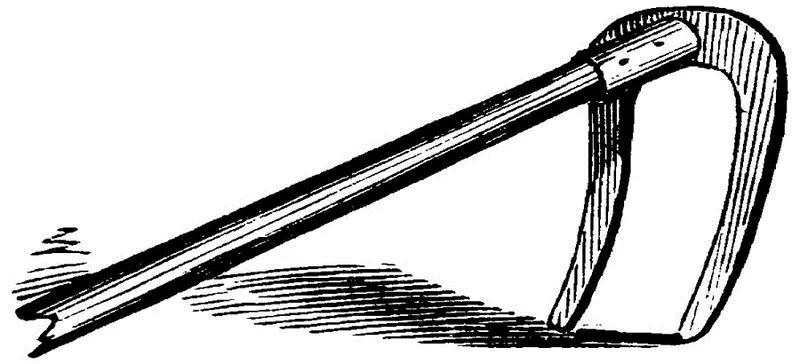
Fig. 24.—THE PRONGED HOE.
Planting Cuttings.—Some of the small fruits, as currants, gooseberries, as well as the quince, are propagated, to a great extent, by cuttings. The ground for growing them, should be very well prepared by trenching or trench-plowing; the difference in the growth between cuttings set on well or on poorly prepared ground is astonishing, and the advantage in favor of trenched land is sufficient to pay for the extra expense bestowed upon the preparation. The soil should be rather sandy, decidedly loose and mellow, and rather moist than dry.
In setting the cuttings, the rows may be quite close, as horse labor is seldom employed among them; but they are tended by hand, or the ground is mulched. They may also be set quite thickly in the row, as they are to remain but a short time in the cutting bed, from which they are transplanted at one year old, though sometimes alternate rows may be left over another season. When the trench is opened for them, the cuttings are set, three or four inches apart, next the line, so that only the top bud shall reach the surface; a little mellow soil is thrown upon them, and they are tramped firmly at the base, when the remainder of the earth is thrown in and the next trench is opened for another row. If they be planted in the autumn, it is well to cover them with a mulch, and for this leaves from the forest are an excellent material. Some propagators insist very strongly upon the necessity for removing all the buds from the lower portion of the cutting, particularly in the currant and gooseberry, so as to prevent suckering and to grow the bush as a miniature tree, with a single stem. This is not desirable when the bushes are liable to have the stems destroyed by the currant borer. Indeed, the nature of the currant appears to require a renewal of the wood by these shoots, which come to replace the old exhausted branches.
The grape is grown in immense quantities from cuttings, which are either planted in a nursery, or set at once in the vineyard. In the former they are planted closely in rows, that are about twenty inches apart. Sometimes the ground is trenched, and the cuttings set at the same operation. When the first trench is opened in a rich mellow loam, which may be sod or clover lea, the edge of the dug soil is dressed to the line with the spade, then the cuttings are placed so as to have one eye at or above the surface, and soil is thrown in and tramped closely to the base of the cuttings. Then the next trench is made with the spade, digging the ground as you proceed.
Grape cuttings are generally made eighteen or twenty inches long; and those which have a heel of old wood are preferred, and command a higher price. The earlier these are taken from the vines, after the fall of the leaves, the better success will attend the plantation; provided they are not too long exposed to the air. Fall planting is very desirable, but if not then planted, the cuttings should be put into the ground and covered as soon as convenient, and they will be better prepared for spring planting. A deep trench is opened, into which the bundles are set in a vertical position, and loose earth filled in about them, and slightly covered over them; they will then be ready for planting by the spring. The length of the cuttings has latterly been much reduced, with advantage; some of the most successful planters make them from six to eight inches long: these are much more easily dug than the longer slips, and are better provided with roots.
Trimming should be practiced in the nursery with a definite object in view, and not at random; much less with any expectation of increasing the hight of the trees by trimming them up. The object in pruning nursery trees should be to develop them in every part, to produce a stout stocky sturdy little tree, one that may be turned out upon the bleak prairie, and be able to withstand the blasts. To produce this result, the leaves should never be stripped from the shoots to make them extend their growth, for the sake of making more leaves; the nurseryman should know the value of leaves, as constituting the great evaporating surface that plays a most important part in causing the ascent of the crude sap, and also in its elaboration after it has been taken up into the organization of the plant. Leaves should be carefully preserved, and in the trimming, which is necessary, this should be borne in mind. To make vigorous, stocky trees, the side branches should be encouraged rather than pruned off. The tops may sometimes need to be pinched, to force out the laterals, and to encourage their growth; if two shoots start together as rivals, one of them should be topped or cut back, or twisted and broken, but not cut off at its origin, unless there be plenty of lateral branches or twigs to furnish the tree. When these become too long, they may be spurred-in, either in the fall and winter when cutting grafts, or in the summer, during the growing season. Whenever it becomes necessary to trim off any of these laterals, it is best to do it at mid-summer, as the healing of the wounds made at this period is very rapid. Heading off the nursery trees is done to force them to branch out uniformly the second year, to form their heads at the right place; this is to be done toward spring, and is applicable especially to those varieties that are prone to make a single shoot the first year without branching, and which have not been pinched-in or headed during the previous summer to force out side branches. Cherries, plums, and pears, and some apples, are very apt to make this kind of growth. It should have been premised that all nursery trees ought to be grown to one main stem, or leader, from which all the branches arise, and to which they should all be made to contribute their quota of woody fibre. It has been asserted that the wood of a tree, instead of being a cone, as its stem appears to be and is, it should be a column of nearly equal size from the bottom to the top; that is, the mass of all the branches taken together, should equal the diameter of the trunk at any point below. A well-grown stocky nursery tree, with its abundance of lateral branches approximates this idea; but the main stem of such an one is very perceptibly a cone, rapidly diminishing in diameter from the collar upwards.
Age of Trees for Planting.—This depends so much upon the views of planters, that the nurseryman cannot always control the period at which he shall clear a block of trees. Peaches should always be removed at one year from the bud. Plums and dwarf pears will be ready to go off at two years from the bud or graft; so with apples and cherries. But many persons, purchasers and sellers, prefer larger trees, and they recommend that the trees should remain one, two, or even three years longer in the nursery. Others, a new school of planters, prefer to set out the maiden tree, in most of the species above named, except some very feebly growing varieties, that will scarcely have attained sufficient size to risk in the orchard. The nurseryman should beware of keeping his trees too long on his hands; they may become unprofitable stock, and are sure to require much more labor in the digging and handling. The purchaser is his own master, and his tastes and wishes must be consulted; if he wants large trees, by all means, let him be indulged; he will have to pay in proportion, he will have more wood for his money, more weight to carry, or more transportation to pay for, more labor in planting, and vastly increased risk of the life of his trees; but, let him be indulged with his five year old trees, while his neighbor, for a smaller sum invested, with less freight, less wood, less labor, and infinitely less risk, will plant his maiden trees, and five years hence will market more fruit.
Читать дальшеИнтервал:
Закладка:
Похожие книги на «American Pomology. Apples»
Представляем Вашему вниманию похожие книги на «American Pomology. Apples» списком для выбора. Мы отобрали схожую по названию и смыслу литературу в надежде предоставить читателям больше вариантов отыскать новые, интересные, ещё непрочитанные произведения.











Обсуждение, отзывы о книге «American Pomology. Apples» и просто собственные мнения читателей. Оставьте ваши комментарии, напишите, что Вы думаете о произведении, его смысле или главных героях. Укажите что конкретно понравилось, а что нет, и почему Вы так считаете.