John Aston Warder - American Pomology. Apples
Здесь есть возможность читать онлайн «John Aston Warder - American Pomology. Apples» — ознакомительный отрывок электронной книги совершенно бесплатно, а после прочтения отрывка купить полную версию. В некоторых случаях можно слушать аудио, скачать через торрент в формате fb2 и присутствует краткое содержание. Жанр: foreign_prose, Биология, foreign_edu, foreign_antique, на английском языке. Описание произведения, (предисловие) а так же отзывы посетителей доступны на портале библиотеки ЛибКат.
- Название:American Pomology. Apples
- Автор:
- Жанр:
- Год:неизвестен
- ISBN:нет данных
- Рейтинг книги:5 / 5. Голосов: 1
-
Избранное:Добавить в избранное
- Отзывы:
-
Ваша оценка:
American Pomology. Apples: краткое содержание, описание и аннотация
Предлагаем к чтению аннотацию, описание, краткое содержание или предисловие (зависит от того, что написал сам автор книги «American Pomology. Apples»). Если вы не нашли необходимую информацию о книге — напишите в комментариях, мы постараемся отыскать её.
American Pomology. Apples — читать онлайн ознакомительный отрывок
Ниже представлен текст книги, разбитый по страницам. Система сохранения места последней прочитанной страницы, позволяет с удобством читать онлайн бесплатно книгу «American Pomology. Apples», без необходимости каждый раз заново искать на чём Вы остановились. Поставьте закладку, и сможете в любой момент перейти на страницу, на которой закончили чтение.
Интервал:
Закладка:
Fig. 15.—BARK GRAFTING,
TO REPAIR AN INJURED TREE.
Re-grafting Old Orchards.—Old orchards of inferior fruit may be entirely re-made and re-formed by grafting the limbs with such varieties as we may desire. A new life is by this process often infused into the trees, which is due to the very severe pruning which the trees then receive; they are consequently soon covered with a vigorous growth of young healthy wood, which replaces the decrepid and often decaying spray that accumulates in an old orchard, and the fruit produced for several years by the new growth is not only more valuable in kind, according to the judgment used in the selection of grafts, but it is more fair, smooth and healthy, and of better size than that which was previously furnished by the trees. Certain varieties are brought at once into bearing when thus top-grafted, which would have been long in developing their fruitful condition if planted as nursery trees. Others are always better and finer when so worked, than on young trees. Some of the finest specimens of the Northern Spy apple, exhibited at the fairs, have been produced by grafts inserted into the terminal branches of old bearing trees. There is a theory held by some orchardists, that the further the junction of the graft with the stock is removed from the root, the better will be the fruit. This, however, is not well supported, and the circumstance, when observed, is probably dependent upon other causes.
In renewing an old orchard by grafting its head, it will not be a good plan to attempt the whole tree at once; the pruning would be too severe, and would be followed by a profusion of succulent shoots breaking out from the large branches, such as are called water-sprouts. Those who have practiced most, prefer at first, to remove about one-third of the limbs for grafting, and those should be selected at the top of the tree. The new growth thus has an open field for its development, and the lower limbs will be invigorated, while they tend also to preserve the equilibrium of the tree in a double sense, physically and physiologically. The next year another third of the limbs may be grafted, and the remainder the year following, as practiced by Mr. Geo. Olmstead, of Connecticut, who, on the sixth year from the first grafting, harvested 28-½ bushels of choice apples from a single tree that was 75 years old, and which before only produced inferior fruit. J.J. Thomas recommends, "to give a well-shaped head to such newly formed trees, and to prevent the branches from shooting upward in a close body near the centre of the tree; that the old horizontal boughs should be allowed to extend to a distance in each direction, while the upright ones should be lopped;" see fig. 16. The same writer also advises, "instead of cutting off large branches and grafting them at once, it is better to prune the top in part, which will cause an emission of vigorous shoots. These are then budded, or grafted. * * * And as the grafts gradually extend by growth, the remainder of the top may, by successive excisions, be entirely removed."
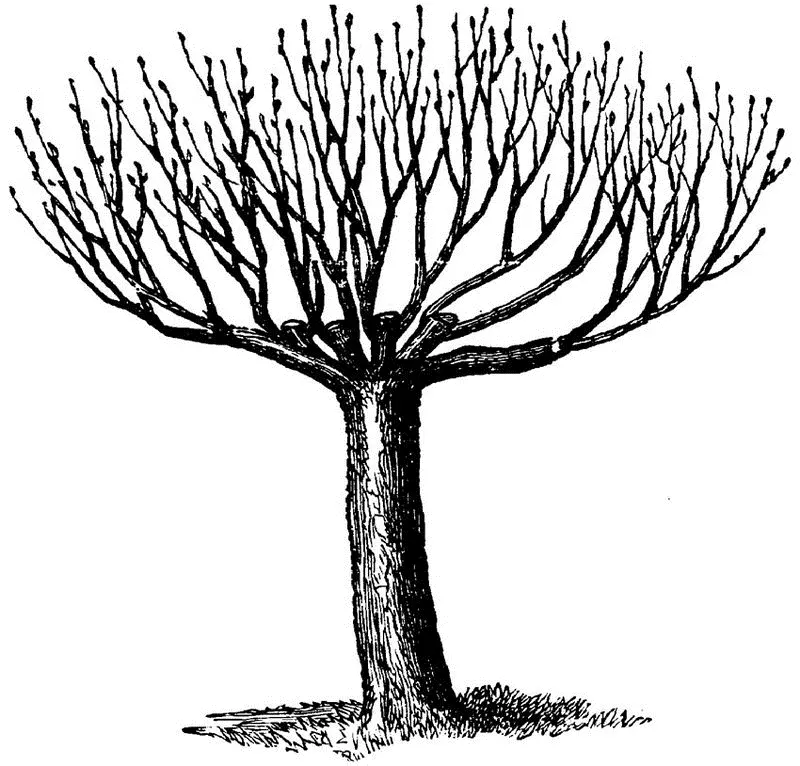
Fig. 16.—RENEWAL OF THE TOP OF AN OLD TREE.
Grafting in the Nursery is either done at or near the collar of the stock, or it is performed in-doors upon the roots or sections of roots of young stocks. The latter may be first described, as it constitutes the most extensive means of multiplying fruit trees. It is a sort of machinery, with division of labor, and appliances, that enable the operators to turn out immense numbers. Machinery has indeed been applied to the business; we have grafting apparatus to facilitate the work. The Minkler machine consists of a frame or gauge which regulates the angle of the slope, which is cut with a broad chisel that reduces the roots and scions to a condition for putting them together; by its use an immense number of grafts can be cut, and another hand binds them together with the waxed thread, without any tie. Mr. Robey's machine consists of a complicated shears to cut the slope and tongue at one operation, preparing the pieces for whip grafting. Mr. S.S. Jackson, of Cincinnati, has also invented an apparatus for this purpose, which proves to be very useful.
Root Grafting.—The methods of performing the operation vary somewhat, but all agree in the object to be attained: the co-aptation of the scion with a piece of root. Some grafters use only the upper portion of the root, thinking the original collar of the seedling stock the only point at which the most perfect and successful union between the aërial and terrestrial portions of trees should or can be effected—theoretically this may be very well, but the practice constantly pursued, in myriads of cases, abundantly proves that the grafting need not be restricted to this part, and that a perfect union may be effected at any point of the root, and that this may even be inverted. The very common practice has been to take two or more cuts from the root, when it is of sufficient size and length; and though some of our best propagators restrict themselves to two cuts from each, others, who have experimented carefully, insist that the third section will average as well as the others. A lot of trees, worked especially for a test in this matter, gave the following results.
In 1859 an average lot of roots and scions, about fifty in each lot, were treated as follows, White Pippin and Willow-leaf being used as scions:—
White Pippin—No. 1, being on the first cut of the root, had made a fair growth.
No. 2, being on the second cut, were quite as good or better.
No. 3, being on the third cut, were not quite so good as the others, the ground being partially shaded by a large tree.
Another, of Willow-leaf—No. 1, on the 3d cut of root, very good growth.
No. 2, on very slender roots, nearly as good.
No. 3, only 1 inch of root to 1 inch of scion; not so good growth nor so good a strike, but shaded by a tree.
No. 4, on 2d cut of root, not so good as the third.
No. 5, on average lot, not waxed, as good as any.
No. 6, roots worked upside-down, mostly failed.
D.O. Reeder exhibited some 2-year old apple trees, worked on the root inverted, they were of very good growth.
For root grafting, thrifty stocks are wanted of one or two years' growth, the smoother and straighter the roots, the better. These should be taken up from the seed-bed in the fall, selected, tied in bundles, and stored in the cellar or cave, or buried in the soil where they shall be accessible at any time, and where they will be kept fresh and plump. The roots and scions having been prepared and under shelter, the work of grafting may proceed at any time during the winter. The stocks, if not clean, should be washed, and one hand trims off the side rootlets. The grafter cuts a hundred scions of the appropriate length, which he puts into a shallow box on the table; he takes up a stock, cuts the slope near the collar, and a dextrous hand will at the same time make the sloping cut to receive the first graft and also the tongue, if that style of grafting is to be done, as is usually practised. He then picks up a scion, from a lot which himself or another hand has already prepared with a slope and tongue, and adapts it to the root, the tongue keeping the two together; a portion of the root is then cut off with the graft, and the process is repeated upon the next section. Two or three or more grafts, are thus made from one seedling root; the length of the sections vary from two to four inches, according to the fancy of the operator, or of his employer. Some persons recommend a long scion with a short root, and others prefer to reverse those terms. The whole root graft should not be more than six or seven inches long.
Читать дальшеИнтервал:
Закладка:
Похожие книги на «American Pomology. Apples»
Представляем Вашему вниманию похожие книги на «American Pomology. Apples» списком для выбора. Мы отобрали схожую по названию и смыслу литературу в надежде предоставить читателям больше вариантов отыскать новые, интересные, ещё непрочитанные произведения.










Обсуждение, отзывы о книге «American Pomology. Apples» и просто собственные мнения читателей. Оставьте ваши комментарии, напишите, что Вы думаете о произведении, его смысле или главных героях. Укажите что конкретно понравилось, а что нет, и почему Вы так считаете.