John Aston Warder - American Pomology. Apples
Здесь есть возможность читать онлайн «John Aston Warder - American Pomology. Apples» — ознакомительный отрывок электронной книги совершенно бесплатно, а после прочтения отрывка купить полную версию. В некоторых случаях можно слушать аудио, скачать через торрент в формате fb2 и присутствует краткое содержание. Жанр: foreign_prose, Биология, foreign_edu, foreign_antique, на английском языке. Описание произведения, (предисловие) а так же отзывы посетителей доступны на портале библиотеки ЛибКат.

- Название:American Pomology. Apples
- Автор:
- Жанр:
- Год:неизвестен
- ISBN:нет данных
- Рейтинг книги:5 / 5. Голосов: 1
-
Избранное:Добавить в избранное
- Отзывы:
-
Ваша оценка:
American Pomology. Apples: краткое содержание, описание и аннотация
Предлагаем к чтению аннотацию, описание, краткое содержание или предисловие (зависит от того, что написал сам автор книги «American Pomology. Apples»). Если вы не нашли необходимую информацию о книге — напишите в комментариях, мы постараемся отыскать её.
American Pomology. Apples — читать онлайн ознакомительный отрывок
Ниже представлен текст книги, разбитый по страницам. Система сохранения места последней прочитанной страницы, позволяет с удобством читать онлайн бесплатно книгу «American Pomology. Apples», без необходимости каждый раз заново искать на чём Вы остановились. Поставьте закладку, и сможете в любой момент перейти на страницу, на которой закончили чтение.
Интервал:
Закладка:
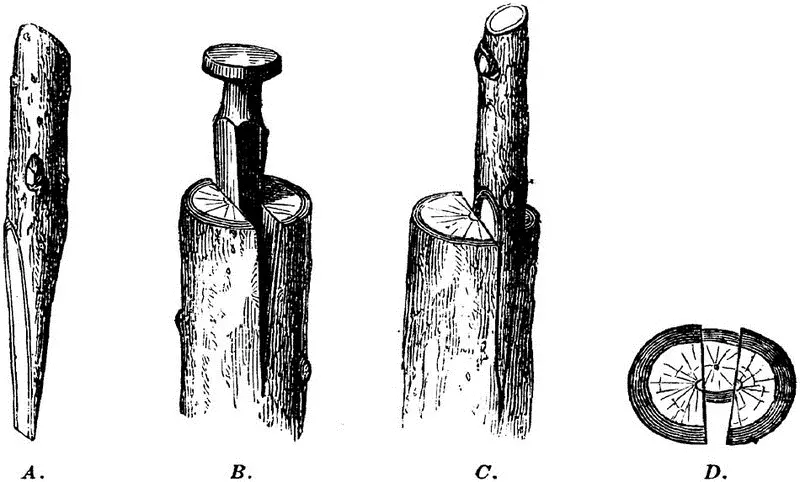
Fig. 9.—DIFFERENT STEPS IN CLEFT GRAFTING. A , SCION PREPARED FOR SETTING. B , THE CLEFT OPENED BY A WEDGE.
C , THE SCION INSERTED. D , SECTION OF STOCK AND SCION TO SHOW THE CO-APTATION OF THE PARTS OF THE TWO.
Fig. 10.—CLEFT GRAFTING WITH
BOTH SCIONS INCLINED INWARD.
Cleft Grafting is generally done when the stock is larger than the scion, and also where the operation is performed at a point above the ground. The stock is split downward, after having been cut off at the point where the grafting is to be done. The knife should be sharp, and the bark should be cut through first, to avoid its being torn, and so that the sides of the cleft shall be smooth. A wedge is inserted to keep the cleft open for the insertion of the scion, which is cut on each side like a fine wedge; but the two planes not being parallel, the bark will be left on one side to the very point of the wedge, while on the other it will be removed a part of the way, making a feather edge, A , fig. 9. The object of this is to have the pressure of the cleft greatest upon the outer side, where the union is to be effected. It is well to have a bud on the strip of bark left between the two cuts used in forming the graft, this should be near the top of the cleft. One or two grafts may be inserted into a cleft, or more clefts may be made, in large stocks, or in re-grafting the large limbs of an old tree, but usually one is sufficient to leave growing; and in the young tree, only one should ever be allowed to remain. When the scion is nicely set into the cleft, so that the inner bark of the stock and graft shall coincide, or rather cross a very little, (see fig. 10,) the wedge, whether of hard wood, or of iron, should be gently withdrawn, and then the elasticity of the stock will hold the scion firmly to its place; this pressure should not be too severe. In this kind of grafting, if the pressure be sufficiently firm, and if the operation have been performed below the surface of the ground, it may not be necessary to make any other application than to press the moist earth about the parts, and cover all but the top of the graft with soil, and place a stick to indicate the plant and protect it from injury. If, on the contrary, the pressure of the cleft be not sufficient to hold the scion firmly, as in small stocks, the graft must be tied. For this a piece of bass matting, or cotton twine, may be used; and if the operation has been performed above ground, the whole must be covered with grafting wax, applied, either hot with a brush, or cold, after having been worked with the hands, or by wrapping with strips of muslin or paper previously spread with the wax. In old times grafting clay was used, and applied with the hands as a lump around the junction; but this disagreeable and clumsy appliance has given way to more elegant and convenient arrangements.
Fig. 11—SIDE GRAFTING.
Fig. 12—SIDE GRAFTING—THE STOCK NOT CUT BACK.
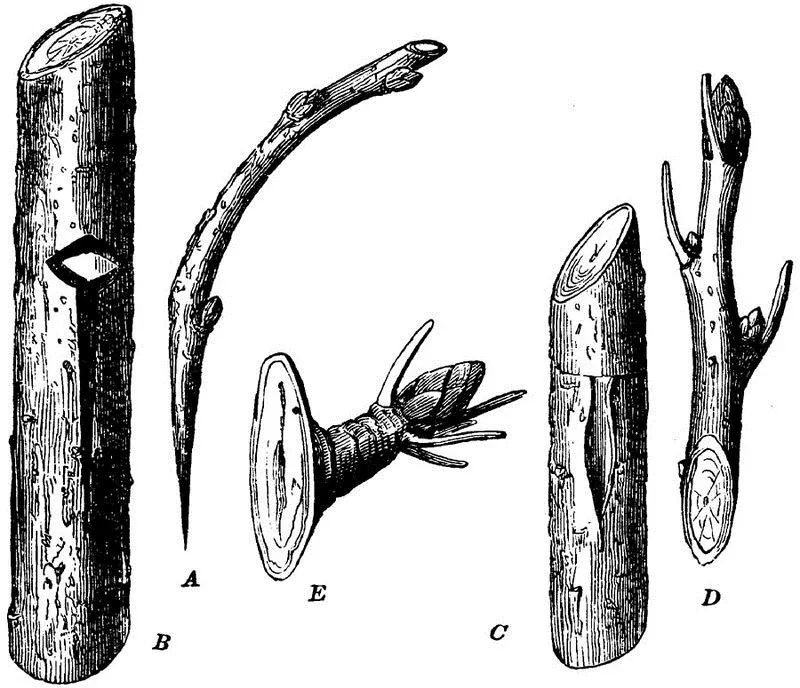
Fig. 13.—TWO FORMS OF SIDE GRAFTING.— A , B , THE SCION AND STOCK FOR THE RICHARD SIDE GRAFT. C , STOCK FOR THE GIRARDIN SIDE GRAFT. D , SCION, AND E , FRUIT BUD FOR THE SAME.
Side Grafting is performed in two ways. In one it is a modification of cleft grafting in which there is no cleft, but the bark is started from the wood, and the scion, cut as shown in figure 11, is pressed down between the wood and bark. This can only be done late in the spring, after the sap has begun to flow in the stock, so that the bark will run; it is indeed more like budding than grafting. The other modification is done without cutting off the stock. The knife is applied to the side of a stock of medium size, and a cut is made downward and extending to one-third the diameter, fig. 12; the scion is cut as for cleft grafting, and inserted so as to have the parts well co-apted, and then secured as usual. This plan is useful where there is danger of too free a flow of sap from the roots. Two other kinds of side graft are shown in fig. 13. The left-hand figures show the Richard side graft, in which an arched branch, A , is used. This is inserted under the bark of the stock, B ; above the graft an incision is made in the stock down to the wood, to arrest the flow of sap. After the insertion, the wound is covered with grafting wax. The Girardin side graft is illustrated at the three right-hand figures. A fruit bud, E , or a graft with a terminal fruit bud, D , is inserted under the bark of the stock, C , in August, or whenever suitable buds can be obtained and the bark will run. The wound is tied and covered with wax, as before. The object of this grafting is to secure immediate fruitage. Another kind of side grafting consists in plunging a dirk-shaped knife directly through the tree, inclining the point downward, into this opening the graft is inserted; the object being to establish a limb on a naked portion of the trunk.
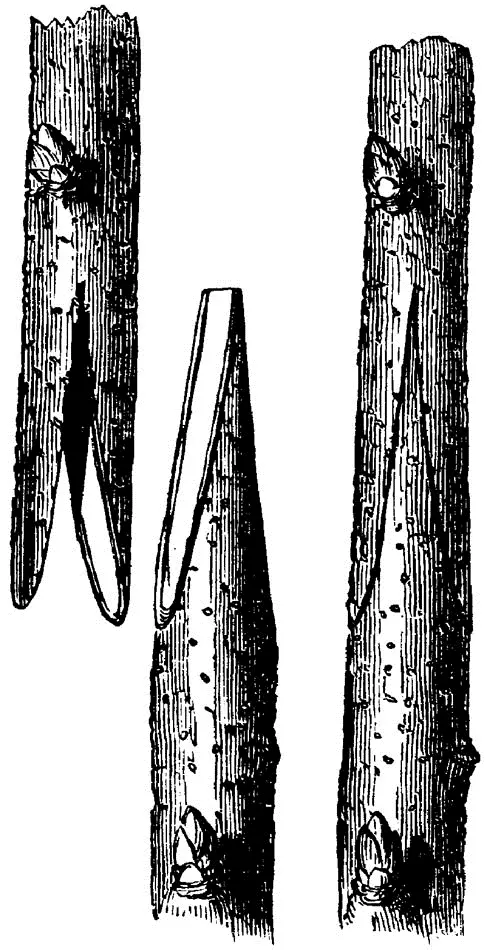
Fig. 14.—SADDLE GRAFTING.
Saddle Grafting is used only with stocks of small size; it is performed by making a double slope upon the stock, and by opening a corresponding space in the graft, by cutting two slopes in the scion, from below upwards, so that they shall meet in the centre, as seen in fig. 14. Some merely split the scion.
Grafting by Approach, or as it is generally termed, inarching , is often practiced where there is difficulty in making the scion unite with the stock; it is not often needed in the culture of our orchard fruits, but may be here described. The stock upon which we wish to graft the scion, must be planted near the variety or species to be increased. A small twig of the latter, which can be brought close to the stock, is selected for the operation; a slice of bark and wood is then removed from the twig, and another of equal size from the stock, so managed, that these cut surfaces can be brought together and secured in that position until they have united, after which the twig, that has been used as a scion, is cut from its parent tree, and the top of the stock is carefully reduced until the scion has sufficiently developed itself to act as the top of the ingrafted tree, which may afterward be transplanted to its proper station.
A modification of this grafting by approach, is, however, sometimes of great service, where we have a valuable tree that has suffered from disease in the roots, or from injury to them. It consists in planting some thrifty young stocks, with good roots, about the base of the tree, after having prepared the ground by thorough digging, and by the addition of good soil if necessary. These stocks are then inserted upwards into the healthy portion of the trunk, by the process of side grafting reversed or inverted, or by the usual method of inarching.
Ring Grafting or Bark Grafting is not much used, and in small stocks it is rather a kind of budding, for then a ring of bark is removed at the proper season of year, generally about midsummer, and it is replaced by a similar ring of bark from a shoot of the same size, taken from a tree of the variety to be propagated; this ring of bark must be furnished with a healthy bud. This method has little to recommend it, and can only be applied when both the stock and the scion are in a growing condition, so that the bark will run freely; care also must be exercised to avoid injuring the eye of the bud, in peeling off the ring. A modification of bark grafting may be applied with great advantage, however, to an old tree, that has met with an injury to a portion of its bark. The injured part should be pared smoothly to the sound bark and wood. This may be done with a sloping cut, or the edge may be made abrupt and square with a chisel and mallet; a piece of fresh wood and bark is then to be cut from a healthy tree and fitted precisely to the fresh wound, and secured in its place with bandages, and grafting clay or wax is then applied, thus making what the surgeons would call a sort of taliacotian operation. Instead of a single piece of wood and bark, a number of young shoots may be used to make the communication complete; these are set close together and secured in the usual manner; see fig. 15.
Читать дальшеИнтервал:
Закладка:
Похожие книги на «American Pomology. Apples»
Представляем Вашему вниманию похожие книги на «American Pomology. Apples» списком для выбора. Мы отобрали схожую по названию и смыслу литературу в надежде предоставить читателям больше вариантов отыскать новые, интересные, ещё непрочитанные произведения.










Обсуждение, отзывы о книге «American Pomology. Apples» и просто собственные мнения читателей. Оставьте ваши комментарии, напишите, что Вы думаете о произведении, его смысле или главных героях. Укажите что конкретно понравилось, а что нет, и почему Вы так считаете.