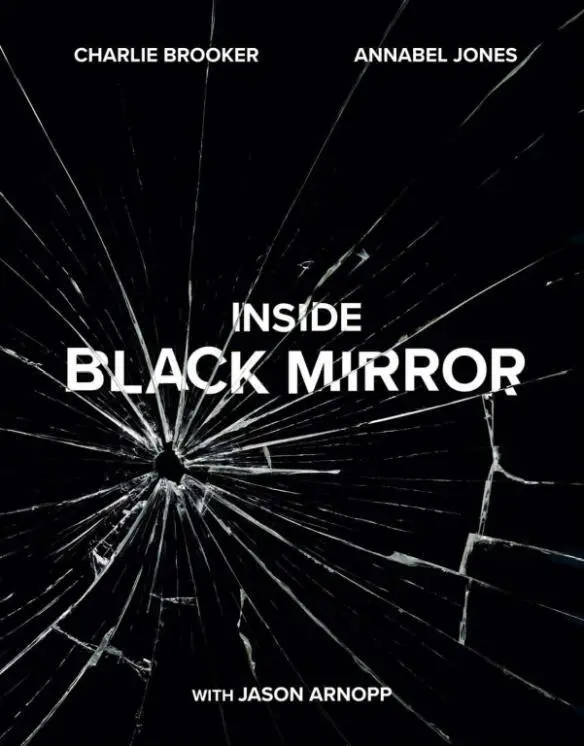
Charlie Brooker - Inside Black Mirror
Здесь есть возможность читать онлайн «Charlie Brooker - Inside Black Mirror» весь текст электронной книги совершенно бесплатно (целиком полную версию без сокращений). В некоторых случаях можно слушать аудио, скачать через торрент в формате fb2 и присутствует краткое содержание. Город: London, Год выпуска: 2018, ISBN: 2018, Издательство: Ebury Publishing, Жанр: cine, на английском языке. Описание произведения, (предисловие) а так же отзывы посетителей доступны на портале библиотеки ЛибКат.
- Название:Inside Black Mirror
- Автор:
- Издательство:Ebury Publishing
- Жанр:
- Год:2018
- Город:London
- ISBN:978-15-2910-258-1
- Рейтинг книги:3 / 5. Голосов: 1
-
Избранное:Добавить в избранное
- Отзывы:
-
Ваша оценка:
Inside Black Mirror: краткое содержание, описание и аннотация
Предлагаем к чтению аннотацию, описание, краткое содержание или предисловие (зависит от того, что написал сам автор книги «Inside Black Mirror»). Если вы не нашли необходимую информацию о книге — напишите в комментариях, мы постараемся отыскать её.
This first official book logs the entire Black Mirror journey, from its origins in creator Charlie Brooker’s mind to its current status as one of the biggest cult TV shows to emerge from the UK. Alongside a collection of astonishing behind-the-scenes imagery and ephemera, Brooker and producer Annabel Jones will detail the creative genesis, inspiration and thought process behind each film for the first time, while key actors, directors and other creative talents relive their own involvement. cite – The Hollywood Reporter cite – Telegraph
Inside Black Mirror — читать онлайн бесплатно полную книгу (весь текст) целиком
Ниже представлен текст книги, разбитый по страницам. Система сохранения места последней прочитанной страницы, позволяет с удобством читать онлайн бесплатно книгу «Inside Black Mirror», без необходимости каждый раз заново искать на чём Вы остановились. Поставьте закладку, и сможете в любой момент перейти на страницу, на которой закончили чтение.
Интервал:
Закладка:
Jerome Flynn:Hector felt very real, full of flaws and weaknesses. I’m quite fond of him. Because of the way it was cut, I think a lot of people thought he was into paedophilia as well, but he wasn’t – he was just looking for a thrill outside of his marriage and trying to feel young again. A lot of middle-aging men can identify with that, even though it wasn’t a wise way to go about it and I’m not condoning that! Also, the farcical ride he went on, and his responses to it, just made me laugh, in the best darkly comic way.
There was quite a lot of laughter during the shoot, actually. At times, Alex and I had to rein ourselves in. I remember some corpsing – that old familiar feeling of having to centre and focus, otherwise you’d be in trouble.
‘The pictures’d hang about on Google like a gypsy fucking curse: no cure for the internet, they’d never go away, it’d be glued to your name, a fucking stain on you’
– HectorAlex Lawther:In desperation, we had to laugh, because there was no levity in the scenes. Apart from when we pick up the brilliant Natasha Little at the petrol station. Jerome and I had been working together for two weeks solidly and all of our scenes had been about panicking and terrible things. Suddenly there was this oasis of another actor coming in to play the irritating Karen. I had a giggle with that, for sure. Maybe there was corpsing on camera and I’ve chosen to forget, having assumed I was way more professional.
James Watkins:Natasha’s very funny and the three of them did set each other off a couple of times there. They were all throwing the odd ad-lib around and catching each other out.
Alex Lawther:My favourite scene is when Karen’s asking me about Birmingham. That’s what’s so brilliant –it’s unrelenting tension, but then Charlie always leaves room for humour. I also got a lot of joy out of Kenny’s gun getting stuck in the door after he’s held up the bank. Hilariously pathetic.
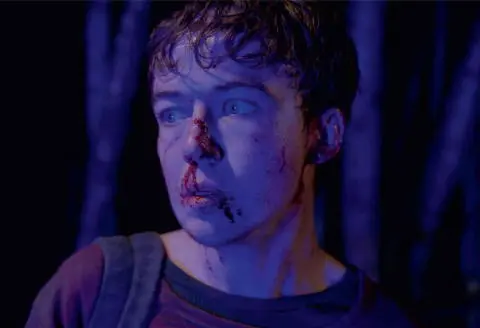
Ultimately, the blackmailers force Kenny to fight another of their victims to the death. They then shop him to the police for viewing child porn.
Charlie Brooker:In the original ending, the hackers had led Kenny and Hector on a wild-goose chase in order to get them arrested by the police. Which felt weirdly anticlimactic. We were also going to see who was behind this: some people in an internet cafe in Eastern Europe or something. It was people just doing it for a laugh, or they were taking part in a competition to see who could fuck with people the most.
Annabel Jones:But the film wasn’t about the hackers. It was about the unknown and the vulnerability of people who are just using their laptops.
Lucy Dyke:This isn’t a film about what might be, but a film about what is. This could happen to any one of us right now . Who didn’t put a bit of Blu-Tack over their laptop webcam after watching this one?
James Watkins:Jon Harris put that Radiohead track on the ending as a sort of temp track and I really loved it. We didn’t think we’d get it, but the line producer Mary McCarthy knew Radiohead’s manager. They were very generous in letting us have it, because they liked the show. Charlie was concerned that Radiohead might be too familiar, but for me that song takes it from being grim to being tragic. It acts as the moral voice in some way.
Charlie Brooker: Shut Up and Dance shares a bit of DNA with White Bear , in terms of punishment being meted out to people. I don’t think we could do a third episode where a person is revealed to be horrible to children… although Daly is in USS Callister . I was worried that people would think Shut Up and Dance was a repeat of White Bear – and some people did say that, but not many. I think that was because they were so wrong-footed.
Alex Lawther:I’m so proud that Shut Up and Dance feels part of the lo-fi Black Mirror that I really loved from those first two seasons. That Britishness and the mundanity. The technology is still scary and powerful, and in this episode omnipotent, but it’s done in a very domestic way.
James Watkins: Shut Up and Dance is gruelling, but hopefully in a good way. Whenever people talk to me about it, they say they really enjoyed it. Then after a pause, they say, “Hmmm. I’m not sure enjoy is the right word…”
SAN JUNIPERO
In Conversation
Gugu Mbatha-Raw – actor
Charlie Brooker – writer and executive producer
Annabel Jones – executive producer
Owen Harris – director
Mackenzie Davis – actor
Laurie Borg – producer
Joel Collins – series production designer
Susie Coulthard – costume designer
Tanya Lodge – hair and make-up
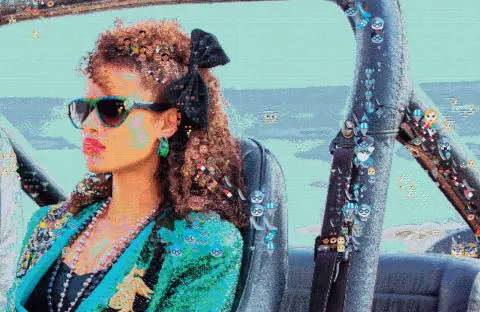
In 1987, self-conscious Yorkie meets flamboyant Kelly in a beach resort bar. The two women fall for each other, but there’s more to the sparkling paradise of San Junipero than meets the eye. As the time nears for Kelly to leave town, she faces a huge decision.
Gugu Mbatha-Raw (actor):I was very much aware that playing Kelly was a gift of a role, and that San Junipero was a gift of a script. Those things don’t come along very often, so I definitely wanted to do it justice. And even though this ended up as Netflix’s Episode Four, it was the very first episode to be shot for that season, so there was a slight pressure of, “Ooh, this is suddenly a Netflix show and there’s a bit more of that American money coming in. Let’s not let the side down!”
Charlie Brooker:I’d been obsessed with doing a story about the afterlife. I wanted to do a sort of supernatural story, and was thinking of spooky, creepy story ideas. So, weirdly, San Junipero had started in a sort of horror movie world.
Annabel Jones:We always have a scientific explanation for things, even if it’s bollocks! We introduced the idea of digital consciousness in White Christmas , but hadn’t really explored the moral or emotional implications. There was so much untapped potential.
Charlie Brooker:Something else that we’d discussed was a way of expanding the world of Be Right Back . We couldn’t do this now because of [the 2016 HBO TV series set in a Wild West-themed android amusement park] Westworld , but we had the idea of a theme park you went to that was essentially Heaven. All your dead relatives and friends would be there, and you’d pay to go and visit them. So that thought stayed around for a while: this notion of Heaven that you go to as a holiday.
Sometimes it’s useful to start by thinking about what genres we haven’t done yet. Partly because we were doing six films now, we wondered about a retro episode. How could we do one set in the past?
And then I’d remembered seeing this BBC documentary called The Young Ones – no relation to the sitcom – back in 2010. They’d taken six ageing celebrities, in their 70s and 80s, and put them in a house decorated like the 1970s, with vintage TV shows playing on the TV and everything, and the results were astonishing. They were suddenly full of life, almost tossing their walking sticks away, like they were 20 years younger.
Читать дальшеИнтервал:
Закладка:
Похожие книги на «Inside Black Mirror»
Представляем Вашему вниманию похожие книги на «Inside Black Mirror» списком для выбора. Мы отобрали схожую по названию и смыслу литературу в надежде предоставить читателям больше вариантов отыскать новые, интересные, ещё непрочитанные произведения.


Обсуждение, отзывы о книге «Inside Black Mirror» и просто собственные мнения читателей. Оставьте ваши комментарии, напишите, что Вы думаете о произведении, его смысле или главных героях. Укажите что конкретно понравилось, а что нет, и почему Вы так считаете.