Frank McCourt - Teacher Man
Здесь есть возможность читать онлайн «Frank McCourt - Teacher Man» — ознакомительный отрывок электронной книги совершенно бесплатно, а после прочтения отрывка купить полную версию. В некоторых случаях можно слушать аудио, скачать через торрент в формате fb2 и присутствует краткое содержание. Жанр: unrecognised, на английском языке. Описание произведения, (предисловие) а так же отзывы посетителей доступны на портале библиотеки ЛибКат.
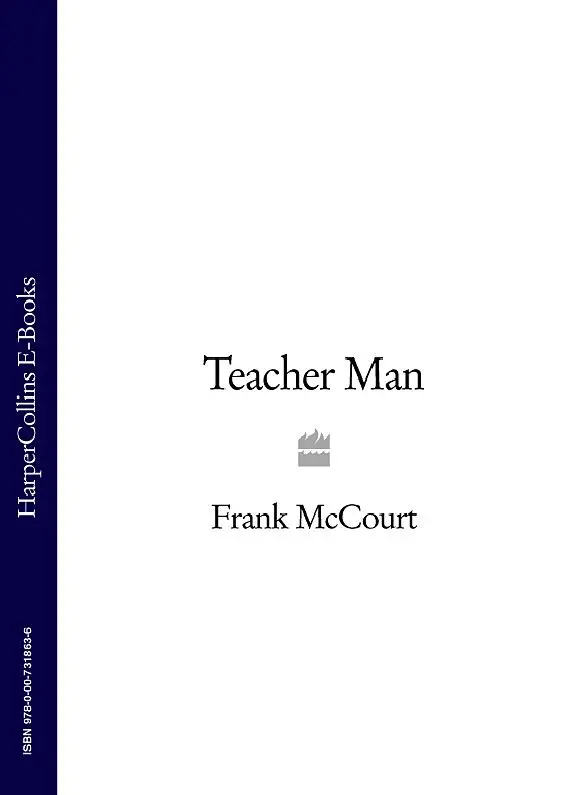
- Название:Teacher Man
- Автор:
- Жанр:
- Год:неизвестен
- ISBN:нет данных
- Рейтинг книги:4 / 5. Голосов: 1
-
Избранное:Добавить в избранное
- Отзывы:
-
Ваша оценка:
Teacher Man: краткое содержание, описание и аннотация
Предлагаем к чтению аннотацию, описание, краткое содержание или предисловие (зависит от того, что написал сам автор книги «Teacher Man»). Если вы не нашли необходимую информацию о книге — напишите в комментариях, мы постараемся отыскать её.
Teacher Man — читать онлайн ознакомительный отрывок
Ниже представлен текст книги, разбитый по страницам. Система сохранения места последней прочитанной страницы, позволяет с удобством читать онлайн бесплатно книгу «Teacher Man», без необходимости каждый раз заново искать на чём Вы остановились. Поставьте закладку, и сможете в любой момент перейти на страницу, на которой закончили чтение.
Интервал:
Закладка:
I walked away and he called after me, Anytime, man, anytime.
I scraped through the teacher’s license examination. I scraped through everything. Passing score on the teacher examination was sixty-five; mine was sixty-nine. The passing points came, I think, through the kindness of an English chairman at Eastern District High School in Brooklyn who judged my demonstration lesson and my good luck in having a skimpy knowledge of the poetry of the Great War. An alcoholic professor at NYU told me in a friendly way that I was a half-assed student. I was offended till I thought about it and realized he was right. I was half-assed all around, but promised that someday I’d pull myself together, focus, concentrate, make something of myself, snap out of it, get my act together, all in the good old American way.
We sat on chairs in the corridors of Brooklyn Technical High School waiting for interviews, filling out forms, signing statements declaring our loyalty to America, assuring the world we were not now, nor had we ever been, members of the Communist Party.
I saw her long before she sat beside me. She wore a green scarf and dark glasses and when she pulled off the scarf there was a dazzle of red hair. I had the yearning ache for her but I wouldn’t give her the satisfaction of turning to look.
Hi, Frank.
If I were a character in a novel or movie I would have stood and walked away, proud. She said hi again. She said, You look tired.
I snapped at her to show her I was not going to be polite after what she did to me. No, I am not tired, I said. But then she touched my face with her fingers.
That fictional character would have pulled his head back to show he hadn’t forgotten, was not going to soften because of two greetings and a few fingertips. She smiled and touched my cheek again.
Everyone in the hallway was looking at her and I thought they were wondering what she was doing with me: she was that gorgeous and I was hardly a prize. They saw her hand on mine.
How are you anyway?
Fine, I croaked. I looked at that hand and thought of it roaming across Norm’s body.
She said, Are you nervous about the interview?
I snapped again. No, I’m not.
You’ll be a fine teacher.
I don’t care.
You don’t care? So why are you going through this?
There’s nothing else to do.
Oh. She said she was getting a teacher’s license to teach for a year and write a book about it. This was Norm’s suggestion. Norm the big expert. He said education in America was a mess and a muckraking book from inside the school system would be a best-seller. Teach a year or two, complain about the terrible state of the schools, and you have a big seller.
My name was called for the interview. She said, How about coffee afterwards?
If I’d had any pride or self-esteem I would have told her no and walked away but I said, OK, and went to my interview with my heart pounding.
I said good morning to the three examiners, but they’re trained not to look at teacher candidates. Man in the middle said, You have a couple of minutes to read the poem on the desk before you. After you’ve read it we’ll ask you to analyze it and tell us how you’d teach it to a high school class.
The title of the poem described how I felt at that interview: “I Would I Might Forget That I Am I.”
Bald man on the right asked if I knew the form of the poem.
Yes, oh, yes. It’s a sonata.
A what?
Oh, I’m sorry. A sonnet. Fourteen lines.
And the rhyme?
Ah… ah… abbaabbacdcdc.
They looked at one another and I didn’t know if I was right or wrong.
And the poet?
Ah, I think it’s Shakespeare. No, no, Wordsworth.
Neither, young man. It’s Santayana.
The bald man glared at me as if I had offended him. Santayana, he said, Santayana, and I almost felt ashamed of my ignorance.
They looked grim and I wanted to declare that asking questions about Santayana was unfair and unjust due to the fact he was in no textbook or anthology I ever looked at in my four dozing years at New York University. They did not ask but I volunteered the only knowledge I had of Santayana, that if we don’t learn from history we’re bound to repeat our mistakes. They looked unimpressed, even when I told them I knew Santayana’s first name, George.
So, said the man in the middle. How would you teach this poem?
I babbled. Well… I think… I think… it’s partly about suicide and how Santayana is fed up, and I’d talk about James Dean because teenagers admire him and how he probably killed himself subconsciously on a motorbike, and I’d bring in Hamlet’s suicide soliloquy, “To be or not to be,” and let them talk about their own feelings about suicide if they ever had any.
Man on the right said, What would you do for reinforcement?
I don’t know, sir. What is reinforcement?
He raised his eyebrows and looked at the others as if trying to be patient. He said, Reinforcement is an activity, enrichment, followup, some kind of assignment where you clinch the learning so that it’s embedded in the student’s memory. You can’t teach in a vacuum. A good teacher relates the material to real life. You understand that, don’t you?
Oh. I felt desperate. I blurted, I’d tell them to write a hundred-and- fifty-word suicide note. That would be a good way of encouraging them to think about life itself, because Samuel Johnson said the prospect of hanging in the morning focuses the mind wonderfully.
Man in the middle exploded. What?
Man on the right shook his head. We’re not here to talk about Samuel Johnson.
Man on the left hissed. Suicide note? You would do no such thing. Do you hear me? You are dealing with tender minds. Jesus Christ! You are excused.
I said, Thank you, but what was the use? I was sure that was the end of me. Easy to see they didn’t like me, my ignorance of Santayana and reinforcement, and I was sure the suicide-note idea was the last straw. They were high school department heads or had other important jobs and I disliked them the way I disliked anyone with power over me, bosses, bishops, college professors, tax examiners, foremen in general. Even so, I wondered why people like these examiners are so impolite they make you feel unworthy. I thought if I were sitting in their place I’d try to help candidates overcome their nervousness. If young people want to become teachers they should be encouraged and not intimidated by examiners who seemed to think Santayana was the center of the universe.
That is what I felt at the time but I didn’t know the ways of the world. I didn’t know that people up there have to protect themselves against people down here. I didn’t know that older people have to protect themselves against younger people who want to push them off the face of the earth.
After my interview she was already in the hallway, knotting her scarf under her chin, telling me, That was a breeze.
It was no such thing. They asked me about Santayana.
Really? Norm adores Santayana.
Did this woman have any sense at all, ruining my day with Norm and that damn Santayana?
I don’t give a shit about Norm. Santayana, too.
My, my. Such eloquence. Is the Irishman having a little tantrum?
I wanted to hold my chest to calm my rage. Instead, I walked away and kept walking even when she called, Frank, Frank, we could be serious.
I walked across the Brooklyn Bridge, repeating, We could be serious, all the way to McSorley’s on East Seventh Street. What did she mean?
I drank beer after beer, ate liverwurst and onion on crackers, pissed mightily in McSorley’s massive urinals, called her from the public phone, hung up when Norm answered, felt sorry for myself, wanted to call Norm again, invite him to a showdown on the sidewalk, picked up the phone, put it down, went home, whimpered into my pillow, despised myself, called myself an ass till I fell into a boozy sleep.
Читать дальшеИнтервал:
Закладка:
Похожие книги на «Teacher Man»
Представляем Вашему вниманию похожие книги на «Teacher Man» списком для выбора. Мы отобрали схожую по названию и смыслу литературу в надежде предоставить читателям больше вариантов отыскать новые, интересные, ещё непрочитанные произведения.





Обсуждение, отзывы о книге «Teacher Man» и просто собственные мнения читателей. Оставьте ваши комментарии, напишите, что Вы думаете о произведении, его смысле или главных героях. Укажите что конкретно понравилось, а что нет, и почему Вы так считаете.