Brian Aldiss - Collected Essays
Здесь есть возможность читать онлайн «Brian Aldiss - Collected Essays» — ознакомительный отрывок электронной книги совершенно бесплатно, а после прочтения отрывка купить полную версию. В некоторых случаях можно слушать аудио, скачать через торрент в формате fb2 и присутствует краткое содержание. Жанр: unrecognised, на английском языке. Описание произведения, (предисловие) а так же отзывы посетителей доступны на портале библиотеки ЛибКат.
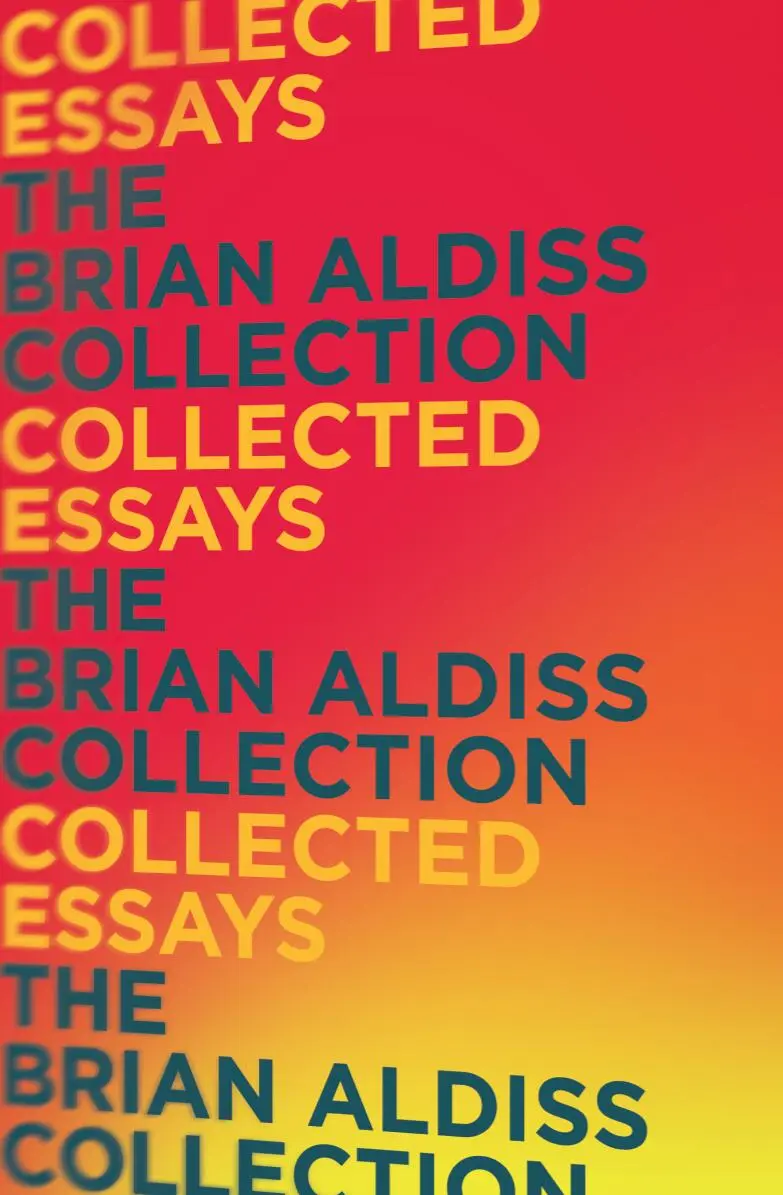
- Название:Collected Essays
- Автор:
- Жанр:
- Год:неизвестен
- ISBN:нет данных
- Рейтинг книги:3 / 5. Голосов: 1
-
Избранное:Добавить в избранное
- Отзывы:
-
Ваша оценка:
Collected Essays: краткое содержание, описание и аннотация
Предлагаем к чтению аннотацию, описание, краткое содержание или предисловие (зависит от того, что написал сам автор книги «Collected Essays»). Если вы не нашли необходимую информацию о книге — напишите в комментариях, мы постараемся отыскать её.
Collected Essays — читать онлайн ознакомительный отрывок
Ниже представлен текст книги, разбитый по страницам. Система сохранения места последней прочитанной страницы, позволяет с удобством читать онлайн бесплатно книгу «Collected Essays», без необходимости каждый раз заново искать на чём Вы остановились. Поставьте закладку, и сможете в любой момент перейти на страницу, на которой закончили чтение.
Интервал:
Закладка:
As the multitudes of mankind are reduced to one, Lionel is revealed as the perennial outsider of no fixed spiritual address. As he begins, so he ends. Apart from the brief happiness of his marriage to Idris, he remains eternally alone. Mary Shelley’s own story underlies her invention.
If some of the miseries of The Last Man flow from Mary’s own harsh experience, so, paradoxically, does the note of tranquillity on which the novel ends. Solitude is not the worst of enemies. Mary Shelley always pined for Italy. During the time she was creating her novel, she was writing of England in a letter to Teresa Guiccioli, ‘Happiness for me is not to be found here; nor forgetfulness of Troubles; I believe that in Rome, in the delightful life of my soul, far from woes, I would find again the shadow of pleasure’ ( Letters, Vol I). In the same year, she tells Leigh Hunt, ‘I think of Italy as a version of Delight afar off’. In Italy and Rome her story ends: calamity has given way to catharsis.
Frankenstein finishes on a sombre note, with the words ‘darkness and distance’. The Last Man also concludes with distance; but here distance is coupled with light, the glorious light of the south, and of ‘the spicy groves of the odorous islands of the far Indian ocean’. As long as life remains, there is light.
The novel was not the dominant literary form in the 1820s it was soon to become. Scott and Peacock were publishing, but the luminaries of the 1840s were still below the horizon. Gothic was going out of vogue.
It was a transitional period. Mary Shelley is a transitional novelist of stature, particularly when we consider a recent critical judgment that ‘prose fiction and the travel account have evolved together, are heavily indebted to each other, and are often similar in both content and technique’. [8]This is perfectly exemplified in Mary Shelley’s two best novels, Frankenstein and The Last Man. In both, travel and ‘foreign parts’ are vital components.
In Mary Shelley, [9]William Walling makes a point which incidentally relates The Last Man more closely still to the science-fictional temper. Remarking that solitude is a common topic of the period and by no means Mary’s monopoly, Walling claims that by interweaving the themes of isolation and the end of civilization, she creates a prophetic account of modern industrial society, in which the creative personality becomes more and more alienated.
Tales and Stories by Mary Shelley were collected together by Richard Garnett and published in 1891. A more recent collection is noted below. Her stories are in the main conventional. Familial and amorous misunderstandings fill the foreground, armies gallop about in the background. The characters are high-born, their speeches high-flown. Tears are scalding, years long, sentiments either villainous or irreproachable, deaths copious, and conclusions not unusually full of well-mannered melancholy. The tales are written for keepsakes of their time. Here again, the game of detecting autobiographical traces can be played. One story, ‘Transformation’, sheds light on Frankenstein —but not much. We have to value Mary Shelley, as we do other authors, for her strongest work, not her weakest; and her best has a strength still not widely enough appreciated.
In the course of eight years, between 1814 and 1822, Mary Shelley suffered miscarriages and bore four children, three of whom died during the period. She travelled hither and thither with her irresponsible husband, who probably enjoyed an affair with her closest friend, Claire. She had witnessed suicides and death all round her, culminating in Shelley’s death. It was much for a sensitive and intellectual woman to endure. No wonder that Claire Clairmont wrote to her, some years after the fury and shouting died down, saying ‘I think in certain things you are the most daring woman I ever knew’ (quoted in Julian Marshall’s Life and Letters of Mary Wollstonecraft Shelley, 1889).
Certainly in literature Mary Shelley was daring. She found new ways in which to clothe her powerful inward feelings.
II II STURGEON: THE CRUELTY OF THE GODS THE DOWNWARD JOURNEY Orwell’s 1984 PEEP CULTURE Is it Worth Losing Your Balls For? WELLS AND THE LEOPARD LADY Lecture delivered at the International Wells Symposium THE ADJECTIVES OF ERICH ZANN A Tale of Horror JEKYLL ONE HUMP OR TWO Lecture given at the IAFA Conference of the Fantastic KAFKA’S SISTER CAMPBELL’S SOUP SOME EARLY MEN IN THE MOON KALIYUGA, OR UTOPIA AT A BAD TIME Talk given at the Annual MENSA meeting in Cambridge UTOPIA: DREAM OR PIPE DREAM? THE ATHEIST’S TRAGEDY REVISITED THE PALE SHADOW OF SCIENCE Address to the British Association for the Advancement of Science DECADENCE AND DEVELOPMENT THE VEILED WORLD A Lecture given to the Oxford Psychotherapy Society A PERSONAL PARABOLA Speech delivered at the Natwest Fundación, Madrid Copyright
New ideas in science are often followed up swiftly by science fictions which utilize or even examine them. The story may be successful even if the original idea is less so. The theory of ‘continuous creation’, so attractive in essence, posited by Fred Hoyle, had to give way to the Big Bang theory of creation. That theory is itself now being challenged.
Literary ideas are less subject to acid tests, more subject to fashion and changing taste.
To put forward a more personal view of Frankenstein, I would say that I seized upon this novel at the inception of Billion Year Spree because I needed to do something more than write a history of science fiction, and of the hundreds of thousands of books and stories I had read. I wished also to render SF more friendly towards its literary aspects. It is a battle needing to be fought; for still these days one sees reviewers and others use the adjective ‘literary’ pejoratively. SF is not separate from ordinary literature: merely apart. A means of distinguishing the best of it definitively from the writings of Herman Melville, Angela Carter, Franz Kafka, Gabriel Garcia Marquez, and Hermann Hesse has yet to be formulated.
As I have pointed out elsewhere, SF is not a literature of prediction, although some may see it in this light, although guesses may turn out to be proved accurate later. A scone, for all the currants in it, remains ineluctably a scone, not a currant. How many times have I been forced to say as much in television interviews? It makes no difference. Those who do not know SF well believe in the prediction theory. I am a literary sort of chap, and must fight my corner.
What SF can do well—it is what Wells does, and the precept is worth following—is take a new theory and dramatize it. James Lovelock’s Galia hypothesis of the biomass of the planet conspiring towards its own survival conditions overtook me with excitement. Was it true? It deserved to be, so beautiful was it. It was adopted with Lovelock’s agreement as one of the bases for my Helliconia novels of the 1980s.
My preference remains for the printed word, despite all that the movies, TV, and Nintendo can do. Billion Year Spree and its successor bear witness to that. There is a density to a page of text lacking even in radio (where you cannot turn back to check) and certainly in TV, where pictures so often get in the way of text; I like my coffee black, not served up as an ice cream.
Billion Year Spree proved an asset to many scholars. It gave them carte blanche not to have to study texts a million miles from the real thing unless they wished; they could narrow their sights on Frankenstein and all the amazements which have poured forth since. That proved to be good news.
The success of the volume meant that I was called upon to update it in the 1980s, when the field had greatly expanded and its parameters became even more blurred than previously. I could not manage the task without my colleague, David Wingrove, the most diligent collaborator a man could wish for. So we produced Trillion Year Spree in 1986, with the able editorial assistance of Malcolm Edwards, then at Gollancz. Trillion Year Spree won a Hugo. What follows is an account of the earlier ground-breaking volume, and some of its rivals.
Читать дальшеИнтервал:
Закладка:
Похожие книги на «Collected Essays»
Представляем Вашему вниманию похожие книги на «Collected Essays» списком для выбора. Мы отобрали схожую по названию и смыслу литературу в надежде предоставить читателям больше вариантов отыскать новые, интересные, ещё непрочитанные произведения.

Обсуждение, отзывы о книге «Collected Essays» и просто собственные мнения читателей. Оставьте ваши комментарии, напишите, что Вы думаете о произведении, его смысле или главных героях. Укажите что конкретно понравилось, а что нет, и почему Вы так считаете.