Brian Aldiss - Collected Essays
Здесь есть возможность читать онлайн «Brian Aldiss - Collected Essays» — ознакомительный отрывок электронной книги совершенно бесплатно, а после прочтения отрывка купить полную версию. В некоторых случаях можно слушать аудио, скачать через торрент в формате fb2 и присутствует краткое содержание. Жанр: unrecognised, на английском языке. Описание произведения, (предисловие) а так же отзывы посетителей доступны на портале библиотеки ЛибКат.
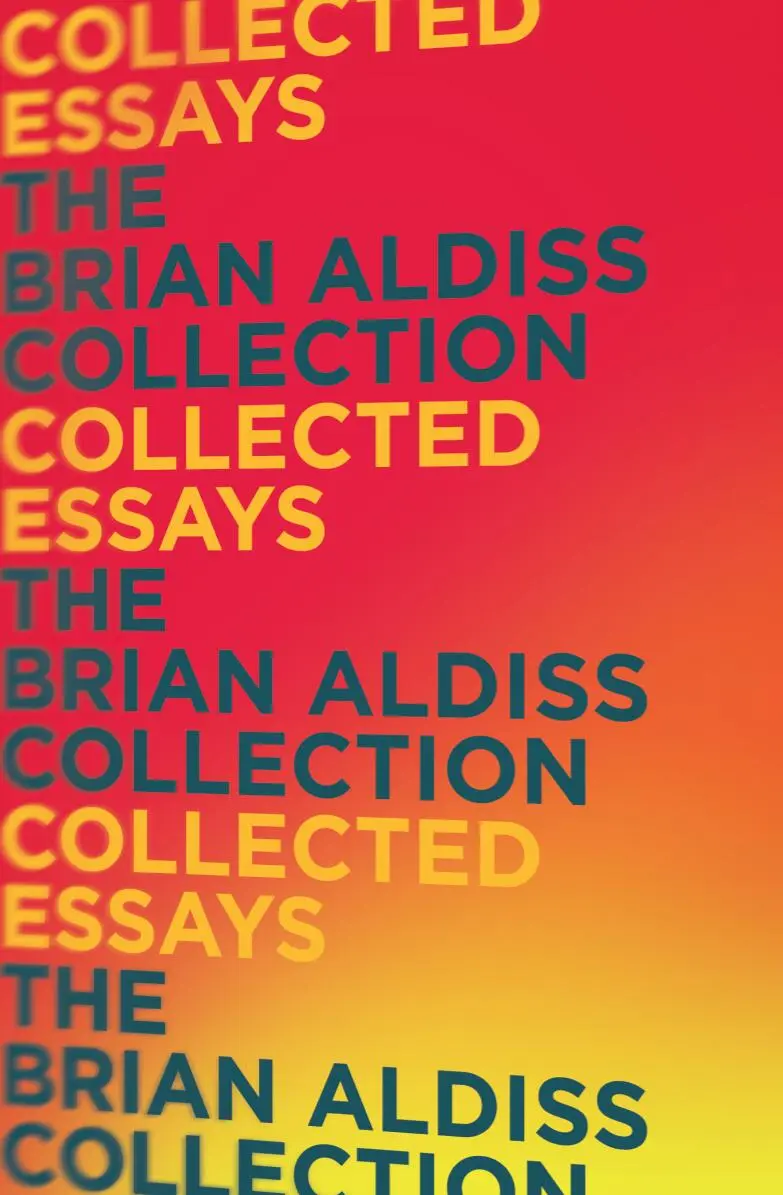
- Название:Collected Essays
- Автор:
- Жанр:
- Год:неизвестен
- ISBN:нет данных
- Рейтинг книги:3 / 5. Голосов: 1
-
Избранное:Добавить в избранное
- Отзывы:
-
Ваша оценка:
Collected Essays: краткое содержание, описание и аннотация
Предлагаем к чтению аннотацию, описание, краткое содержание или предисловие (зависит от того, что написал сам автор книги «Collected Essays»). Если вы не нашли необходимую информацию о книге — напишите в комментариях, мы постараемся отыскать её.
Collected Essays — читать онлайн ознакомительный отрывок
Ниже представлен текст книги, разбитый по страницам. Система сохранения места последней прочитанной страницы, позволяет с удобством читать онлайн бесплатно книгу «Collected Essays», без необходимости каждый раз заново искать на чём Вы остановились. Поставьте закладку, и сможете в любой момент перейти на страницу, на которой закончили чтение.
Интервал:
Закладка:
Mary Shelley had her escapes from Skinner Street—to a school in Ramsgate, to a friend of her father’s near Dundee (then a seven-day sea voyage away). She remembered Scotland with affection; its wildness is recaptured in the early pages of The Last Man; but she would have felt too the chill of isolation which, experienced unrelievedly in childhood, frequently persists in adult life.
The landscapes of Scotland and Switzerland are put to good use in The Last Man : landscapes of chaos and grandeur. Mary’s language, though it is the high-flown prose of Romantic sensibility, carries with it a modern apprehension that nature offers no refuge, being somehow implicated in disaster.
‘Old towns are always dirty’, said Claire Clairmont, dismissively cheerful. Mary Shelley and Claire had grown up in a time of war and destruction; for them, catastrophe formed part of the natural order. All of Mary Shelley’s novels are to a large extent autobiographical; although The Last Man is a symbolist drama, its drama reflects suffering seen or endured. In many of its aspects, The Last Man is a transposition of reality, rather than pure fantasy.
During the eight years Mary and Shelley spent together, they were generally short of money, on the move and hungry. She was generally pregnant. But even the equable period of their relationship seemed to have fate against it. 1816 was known as ‘the year without a summer’. Following the eruption of the volcano Tamboro in the East Indies, dust penetrated the stratosphere and deflected sunlight from the Earth. All over Europe, grain harvests and vintages were late. Rainfall was heavy. Weather anomalies were blamed for the typhus epidemics and that great cholera outbreak of 1818. The decade from 1810 to 1819—the decade in which Thackeray and Dickens were born—was the coldest in England since the 1690s. The phenomena in The Last Man appear less freakish when we recall the actual phenomena of Mary’s lifetime.
Among these manifestations are a wind (Chapter V) raging for four months without cease. It is the occasion for one of Mary’s finest apostrophes, written, no doubt, with Shelley’s Ode to the West Wind in mind. Less scientifically, a black sun rises in the west and eclipses the ‘parent of day’, to the understandable terror of all who behold it. Such celestial effects were taken over wholesale by the painter of apocalypse, John Martin, whose watercolour, ‘The Last Man’, was painted only a few years after the novel was published.
Mary Shelley follows up her divine portents with speculations on human arrogance, in a passage which begins, ‘What are we, the inhabitants of this globe, least among the many that people infinite space? Our minds embrace infinity; the visible mechanism of our being is subject to merest accident.’ The inner voice is calling again, many miles from Mercier’s utopianism.
The Last Man was published anonymously, as being ‘by the author of Frankenstein’. Its reception was mainly cold. When the name of Shelley was mentioned in reviews, Shelley’s father, tiresome old Sir Timothy, cut Mary’s allowance.
Muriel Spark claims of The Last Man that it is not typical of anything written in the nineteenth century or earlier; nor can it be placed in any existing category. Nevertheless, it comes towards the end of a considerable series of romantic tales and poems about ‘the last man’ which probably commenced with Le Dernier Homme (1805) by Jean-Baptiste Cousin de Granville, where the world is brought to a close by secular, rather than religious, means. Byron’s striking poem, Darkness (1816, ‘the year without a summer’), must also have had its effect on Mary Shelley. Her novel, however, represents a culmination of this lineage, as Frankenstein does of the Gothic.
The twentieth century, engendering a fresh set of anxieties, released a fresh set of similar apocalypses—such as M. P. Shiel’s The Purple Cloud (1901), in which the sole survivor of a poison gas roams the world setting fire to great cities. An American commentator, W. Warren Wagar, speaks of The Last Man as ‘an event of high significance in the history of secular eschatology, and in the history of the secularization of Western consciousness itself’. [7]
The Last Man is set in the future, the late twenty-first century—a bold stroke for 1826; it contrasts elaborate schemes for the establishment of a utopia on Earth—or in England at least—with an unforeseen disaster which involves all mankind. Mankind’s plans are disrupted by something unanticipated and hostile. It is a prescription which looks forward to H. G. Wells and the crowded SF publishers’ lists of the present day.
Nevertheless, one sees Muriel Spark’s difficulty, and one sees why The Last Man has been so long neglected. It is a non-Gothic. Terror is not its raison d’être. Like a concerto, it comes in three movements, and the movements are at odds with each other. The first movement is of great length, almost a social novel in itself; the second movement concerns the coming of the plague and the liberation of Constantinople by Lord Raymond; and the third is almost a travel diary alarmingly dominated by the mathematics of diminishing numbers. Also, Mary’s prose, sinewy a decade earlier when she began to write Frankenstein, here runs a little to fat. A modern reader must accustom him- or herself to it.
To find one’s way through The Last Man, it should be remembered that portraits of those Mary knew and loved best—almost all of them dead by 1826—are presented in thin disguises. The last man himself, Lionel Verney, is Mary herself. Shelley is Adrian, made Lord Protector of England, the legislator acknowledged. Byron becomes Lord Raymond, liberator of Constantinople. Others in the cast include the dead children such as Clara, and Claire Clairmont, although the resemblances are not always one-to-one. An assortment of relations and relationships harks back to the unhappy muddle of Mary’s childhood. Still, one often wishes for more conversation and fewer descriptions, and altogether less rhetoric.
Mary enlivens the text with the occasional cameos. The astronomer, Merrival, who happily discusses the state of mankind ‘six thousand years hence’, while his wife and children starve, presents a less favourable aspect of Shelley. The Countess of Windsor (Mary was serendipitous in alighting on the name of Britain’s future ruling house) may represent the cantankerous father, Sir Timothy Shelley, who put so many obstacles in Mary’s way.
The name of Raymond occurs in Caleb Williams, where Godwin’s Raymond is a kind of eighteenth-century Robin Hood. In that novel, a ‘malignant contagious distemper’ carries off Mr Clare, the one good man, opening the gate to the endless injustice with which that novel concerns itself. Mary Shelley shows the influence of her father also in depicting England evolving peacefully from a monarchy into a republic; civil war threatens but is averted, thanks to the British aversion to violence, except in speech, and to ‘the absence of the military’.
Nor does Shelley’s voice go unheard, even from the early pages. When Adrian befriends Lionel, to bestow on the latter ‘the treasures of his mind and fortune’, this informal education recalls Mary’s own, as well as that of the awakening of Frankenstein’s monster’s intellect.
Once the plague, ‘this enemy to the human race’, gets under way, the novel acquires tension. Here Mary Shelley shows a command of large movements, of political designs and human traits, particularly of forms of ambition, which only a good understanding of the world can encompass. Muriel Spark speaks of Mary’s Platonism, especially in her reading of The Republic, as giving the novel ‘a philosophical unity very rarely achieved in a work of so comprehensive a range’. We are better equipped than Mary’s first readers to appreciate the comprehensiveness of the catastrophe.
Читать дальшеИнтервал:
Закладка:
Похожие книги на «Collected Essays»
Представляем Вашему вниманию похожие книги на «Collected Essays» списком для выбора. Мы отобрали схожую по названию и смыслу литературу в надежде предоставить читателям больше вариантов отыскать новые, интересные, ещё непрочитанные произведения.

Обсуждение, отзывы о книге «Collected Essays» и просто собственные мнения читателей. Оставьте ваши комментарии, напишите, что Вы думаете о произведении, его смысле или главных героях. Укажите что конкретно понравилось, а что нет, и почему Вы так считаете.