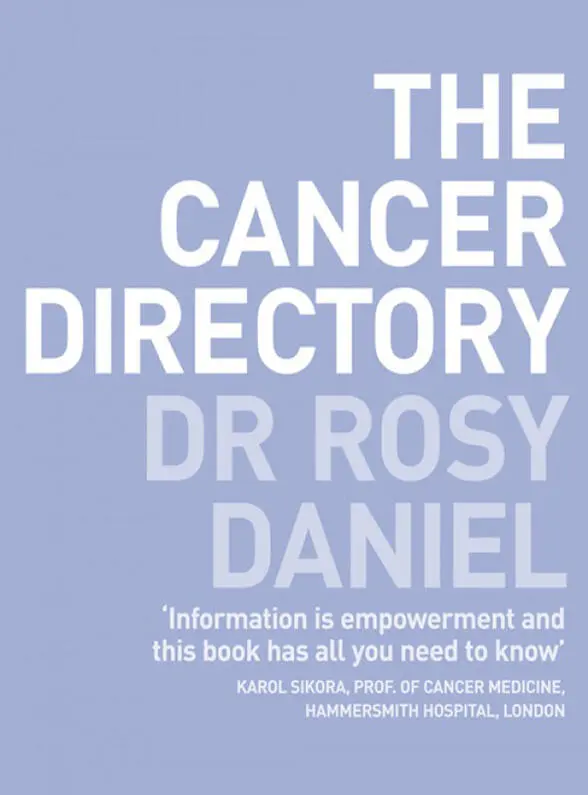
Dr. Daniel - The Cancer Directory
Здесь есть возможность читать онлайн «Dr. Daniel - The Cancer Directory» — ознакомительный отрывок электронной книги совершенно бесплатно, а после прочтения отрывка купить полную версию. В некоторых случаях можно слушать аудио, скачать через торрент в формате fb2 и присутствует краткое содержание. Жанр: unrecognised, на английском языке. Описание произведения, (предисловие) а так же отзывы посетителей доступны на портале библиотеки ЛибКат.
- Название:The Cancer Directory
- Автор:
- Жанр:
- Год:неизвестен
- ISBN:нет данных
- Рейтинг книги:3 / 5. Голосов: 1
-
Избранное:Добавить в избранное
- Отзывы:
-
Ваша оценка:
The Cancer Directory: краткое содержание, описание и аннотация
Предлагаем к чтению аннотацию, описание, краткое содержание или предисловие (зависит от того, что написал сам автор книги «The Cancer Directory»). Если вы не нашли необходимую информацию о книге — напишите в комментариях, мы постараемся отыскать её.
The Cancer Directory — читать онлайн ознакомительный отрывок
Ниже представлен текст книги, разбитый по страницам. Система сохранения места последней прочитанной страницы, позволяет с удобством читать онлайн бесплатно книгу «The Cancer Directory», без необходимости каждый раз заново искать на чём Вы остановились. Поставьте закладку, и сможете в любой момент перейти на страницу, на которой закончили чтение.
Интервал:
Закладка:
Skin Burns
With skin cancer, the area being treated is likely to be affected by the radiation, leaving your skin red and sore, rather like sunburn, towards the end of treatment. (Again, for information on helpful radiation cream, see Chapter 7.) Individuals vary in their sensitivity to radiation. The same dose may produce a severe skin reaction in one person and only a mild reaction in another. As a rule, symptoms are worse towards the end of treatment, often reaching a peak after four or five weeks.
Difficulties with Eating and Drinking
If treatment affects your oesophagus or throat, you may find it becomes rather inflamed and sore. This is because radiotherapy initially causes an inflammatory reaction. You may have difficulty swallowing, and find eating and drinking painful. Discuss this with your doctor to try and prevent this as much as possible, as this problem is unpleasant and can make you feel miserable. A nutritional advisor would be helpful at this time for advice on suitable food, drinks and remedies, and also to support you if the going gets tough. Again, see Chapter 7 for any complementary therapies that may help. You may also experience diarrhoea if the bowel is irradiated.
Possible Flare-up of Symptoms
Because the effect of radiotherapy builds up over weeks and because the tissues being irradiated become inflamed, your initial symptoms may temporarily get worse before they get better. For example, if the problem is a bony secondary tumour pressing on a nerve, then, for up to six weeks post-treatment, the pain or nerve impairment may get worse. But as the inflammation subsides, relief will be experienced.
Infertility
Radiotherapy to the reproductive organs may affect your ability to have children. Some effects are transient and return to normal after a while, whereas others are permanent. If you are considering having children in the future, check with your doctor about the possible risks, and find out what steps can be taken to aid fertility in the future. For example, men may wish to have sperm frozen for use later or, for women, egg collection and later IVF (in vitro fertilization) may be considered.
Limitations of Radiotherapy
Tumours are given a dose of radiotherapy that is close to the maximum tolerated by the normal tissues in the area being treated. The risk of damage to normal tissue is the major factor limiting the dose of radiotherapy given. There is also an overall limit to how much radiation can be given to one area or the whole body.
Should the tumour recur, further radiotherapy to the previously treated area may then exceed the normal tissue tolerance, so it is unusual to be able to repeat a course of treatment if there is a recurrence in the same place. Especially sensitive structures include the brain, spinal cord, lungs, liver and bone marrow, and great care is taken not to cause radiation damage in such areas.
It can be very frustrating for someone who responded well to radiotherapy the first time not to be able to have further radiotherapy for a tumour recurrence at the same site.
Radiotherapy, like surgery, is a form of local treatment. So if the tumour has spread beyond the confines of its primary site, radiotherapy cannot be considered a curative treatment.
Palliative Radiotherapy for Symptom Control
Radiotherapy is often used to control symptoms in a palliative setting. In general, palliative care is aimed at improving your comfort and quality of life. Palliative radiotherapy is given in short bursts or sometimes as only a single treatment.
Radiotherapy can be very effective for pain relief, especially of that caused by bone metastases. Studies have shown that single treatments for pain can be as effective for many symptoms as a long drawn-out course requiring many hospital visits. If you are in any doubt as to the usefulness of radiotherapy for your symptoms, ask the oncologist, the radiographers or a palliative care consultant.
Here is a checklist of questions for the radiotherapist:
• What is the treatment being offered?
• When will the treatment be planned?
• How long will this take?
• When will the treatment start?
• How many treatments will I have and how long will each one last?
• Can I drive myself to treatments and, if so, where can I park my car?
• Can I stay in hospital or in a hostel nearby during my treatment period?
• Can I choose the time I will be treated each day?
• Are there any days that I will not be treated?
• What are the immediate side-effects and what should I do about them?
• Will it affect my fertility?
• Is there anything I should avoid, such as sunbathing, swimming or washing?
• When will I next see a doctor?
• What happens when I finish the course of treatment?
• Is there any support available if I am frightened or upset during treatment?
Leading-edge Developments in Radiotherapy Treatments
There are ever-changing and more sophisticated methods of tackling cancer cells with radiotherapy. However, some of the treatments described here have not yet reached the UK.
Intensity Modulated Radiation Therapy
This is precision radiotherapy that targets the tumour with a high dose over less time. Because it is so precise, it reduces radiation exposure to healthy tissues.
In addition to boosting effectiveness, the combination of accuracy and increased dose also cuts treatment time by 90 per cent compared with conventional radiotherapy. This significantly reduces side-effects and improves tolerance of treatment.
Treatment outcomes are expected to be the same as with standard radiotherapy. So far, this has been used on a wide range of tumours, with much better cosmetic effects when used on breast cancer. It is likely to become a standard method in the future.
Its main disadvantage – as with any precise treatment at this time – is that your doctor has to be absolutely certain that he is able to target the entire tumour within the exact treatment field. If this is not possible, your doctor may choose to use a more conventional form of radiotherapy.
Intraoperative Radiotherapy
Intraoperative treatments involve a miniature X-ray source inserted into the body during surgery to administer the radiotherapeutic dose.
This may be used to apply radiotherapy to where the surgeon has just removed a tumour or to a space where a tumour has been removed previously. While this treatment has been around for a while, new developments mean that more precise technology can deliver the radiotherapy to the appropriate tissue without damaging the surrounding areas.
Radiofrequency Ablation
This uses electrical energy to create heat at a specific location up to a specific temperature and for a specific period of time and, ultimately, results in the death of unwanted tissue.
The ablation probe is placed directly into the tumour tissue. The radiofrequency energy flows through electrodes, causing ionic agitation and, therefore, friction in the nearby tissue. This friction creates heat and, once sufficient temperatures have been reached, the heat will kill the target tissue within a matter of minutes.
This procedure can be used for liver tumours:
• by putting an electrode through the skin and using an ultrasound, CT or MRI scanner to guide the needle to the tumour
• during open abdominal surgery, when the specialist has direct access to the liver
• during a laparoscopic or ‘keyhole’ surgical technique.
Читать дальшеИнтервал:
Закладка:
Похожие книги на «The Cancer Directory»
Представляем Вашему вниманию похожие книги на «The Cancer Directory» списком для выбора. Мы отобрали схожую по названию и смыслу литературу в надежде предоставить читателям больше вариантов отыскать новые, интересные, ещё непрочитанные произведения.









Обсуждение, отзывы о книге «The Cancer Directory» и просто собственные мнения читателей. Оставьте ваши комментарии, напишите, что Вы думаете о произведении, его смысле или главных героях. Укажите что конкретно понравилось, а что нет, и почему Вы так считаете.