Dr. Pass - Economics
Здесь есть возможность читать онлайн «Dr. Pass - Economics» — ознакомительный отрывок электронной книги совершенно бесплатно, а после прочтения отрывка купить полную версию. В некоторых случаях можно слушать аудио, скачать через торрент в формате fb2 и присутствует краткое содержание. Жанр: unrecognised, на английском языке. Описание произведения, (предисловие) а так же отзывы посетителей доступны на портале библиотеки ЛибКат.
- Название:Economics
- Автор:
- Жанр:
- Год:неизвестен
- ISBN:нет данных
- Рейтинг книги:4 / 5. Голосов: 1
-
Избранное:Добавить в избранное
- Отзывы:
-
Ваша оценка:
Economics: краткое содержание, описание и аннотация
Предлагаем к чтению аннотацию, описание, краткое содержание или предисловие (зависит от того, что написал сам автор книги «Economics»). Если вы не нашли необходимую информацию о книге — напишите в комментариях, мы постараемся отыскать её.
Economics — читать онлайн ознакомительный отрывок
Ниже представлен текст книги, разбитый по страницам. Система сохранения места последней прочитанной страницы, позволяет с удобством читать онлайн бесплатно книгу «Economics», без необходимости каждый раз заново искать на чём Вы остановились. Поставьте закладку, и сможете в любой момент перейти на страницу, на которой закончили чтение.
Интервал:
Закладка:
burden of taxationsee TAX BURDEN.
businessa supplier of goods and services. The term can also denote a FIRM. In economic theory, businesses perform two roles. On the one hand, they enter the market place as producers of goods and services bought by HOUSEHOLDS; on the other hand, they buy factor inputs from households in order to produce those goods and services. The term ‘businesses’ is used primarily in macro (national income) analysis, while the term ‘firms’ is used in micro (supply and demand) analysis. See also CIRCULAR FLOW OF NATIONAL INCOME MODEL.
business cycle or trade cyclefluctuations in the level of economic activity (ACTUAL GROSS NATIONAL PRODUCT), alternating between periods of depression and boom conditions.
The business cycle is characterized by four phases (see Fig. 20):
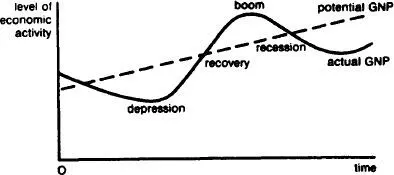
Fig. 20 Business cycle.Fluctuations in the level of economic activity.
(a) DEPRESSION, a period of rapidly falling AGGREGATE DEMAND accompanied by very low levels of output and heavy UNEMPLOYMENT, which eventually reaches the bottom of the trough;
(b) RECOVERY, an upturn in aggregate demand accompanied by rising output and a reduction in unemployment;
(c) BOOM, aggregate demand reaches and then exceeds sustainable output levels (POTENTIAL GROSS NATIONAL PRODUCT) as the peak of the cycle is reached. Full employment is reached and the emergence of excess demand causes the general price level to increase (see INFLATION);
(d) RECESSION, the boom comes to an end and is followed by recession. Aggregate demand falls, bringing with it, initially, modest falls in output and employment but then, as demand continues to contract, the onset of depression.
What causes the economy to fluctuate in this way? One prominent factor is the volatility of FIXED INVESTMENT and INVENTORY INVESTMENT expenditures (the investment cycle), which are themselves a function of businesses’ EXPECTATIONS about future demand. At the top of the cycle, income begins to level off and investment in new supply capacity finally ‘catches up’ with demand (see ACCELERATOR). This causes a reduction in INDUCED INVESTMENT and, via contracting MULTIPLIER effects, leads to a fall in national income, which reduces investment even further. At the bottom of the depression, investment may rise exogenously (because, for example, of the introduction of new technologies) or through the revival of REPLACEMENT INVESTMENT. In this case, the increase in investment spending will, via expansionary multiplier effects, lead to an increase in national income and a greater volume of induced investment. See also DEMAND MANAGEMENT, KONDRATIEF CYCLE, SECULAR STAGNATION.
Business Linka nationwide network of agencies that brings together the business support activities of many chambers of commerce, enterprise agencies, learning and skills councils and local authorities to provide a single local point of access for business information and advisory services to small and medium-sized businesses. The Business Link operates under the auspices of the SMALL BUSINESS SERVICE (SBS), an arm of the DEPARTMENT FOR TRADE AND INDUSTRY (DTI). See INDUSTRIAL POLICY.
business strategythe formulation of long-term plans and policies by a firm which interlock its various production and marketing activities in order to achieve its business objectives. See FIRM OBJECTIVES, COMPETITIVE STRATEGY, HORIZONTAL INTEGRATION, VERTICAL INTEGRATION, DIVERSIFICATION.
buyera purchaser of a GOOD or SERVICE. A broad distinction can be made between purchasers of items such as raw materials, components, plant and equipment that are used to produce other products (referred to as ‘industrial buyers’) and purchasers of products for personal consumption (referred to as ‘consumers’).
In general, industrial buyers (in the main purchasing/procurement officers) are involved in the purchase of ‘functional’ inputs to the production process, usually in large quantities and often involving the outlay of thousands of pounds. Their particular concern is to obtain input supplies that are of an appropriate quality and possess the technical attributes necessary to ensure that the production process goes ahead smoothly and efficiently. In selling to industrial buyers, personal contacts, the provision of technical advice and back-up services are important.
Buyers of consumer goods, by contrast, typically buy a much wider range of products, mainly in small quantities. Purchases are made to satisfy some ‘physical’ or ‘psychological’ need of the consumer. Thus, it is important for suppliers to understand the basis of these needs and to produce and promote BRANDS that satisfy identifiable consumer demands. In this context, ADVERTISING and SALES PROMOTION are important tools for shaping consumers’ perceptions of a brand and establishing BRAND LOYALTY. See PRODUCT DIFFERENTIATION.
buyer concentrationan element of MARKET STRUCTURE that refers to the number and size distribution of buyers in a market. In most markets, buyers are numerous, each purchasing only a tiny fraction of total supply. In some markets, however, most notably in INTERMEDIATE GOODS industries, a few large buyers purchase a significant proportion of total supply. Such situations are described as OLIGOPSONY, or, in the case of a single buyer, MONOPSONY.
Market theory predicts that MARKET PERFORMANCE will differ according to whether there are many buyers in the market, each accounting for only a minute fraction of total purchases, (PERFECT COMPETITION), or only a few buyers, each accounting for a substantial proportion of total purchases (oligopsony), or a single buyer (monopsony). See COUNTERVAILING POWER, MARKET CONCENTRATION, SELLER CONCENTRATION, BULK-BUYING.
buyer’s marketa SHORT-RUN market situation in which there is EXCESS SUPPLY of goods or services at current prices, which forces prices down to the advantage of the buyer. Compare SELLER’S MARKET.
buy-insee MANAGEMENT BUY-IN.
buy-outsee MANAGEMENT BUY-OUT.
by-producta product that is secondary to the main product emerging from a production process. For example, the refining of crude oil to produce petroleum generates a range of by-products like bitumen, naptha and creosote.
c
Cadbury Committee Reportsee CORPORATE GOVERNANCE.
called-up capitalthe amount of ISSUED SHARED CAPITAL that shareholders have been called upon to subscribe to date where a JOINT-STOCK COMPANY issues SHARES with phased payment terms. Called-up capital is usually equal to PAID-UP CAPITAL except where some shareholders have failed to pay instalments due (CALLS IN ARREARS). See SHARE ISSUE.
call money or money at call and short noticeCURRENCY (notes and coins) loaned by the COMMERCIAL BANKS to DISCOUNT HOUSES. These can be overnight (24-hour) loans or one-week loans. Call money is included as part of the commercial banks’ RESERVE ASSET RATIO.
call optionsee OPTION.
calls in arrearsthe difference that arises between CALLED-UP CAPITAL and PAID-UP CAPITAL where a JOINT-STOCK COMPANY issues SHARES with phased payment terms and shareholders fail to pay an instalment. See SHARE ISSUE.
Cambridge equationsee QUANTITY THEORY OF MONEY.
CAPsee COMMON AGRICULTURAL POLICY.
capacity1 the maximum amount of output that a firm or industry is physically capable of producing given the fullest and most efficient use of its existing plant. In microeconomic theory, the concept of full capacity is specifically related to the cost structures of firms and industries. Industry output is maximized (i.e. full capacity is attained) when all firms produce at the minimum point on their long-run average total cost curves (see PERFECT COMPETITION). If firms fail to produce at this point, then the result is EXCESS CAPACITY.
Читать дальшеИнтервал:
Закладка:
Похожие книги на «Economics»
Представляем Вашему вниманию похожие книги на «Economics» списком для выбора. Мы отобрали схожую по названию и смыслу литературу в надежде предоставить читателям больше вариантов отыскать новые, интересные, ещё непрочитанные произведения.









Обсуждение, отзывы о книге «Economics» и просто собственные мнения читателей. Оставьте ваши комментарии, напишите, что Вы думаете о произведении, его смысле или главных героях. Укажите что конкретно понравилось, а что нет, и почему Вы так считаете.