Dr. Pass - Economics
Здесь есть возможность читать онлайн «Dr. Pass - Economics» — ознакомительный отрывок электронной книги совершенно бесплатно, а после прочтения отрывка купить полную версию. В некоторых случаях можно слушать аудио, скачать через торрент в формате fb2 и присутствует краткое содержание. Жанр: unrecognised, на английском языке. Описание произведения, (предисловие) а так же отзывы посетителей доступны на портале библиотеки ЛибКат.
- Название:Economics
- Автор:
- Жанр:
- Год:неизвестен
- ISBN:нет данных
- Рейтинг книги:4 / 5. Голосов: 1
-
Избранное:Добавить в избранное
- Отзывы:
-
Ваша оценка:
Economics: краткое содержание, описание и аннотация
Предлагаем к чтению аннотацию, описание, краткое содержание или предисловие (зависит от того, что написал сам автор книги «Economics»). Если вы не нашли необходимую информацию о книге — напишите в комментариях, мы постараемся отыскать её.
Economics — читать онлайн ознакомительный отрывок
Ниже представлен текст книги, разбитый по страницам. Система сохранения места последней прочитанной страницы, позволяет с удобством читать онлайн бесплатно книгу «Economics», без необходимости каждый раз заново искать на чём Вы остановились. Поставьте закладку, и сможете в любой момент перейти на страницу, на которой закончили чтение.
Интервал:
Закладка:
brand switchingthe decision by consumers to substitute an alternative BRAND for the one they currently consume. Brand switching may be induced by ADVERTISING designed to overcome BRAND LOYALTY to existing brands.
brand transferencethe use of an existing BRAND name for new or modified products. Brand transference or extension seeks to capitalize on consumers’ BRAND LOYALTY towards the firm’s established brands to gain rapid consumer acceptance of a new product.
brand valuethe money value of an established BRAND name. The valuation of a brand reflects the BRAND LOYALTY of consumers towards it, built up by cumulative ADVERTISING. See TAKEOVER.
Fig. 17 Break-even.A supplier’s typical short-run costs and revenues. Fixed costs do not vary with output and so are shown as the horizontal line FC. Total cost comprises both fixed costs and total variable costs and is shown by line TC. Total revenue rises as output and sales are expanded and is depicted by line TR. At low levels of output like Q 1total costs exceed total revenues and the supplier makes a loss equal to AB. At high levels of output like Q 2revenues exceed costs and the supplier makes a profit equal to DE. At output Q 1total revenues exactly match total costs (at C) and the supplier breaks even.
break-eventhe short-run rate of output and sales at which a supplier generates just enough revenue to cover his fixed and variable costs, earning neither a PROFIT nor a LOSS. If the selling price of a product exceeds its unit VARIABLE COST, then each unit of product sold will earn a CONTRIBUTION towards FIXED COSTS and profits. Once sufficient units are being sold so that their total contributions cover the supplier’s fixed costs, then the company breaks even. If less than the break-even sales volume is achieved, then total contributions will not meet fixed costs and the supplier will make a loss. If the sales volume achieved exceeds the break-even volume, total contributions will cover the fixed costs and leave a surplus that constitutes profit. See Fig. 17.
Bretton Woods Systemsee INTERNATIONAL MONETARY FUND.
bridging loana form of short-term LOAN used by a borrower as a continuing source of funds to ‘bridge’ the period until the borrower obtains a medium- or long-term loan to replace it. Bridging loans are used in particular in the housing market to finance the purchase of a new house while arranging long-term MORTGAGE finance and awaiting the proceeds from the sale of any existing property.
broad moneysee MONEY SUPPLY.
brownfield locationa derelict industrial site or housing estate that has been demolished and redeveloped to accommodate new industrial premises, often as part of a regional industrial regeneration programme. Compare GREENFIELD LOCATION. See REGIONAL DEVELOPMENT AGENCY.
budget (firm)a firm’s planned revenues and expenditures for a given future period. Annual or monthly sales, production, cost and capital expenditure budgets provide a means for the firm to plan its future activities, and by collecting actual data about sales, product cost, etc., to compare with budget the firm can control these activities more effectively.
budget (government)a financial statement of the government’s planned revenues and expenditures for the fiscal year. The main sources of current revenues, as shown in Fig. 18 (a), are TAXATION, principally income and expenditure taxes, and NATIONAL INSURANCE CONTRIBUTIONS. The main current outgoings of GOVERNMENT EXPENDITURE are the provision of goods and services (principally wage payments to health, education, police and other public service employees), TRANSFER PAYMENTS (old-age pensions, interest payments on the NATIONAL DEBT, etc.) and social security benefits.
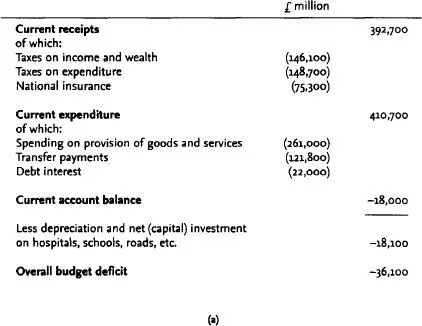

Fig. 18 Budget (government).(a) The UK budget for 2003/04. (b) UK budget deficits and surpluses, 1979–2004. Source: UK National Accounts , ONS (Blue Book), 2004.
The budget has two main uses: (a) it forms the basis of the government’s longer-term financial planning of its own economic and social commitments; (b) it is an instrument of FISCAL POLICY in regulating the level (and composition) of AGGREGATE DEMAND in the economy. A BUDGET SURPLUS (revenues greater than expenditures) reduces the level of aggregate demand. By contrast, a BUDGET DEFICIT (expenditure greater than revenues) increases aggregate demand. Fig. 18 (b) shows UK budget deficits (and surpluses) over the past two decades.
Recently (post 1997) the government has accepted that fiscal stability is an important element in the fight against INFLATION and UNEMPLOYMENT. To this end, fiscal ‘prudence’, specifically a current budget deficit within the European Union’s MAASTRICHT TREATY limits of no more than 3% of GDP (and an outstanding total debt limit of 60% of GDP), was endorsed as being a necessary adjunct to avoid excessive monetary creation of the kind that fuelled previous runaway inflation.
In fact, the government has gone further than this in adopting the so-called ‘golden rule’, which requires that the government should ‘aim for an overall budget surplus over the economic cycle’ (defined as 1998/99 to 2003/04, with some of the proceeds being used to pay off government debt to reduce outstanding debt eventually to 40% of GDP. Along the way it has introduced more rigorous standards for approving increases in public spending, in particular the ‘sustainable investment rule’, which stipulates that the government should borrow only to finance capital investment and not to pay for general spending. In addition, the government has announced it will ‘ring-fence’ increases in particular tax receipts to be used only for funding specific activities. For example, receipts from future increases in fuel taxes and tobacco taxes will be spent, respectively, only on road-building programmes and the National Health Service. See PUBLIC SECTOR BORROWING REQUIREMENT, PUBLIC SECTOR DEBT REPAYMENT, DEMAND MANAGEMENT, PUBLIC FINANCE.
budget (household)a household’s planned income and expenditure for a given time period. The household’s expenditure will depend upon its DISPOSABLE INCOME, and the THEORY OF CONSUMER BEHAVIOUR seeks to show how households, or consumers, allocate their income in spending on various goods and services. See CONSUMER EQUILIBRIUM.
budget deficitthe excess of GOVERNMENT EXPENDITURE over government TAXATION and other receipts in any one fiscal year. See BUDGET (government). The operation of a budget deficit ( deficit financing ) is a tool of FISCAL POLICY to enable government to influence the level of AGGREGATE DEMAND and EMPLOYMENT in the economy. Such a policy was advocated by KEYNES in the 1930s to offset the DEPRESSION that occurred at that time. Opinion prior to this was that the government should operate a BALANCED BUDGET policy, allowing the economy to respond in its own way without government intervention. Keynes argued that government should intervene by deliberately imbalancing its budget in order to inject additional aggregate demand into a depressed economy and vice-versa.
Since the Second World War, most western governments have tended to operate a budget deficit to keep employment high and to promote long-term ECONOMIC GROWTH. This has been financed by increasing the PUBLIC SECTOR BORROWING REQUIREMENT (PSBR) through the issue of TREASURY BILLS and long-term bonds. This is acceptable as long as the economy is growing and the interest payments on such borrowings do not become disproportionate to the overall level of government expenditure. Government borrowing in excess of the amount required to promote long-term growth and effect counter-cyclical policies will ultimately result in INFLATION. Consequently, both the timing and magnitude of the expenditure over and above receipts is of crucial importance. In more recent times recognition that low inflation is necessary to secure low UNEMPLOYMENT has led to an acceptance of the need for ‘fiscal stability’. This has found expression, for example, within the European Union’s MAASTRICHT TREATY limits of a current budget deficit of no more than 3% of GDP and a total outstanding government debt limit of no more than 60% of GDP.
Читать дальшеИнтервал:
Закладка:
Похожие книги на «Economics»
Представляем Вашему вниманию похожие книги на «Economics» списком для выбора. Мы отобрали схожую по названию и смыслу литературу в надежде предоставить читателям больше вариантов отыскать новые, интересные, ещё непрочитанные произведения.







Обсуждение, отзывы о книге «Economics» и просто собственные мнения читателей. Оставьте ваши комментарии, напишите, что Вы думаете о произведении, его смысле или главных героях. Укажите что конкретно понравилось, а что нет, и почему Вы так считаете.