Christopher Sandford - McQueen - The Biography
Здесь есть возможность читать онлайн «Christopher Sandford - McQueen - The Biography» — ознакомительный отрывок электронной книги совершенно бесплатно, а после прочтения отрывка купить полную версию. В некоторых случаях можно слушать аудио, скачать через торрент в формате fb2 и присутствует краткое содержание. Жанр: unrecognised, на английском языке. Описание произведения, (предисловие) а так же отзывы посетителей доступны на портале библиотеки ЛибКат.
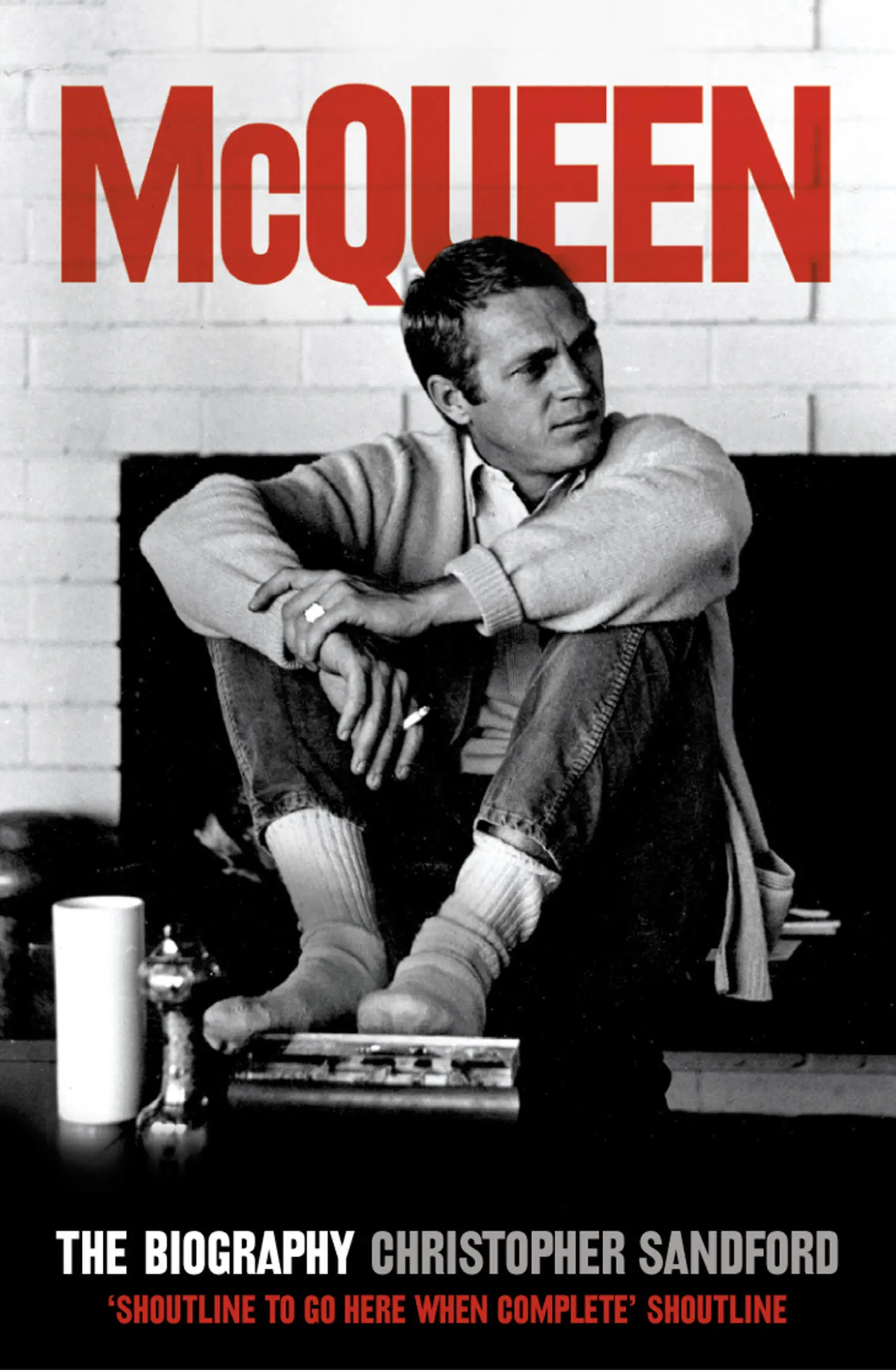
- Название:McQueen: The Biography
- Автор:
- Жанр:
- Год:неизвестен
- ISBN:нет данных
- Рейтинг книги:5 / 5. Голосов: 1
-
Избранное:Добавить в избранное
- Отзывы:
-
Ваша оценка:
McQueen: The Biography: краткое содержание, описание и аннотация
Предлагаем к чтению аннотацию, описание, краткое содержание или предисловие (зависит от того, что написал сам автор книги «McQueen: The Biography»). Если вы не нашли необходимую информацию о книге — напишите в комментариях, мы постараемся отыскать её.
McQueen: The Biography — читать онлайн ознакомительный отрывок
Ниже представлен текст книги, разбитый по страницам. Система сохранения места последней прочитанной страницы, позволяет с удобством читать онлайн бесплатно книгу «McQueen: The Biography», без необходимости каждый раз заново искать на чём Вы остановились. Поставьте закладку, и сможете в любой момент перейти на страницу, на которой закончили чтение.
Интервал:
Закладка:
McQueen’s ambivalence on the subject was legendary. Whatever he thought about them as ‘chicks’, he distrusted them as people, and his suspicious mind frequently crossed over into that less attractive realm, paranoia. Some of this equivocal mood was on show at Julian’s funeral in October 1965. Steve, acting as officiant, variously ranted, raved, knelt, implored and suddenly wept, before looking down and weakly muttering the word ‘Why?’ into the open grave. In later years he always spoke of her in the same bewildered tone. McQueen’s mother could never lie in peace; she could be dug up precipitously, her praises might be sung – but more often, her old sins would be remembered.
With nowhere particular to go Steve took in all New York had to offer, and he liked it. He won a few dollars in pool tournaments, bought a used Vespa and befriended the streetwalkers and other people of the night. He already knew something about sex. One plausible but unproven theory is that, long before that dungeon in Greenwich Village, he’d been in his share of deviant physical dramas, even that he was homosexually raped at Chino. As McQueen later recalled it in his dramatic hint, ‘I lost it big-time when I was [living] in California,’ thus leaving all his biographers to speculate on the identity of the other party – a boy? an older woman? – who initiated one of the twentieth century’s red-hot lovers.
According to a New Yorker named Jules Mowrer, who still lives in the city, ‘I met Steve McQueen in the summer of ’46 and wound up, when they were out, at my parents’ brownstone uptown. “Nice place,” he’d say. I always got the feeling Steve knew life could be better for him. He yearned for something more.’
Something more, at that moment, turned out to be sex. ‘Steve had a broken heart. That was the reason for all the attitude. And I think it made him hard – what I mean is, I think it gave him that edge. For a fifteen-year-old [sic], he knew exactly what he was about…I remember Steve took all my clothes off and casually looked me up and down. He posed me, and it was made clear that I was only one of his harem.’ (The voyeur routine resurfaced when McQueen’s later partners were told to ‘sit for me’ and his wives’ bodies were subjected to minute inspection.) ‘Steve was a dear, even if he rushed things a bit in bed, sweet and with a dozy smile like a little boy who’d just woken up. Naughtiness and innocence – that was my Mac.’ McQueen told Mowrer that he’d lost his virginity to another teenage girl ‘in an alley someplace’ behind one of the Silver Lake night spots. Moreover, anyone who had regularly hitched his way along Sunset into Hollywood was unlikely to be a stranger to ‘straight’ prostitution.
Mowrer remembers Steve ‘hunched up, no money, no food’, leaving the brownstone for the last time to ‘go do the world’. In a bar in Little Italy he duly fell in with two comic-opera chancers, Ford and Tinker, who stood him several drinks before asking him to sign a scrap of paper. After the hangover died down, McQueen found himself in the merchant marine. He shipped out, bound for Trinidad, on board the SS Alpha , and jumped it a week later in Santo Domingo. There Steve lived in a bordello for three months. It was a heady scene: a thick vine jungle lay between his room and the ocean. The cathouse itself, made of palm fronds and tin scraps, provided viable winter digs in return for odd jobs and physically extracting the customers’ dues. Something similar happened after Steve worked his way back to the Texas panhandle. His burgeoning career as a towel-boy in the Port Arthur brothel was, in turn, cut short by a police raid. Next he signed on as a ‘grunt’ labourer in the oilfields around Waco. He sold pen-and-pencil sets in a medicine show. January 1947 found him starting out as a lumberjack in Ontario, Canada. There, with a partial reversion to his original name, he emerged as ‘Stevie McQueen’. Several other such stints followed, including prizefighting and petty crime. If he never thought about acting, that must have been the one job he failed to tackle, though McQueen’s permanent audition for the role of Jack Kerouac hints otherwise. ‘I got around,’ he understated.
While spending an Easter break in Myrtle Beach, South Carolina, on 7 April 1947, Steve wandered into a bar and saw a recruitment poster advertising the US Marines. This appealed to his sense of adventure, not to say of the ridiculous. Exactly three weeks later, after one final binge in New York, he became Cadet McQueen, serial number 649015, rising to Private First Class and training as a tank-driver. It wasn’t so much the breadth as the speed of Steve’s apprenticeship that struck friends. As he quite accurately put it, ‘I was an old man by the time I was seventeen.’
After boot camp, McQueen was sent to Camp Lejeune in North Carolina. Here he carried out basic training, as well as such extra duties as lugging beds, bedding and clothes baskets for the officers when they moved to new quarters. It was the ‘same old shit’ as Chino, he griped. After three frustrating and uneventful months as a private soldier, Steve was ready to desert. The sole surviving photo of him in khaki shows a teenager with a face so taut his garrison cap is sliding down it; scowling, thick through the shoulders and chest but cinched at the waist, Steve looked like a welterweight boxer with submerged psychopathic tendencies. Colleagues remember his legs were constantly restless and his feet ‘gave nervous jerks’. Below, shuffling energy; above, coolness and poise, a certain menacing handsomeness. His best friend in the corps recalls how ‘that look of Steve’s bothered you until you got to know him, and then it bothered you some more…There was nobody better in the world to have on your side, and nobody worse to cross, than McQueen.’
Speaking of this era to the writer William Nolan, Steve described his technique for dealing with a platoon bully:
His name was Joey, and he was always with this tough-looking buddy of his. Real big dude. These two were like glued together, and I knew I couldn’t handle both of ’em at once. So I played it smart. I hid inside the head until Joey came in alone to take a piss. I said, ‘Hello, pal,’ and when he turned around with his fly unzipped, I punched him in the chops.
After that, harassment never visited Private McQueen.
Another marine walked into the barrack hut one day and found McQueen alone on his bunk, writing a letter to Julian. What struck the other man, whom Steve called over to help with his grammar, was the opening statement, scrawled in an ink that looked uncommonly like blood – ‘IM MY OWN MAN NOW, fuggit!’ – and which went on from there to get angry. There would never be a more accurate or succinct description of McQueen’s three-year hitch in uniform. Those first four words, in particular, expressed the whole throughline of his career. His own man. Fuggit. While most of the grunts tore about the camp in quick-moving, impetuous gangs, seeing almost nothing, Steve was watchful, curious, even as the rawest recruit, about the way people behaved. The military, as a rule, humiliates the individual, but never so McQueen. His rebellion turned on the familiar devices of sarcasm, cunning and obliging charm – Why didn’t he wash everyone’s jeeps? ‘I’ll make ’em glow!’ – again and again.
A note of satire, needless to say, lurked just below the smile. ‘Steve was always on the side of Steve,’ is one ex-marine’s fond memory. Yet another contemporary account of Camp Lejeune has McQueen ‘marching up and down, mumbling obscenities and doing hilarious impersonations of the officers under his breath’. He was a gifted mimic, and now military ritual was feeding his inborn talent as fast as he could hone it. Not surprisingly, Steve got involved in his unit’s biannual revue, and in later years he always felt that his time in the service had made it natural for him to ‘hang with show types’, and even to join them.
Читать дальшеИнтервал:
Закладка:
Похожие книги на «McQueen: The Biography»
Представляем Вашему вниманию похожие книги на «McQueen: The Biography» списком для выбора. Мы отобрали схожую по названию и смыслу литературу в надежде предоставить читателям больше вариантов отыскать новые, интересные, ещё непрочитанные произведения.






Обсуждение, отзывы о книге «McQueen: The Biography» и просто собственные мнения читателей. Оставьте ваши комментарии, напишите, что Вы думаете о произведении, его смысле или главных героях. Укажите что конкретно понравилось, а что нет, и почему Вы так считаете.