David Cabot - Collins New Naturalist Library
Здесь есть возможность читать онлайн «David Cabot - Collins New Naturalist Library» — ознакомительный отрывок электронной книги совершенно бесплатно, а после прочтения отрывка купить полную версию. В некоторых случаях можно слушать аудио, скачать через торрент в формате fb2 и присутствует краткое содержание. Жанр: unrecognised, на английском языке. Описание произведения, (предисловие) а так же отзывы посетителей доступны на портале библиотеки ЛибКат.
- Название:Collins New Naturalist Library
- Автор:
- Жанр:
- Год:неизвестен
- ISBN:нет данных
- Рейтинг книги:3 / 5. Голосов: 1
-
Избранное:Добавить в избранное
- Отзывы:
-
Ваша оценка:
Collins New Naturalist Library: краткое содержание, описание и аннотация
Предлагаем к чтению аннотацию, описание, краткое содержание или предисловие (зависит от того, что написал сам автор книги «Collins New Naturalist Library»). Если вы не нашли необходимую информацию о книге — напишите в комментариях, мы постараемся отыскать её.
Collins New Naturalist Library — читать онлайн ознакомительный отрывок
Ниже представлен текст книги, разбитый по страницам. Система сохранения места последней прочитанной страницы, позволяет с удобством читать онлайн бесплатно книгу «Collins New Naturalist Library», без необходимости каждый раз заново искать на чём Вы остановились. Поставьте закладку, и сможете в любой момент перейти на страницу, на которой закончили чтение.
Интервал:
Закладка:
‘The water streames, besides lampreys, roches, and the like of no value, breed salmons (where there is recourse to the sea), eels and divers sorts of trouts. There was never a pike or bream as yet engendered in all this countrey, nor in the adjacent parts of Mayo or Galway counteys.’ 55
The pike must have been brought into Ireland some time before 1682, for historical records state the presence of weirs for eels and pike on the River Camoge at the Abbey of Monasternenagh, near Croom, Co. Limerick, at the time of the Abbey’s dissolution. 56The Civil Survey of Ireland (1654–6) also noted the River Camoge as well as other tributaries of the River Maigue had pike. 57Its widespread distribution today should not be mistaken for a sign of long-lasting presence in the country. As a rapid coloniser, the species was able, once introduced, to spread throughout freshwater systems over a short period of time. 53
Went stated that there was no evidence as to whether the perch was a native species or not. However, since the remark by Young in Tour in Ireland that perch first ‘swarmed in the Shannon’ in about the year 1770, the geographic distribution of the species and its numbers have increased considerably. 58The roach, often confused with the rudd, was introduced to the River Blackwater, Co. Cork, in 1889. The barbel and ‘gardon’ – almost certainly the chub – referred to by Cambrensis are not present in Ireland today. The gudgeon, however, which the Welshman reported absent in the twelfth century, is now claimed to be a native species as are minnows – also called ‘verones’ by Cambrensis – and the stone loach.
The ‘salares’ of Cambrensis is almost certainly one of the pollan or whitefìsh species, restricted to five of the largest Irish lakes – Lough Neagh, Upper Lough Erne (no records this century), Lower Lough Erne (small but precarious population 59), Lough Derg and Lough Ree (no recent records). Absent from Britain and elsewhere in western Europe, its presence in Ireland is outlandish, and it is possibly a relict from a once wider distribution. Today it is only found in the coastal areas and lower reaches of arctic rivers in eastern Europe, Asia and western North America. Once thought to be an intermediate between the powan and the vendace – both absent from Ireland – it has the status of an endemic Irish subspecies of the Arctic cisco which lives in Alaska, Coregonus autumnalis pollan. These two ‘conspecifics’, the Arctic cisco and Irish pollan, have probably been separated for about 10,000 years since the first pollan – a cold water species able to withstand life at the edge of ice sheets – are thought to have entered Ireland through the Shannon system at the start of the postglacial period. 60Although the pollan are anadromous throughout most of their northern range, in Ireland they are virtually non-migratory, and restricted to fresh waters. The species named the ‘tymal’ by Cambrensis is the grayling which, in fact, is absent from Ireland. Was it ever present or did the observer misidentify the species? It is impossible to say.
The ‘spotless’ fish referred to by Cambrensis is the Arctic charr, whose name is derived from the Gaelic ‘ tarr ’, meaning belly. The male belly colour ranges from pink to bright vermilion, as pointed out in two Irish names, tarr-dhearg, meaning ‘red-bellied’, and ruadh bhreac , meaning ‘red trout’. 52The female is drabber than her male counterpart whose bright red colour plays an important role both in courtship and defence of the breeding territory. Charr, more than most other freshwater fish, excite the imagination of naturalists who know them as ‘glacial, or Ice Age relicts’, i.e. survivors of the Ice Age. They inhabit the deep dark, oligotrophic (nutrient-poor) formerly glaciated lakes which they invariably share with brown trout – although in Ireland, they often break from their austere habitats and are found in shallow and eutrophic (nutrient-rich) waters. The Arctic charr is distributed throughout the northern hemisphere with both anadromous and non-anadromous populations. In Ireland, it is non-anadromous. Like the smelt and Twaite shad, it is classified as an ‘endangered and vulnerable’ species – the pollan, Killarney shad and Allis shad are ‘endangered’ species while the sea lamprey, river lamprey and brook lamprey are ‘threatened’ species. 61
In an exercise of species-splitting much practised once, Regan examined various charr from Ireland and identified six ‘species’ living in different Irish lakes. 62They were: Cole’s charr, Salvelinus colii, (Loughs Eske and Derg, Co. Donegal, Lough Conn, Co. Mayo, Loughs Mask and Inagh, Co. Galway, Counties Clare and Kerry); Grey’s charr, S. grayi, (Lough Melvin, Co. Fermanagh); Trevelyan’s charr, S. trevelyani, (Lough Finn, Co. Donegal); Scharff’s charr, S. scharffii, (Loughs Owel and Ennell, Co. Westmeath); Coomasaharn charr, S. fimbriatus , (Coomasaharn Lake, Co. Kerry) and blunt-nosed charr, S. obtusus , (Loughs Tay and Dan, Co. Wicklow, and Loughs Leane and Acoose, Co. Kerry). Today these are regarded as different local forms of the single species Arctic charr. 63Since 1930, the Arctic charr has been recorded in 32 lakes in western Ireland ranging from Lough Fad, Co. Donegal, to Lough Inchiquin, Co. Kerry, together with Lough Dan, Co. Wicklow. Several other lakes, especially those suffering from eutrophication, have lost their populations of this pollution-sensitive salmonid. 61
The freshwater fish that have been indisputably introduced to Ireland, and for which there are reasonably good historical records, include the following five species.
1. RAINBOW TROUT
Introduced to Ireland from western North America in 1888 when eggs were sent to hatcheries at Inishshannon and the River Bandon, Co. Cork, and Ballymena, Co. Antrim. 64Spawning takes place at about 40 sites in Britain and Ireland but the populations are self-sustaining at only six, including three in Ireland. One site was at Lough Shure, Aran Island, Co. Donegal, where they were recorded present in 1940, and the second was at White Lough, Co. Westmeath, where they were introduced by the Inland Fisheries Trust in 1955. 64Breeding was recorded at the third site, Lough na Leibe, Ballymote, Co. Sligo, in 1971 (originally stocked in 1955 by the Inland Fisheries Trust). In all cases their present status is unknown. 65,66Elsewhere most populations are maintained by the continued introduction of hatchery-reared fish.
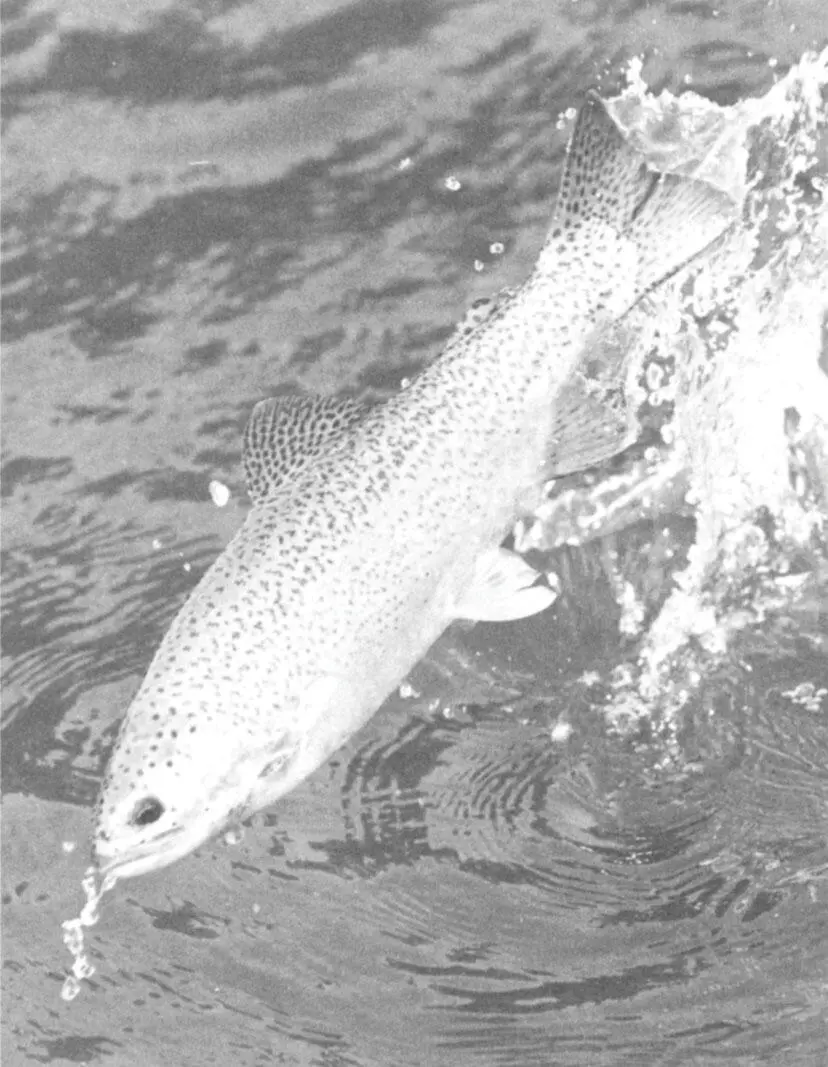
Rainbow trout. There are only two self-sustaining populations in Ireland (J. Barlee).
2. CARP
Originally a central Asian species, carp was brought to England in the first quarter of the sixteenth century and to Ireland some time around 1634 on account of its potential as a food fish. Originally introduced to Ireland by Richard Boyle, Earl of Cork, as announced by his son Robert to the Royal Society in April 1663. 67Diary entries in the autumns of 1640 and 1643 record orders given by the Earl to send both carp and tench to his friends. 68Smith claims that both carp and tench were in the River Awbeg, Co. Cork, during the reign of James I (1603–25). 69Like tench, carp can live in stagnant waters with very low oxygen levels (down to 0.7 mg/1) but require a water temperature of at least 18°C before they can spawn either in spring or late summer.
3. TENCH
Since its introduction in the seventeenth century noted above there have been selective introductions to Ireland during the past 40 years.
4. ROACH
Accidentally introduced to the River Blackwater, Co. Cork, in 1889, then introduced to a small ornamental lake on the River Foyle system in the mid 1920s, from where it soon escaped to colonise the river system. In the early 1970s it was illegally introduced to the Erne waterways and within ten years had colonised this large river system up to its headwaters. Since then it has been introduced to the rivers Boyne, Shannon, Corrib, Liffey, Barrow and Nore. 70,71
Читать дальшеИнтервал:
Закладка:
Похожие книги на «Collins New Naturalist Library»
Представляем Вашему вниманию похожие книги на «Collins New Naturalist Library» списком для выбора. Мы отобрали схожую по названию и смыслу литературу в надежде предоставить читателям больше вариантов отыскать новые, интересные, ещё непрочитанные произведения.






Обсуждение, отзывы о книге «Collins New Naturalist Library» и просто собственные мнения читателей. Оставьте ваши комментарии, напишите, что Вы думаете о произведении, его смысле или главных героях. Укажите что конкретно понравилось, а что нет, и почему Вы так считаете.