David Cabot - Collins New Naturalist Library
Здесь есть возможность читать онлайн «David Cabot - Collins New Naturalist Library» — ознакомительный отрывок электронной книги совершенно бесплатно, а после прочтения отрывка купить полную версию. В некоторых случаях можно слушать аудио, скачать через торрент в формате fb2 и присутствует краткое содержание. Жанр: unrecognised, на английском языке. Описание произведения, (предисловие) а так же отзывы посетителей доступны на портале библиотеки ЛибКат.

- Название:Collins New Naturalist Library
- Автор:
- Жанр:
- Год:неизвестен
- ISBN:нет данных
- Рейтинг книги:3 / 5. Голосов: 1
-
Избранное:Добавить в избранное
- Отзывы:
-
Ваша оценка:
Collins New Naturalist Library: краткое содержание, описание и аннотация
Предлагаем к чтению аннотацию, описание, краткое содержание или предисловие (зависит от того, что написал сам автор книги «Collins New Naturalist Library»). Если вы не нашли необходимую информацию о книге — напишите в комментариях, мы постараемся отыскать её.
Collins New Naturalist Library — читать онлайн ознакомительный отрывок
Ниже представлен текст книги, разбитый по страницам. Система сохранения места последней прочитанной страницы, позволяет с удобством читать онлайн бесплатно книгу «Collins New Naturalist Library», без необходимости каждый раз заново искать на чём Вы остановились. Поставьте закладку, и сможете в любой момент перейти на страницу, на которой закончили чтение.
Интервал:
Закладка:
Some of the fossilised frog bones recovered from Plunkett Cave lay in the clay stratum nearly 2 m below the surface layers. Such depth ruled out any likelihood that frogs from more recent times had burrowed down through this overburden, or were deposited there by other animals digging up holes, or had been displaced by soil shifts caused by running water coursing through the cave systems. Moreover the bones were blackened and filled with clay showing that they had not arrived recently. The evidence was enough to convince Scharff that the frog was indeed a member of the ancient fauna of Ireland. 24,42But there are other opinions about the bones’ antiquity and the argument can only be settled with a radiocarbon date. That this task has not yet been undertaken is quite astonishing. As the European frog lives quite happily throughout Europe and within the Arctic Circle there is no reason why low temperatures in Ireland, at the end of the last glacial phase some 10,000 years ago, would have cramped their style or inhibited their spread throughout the country.
The natterjack toad’s history in Ireland is equally controversial without any definitive conclusion as to its antiquity. However, the somewhat slender evidence would point to it being a more recent arrival in the country than the frog.
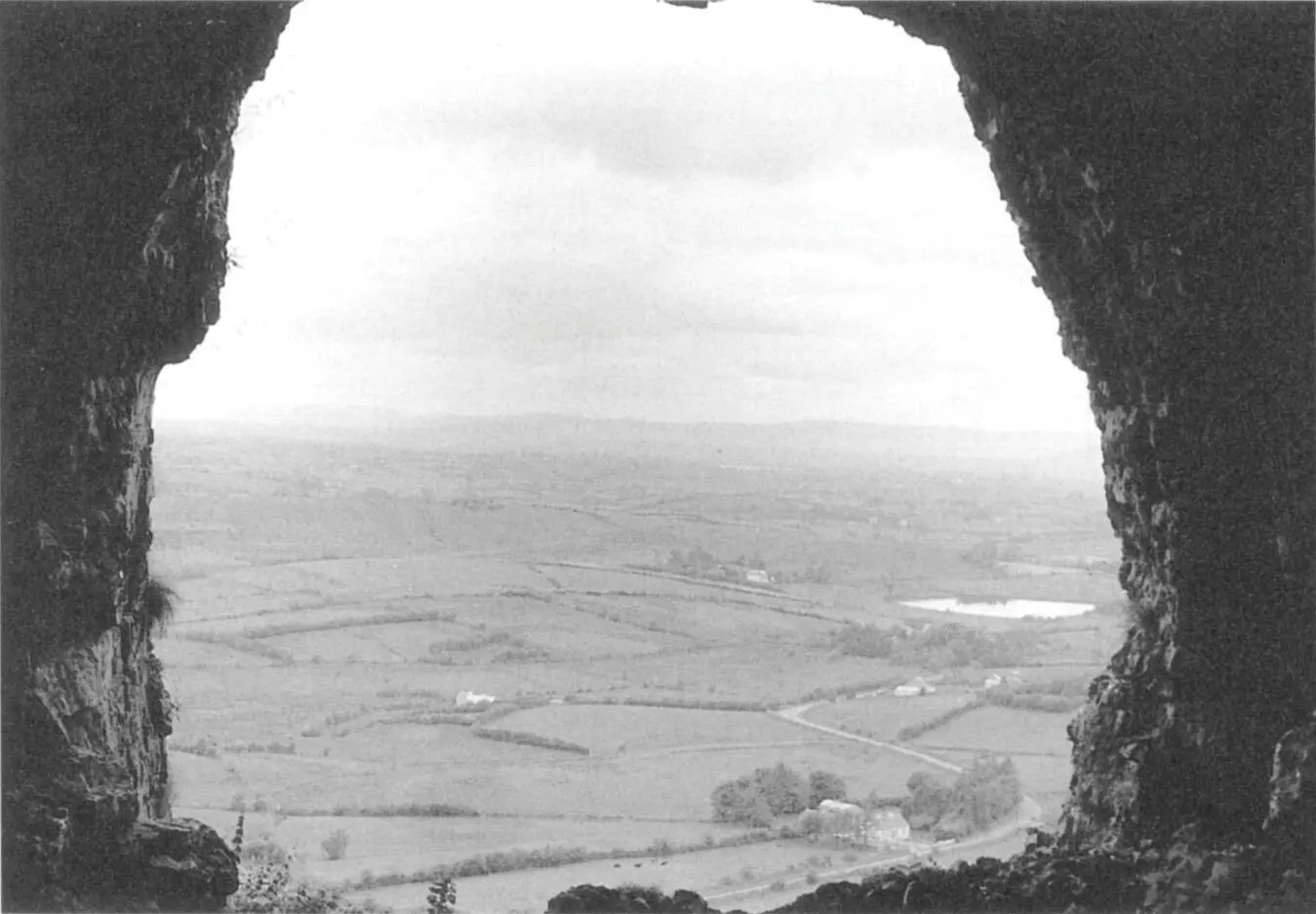
View from Keishcorran Cave, Co. Sligo, where ancient frog bones were discovered.
Although Cambrensis observed that there were no toads in Ireland in the twelfth century 43there is no evidence in his texts that he went to west Kerry or had any informants from the region. There was no written reference to toads until 1836, when J.T. Mackay, botanist and author of Flora Hibernica , reported seeing them in 1805 in Callanafersy, a large district between the lower parts of the Rivers Laune and Maine adjacent to the eastern end of Castlemaine Harbour. 44
How did these toads come to Ireland and why are they restricted to a relatively small sandy coastal area in west Kerry? Are they relicts of a once more widely spread population from a warmer and drier period? What do we make of Chute, writing from Blennerville on 31 March 1846, to Thompson, author of The Natural History of Ireland, ‘I believe the Natter-jack is indigenous to Kerry, though there is an old tradition that a ship at one time brought a lot of them and let them go at the head of Dingle Bay. This is born out by the fact that this is the only part of Kerry that they are met in: a district extending from the sandhills at Inch at Rosbegh at the head of the bay (where they are most numerous) to Carrignaferay, about ten miles in length in low marshy ground, and about the same number in breadth.’ 45A century later, Praeger spoke contemptuously of this invasion hypothesis: ‘Could misdirected ingenuity go further than to suggest the importation or shipwreck of a cargo of toads on that lonely and harbourless coast!’ 20
Beebee says of natterjack toads in Ireland: ‘It seems much more likely that they are truly indigenous’ and he argues that they are part of the Lusitanian biota of the Iberian peninsula which is well known in southwest Ireland. 46However, the natterjack can hardly be considered Lusitanian with a European distribution stretching northwards to southern Sweden and into western Russia.
Their indigenous status is also supported by Praeger who wrote ‘There is no doubt that in spite of its extremely restricted range the animal is indigenous in Kerry – a relict species like some of the Kerry plants.’ 20The only real evidence to support the indigenous status of the toad comes from the discovery of their bones from a megalithic cemetery at Carrowmore, Co. Sligo, during the 1970s. 47But the status of these bones is not clear. Were they contemporary with Neolithic man or did they arrive much later and end up buried in the soil at the same spot? Whatever the explanation, this would be the first evidence of the natterjack existing outside its very restricted Kerry range.
In fact, there are two flies in the indigenous ointment. First, the natterjack’s restricted distribution and its failure over its presumed long period of residence to colonise other available habitats and second, the lack of place names incorporating the Irish for ‘toad’. 36Both would argue against its native status. On the other hand, it would be wrong to dismiss completely the possibility of their arrival from a ship at the head of Dingle Bay for two reasons. First, local stories in Ireland are more than often grounded in fact and there is no reason to disbelieve this one. Smith, in his survey of Kerry published in 1756, wrote about Castlemaine Harbour in the mid-eighteenth century: ‘Deep enough for vessels of 50 tons or upwards to sail up to the bridge at high water where they may lie on soft oozy ground to discharge. Some vessels are unloaded here on the bankside which serves as a wharf. These are generally freighted with rock salt from England, and others are laden with iron ore which is carried on horses to the iron foundries.’ 48Some toads could have been caught up in sand ballast, brought from European ports, and dumped on the shore at any point of the operations described above. The dumping of ballast on both sides of the Dingle Peninsula would explain the toad’s presence at Castlegregory and Castlemaine sites. Secondly, toads would have almost certainly been noticed and commented upon prior to their first recording in 1805 had they been present in the area over the centuries. Also, how could such an astute recorder as Smith overlook them in the 1750s? Finally, the non-indigenous hypothesis is strengthened by the absence in Ireland of the common toad whose European distribution is even more widespread than the natterjack’s, with populations extending much further north and east. It might therefore be suggested that the factors operating against the common toad’s spread westwards were also operating against the natterjack: both were probably prevented from hopping across land bridges connecting Britain and Ireland because those had already been drowned.
The hypothesis of the natterjack’s arrival by boat is also supported by some comments by Cambrensis. When discussing the fate of poisonous reptiles when they arrive in Ireland he states ‘I have heard merchants that ply their trade on the seas say that sometimes, when they unloaded their cargoes at Irish port, they found toads brought in by chance in the bottom of the holds. They threw them out still living on to the land…’. 43One way of throwing more light onto the natterjack’s status would be to investigate biochemical and genetic divergence between the Irish, British and European populations by electrophoresis or more sophisticated genetic techniques. Some historical research into the traffic of boats and the way their ballast and cargoes were handled in Dingle and Tralee Bays might also be helpful. The occurrence of jettisoned ballast on Irish shores is well known: it has been accepted that the large erratics of flint on the foreshore at Kilmore Quay, Co. Wexford, came by boat, while the many small boulders of brown granite found near the entrance of Lough Hyne, Co. Cork, close to a rough disused landing place were the same rocks used to build the lighthouse works on Clear Island, Co. Cork – they came from Cornwall. In Broadstrand Bay, on the west side of Courtmacsherry Bay, Co. Cork, a variety of igneous pebbles and boulders, most of them granite with coloured feldspars, were found in the clefts of an early glacial rock platform as well as in the gullies of small beaches. Farrington was in no doubt, having examined all likely local sources, that the boulders and pebbles in question were ballast, probably deposited 60 years before he recorded his observations in 1965. 49
Читать дальшеИнтервал:
Закладка:
Похожие книги на «Collins New Naturalist Library»
Представляем Вашему вниманию похожие книги на «Collins New Naturalist Library» списком для выбора. Мы отобрали схожую по названию и смыслу литературу в надежде предоставить читателям больше вариантов отыскать новые, интересные, ещё непрочитанные произведения.









Обсуждение, отзывы о книге «Collins New Naturalist Library» и просто собственные мнения читателей. Оставьте ваши комментарии, напишите, что Вы думаете о произведении, его смысле или главных героях. Укажите что конкретно понравилось, а что нет, и почему Вы так считаете.