Lloyd Minor - Discovering Precision Health
Здесь есть возможность читать онлайн «Lloyd Minor - Discovering Precision Health» — ознакомительный отрывок электронной книги совершенно бесплатно, а после прочтения отрывка купить полную версию. В некоторых случаях можно слушать аудио, скачать через торрент в формате fb2 и присутствует краткое содержание. Жанр: unrecognised, на английском языке. Описание произведения, (предисловие) а так же отзывы посетителей доступны на портале библиотеки ЛибКат.
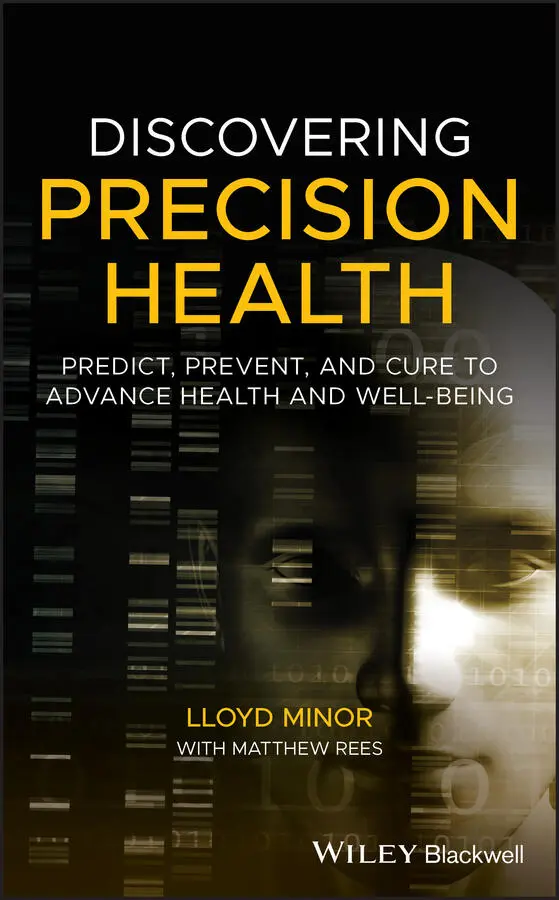
- Название:Discovering Precision Health
- Автор:
- Жанр:
- Год:неизвестен
- ISBN:нет данных
- Рейтинг книги:4 / 5. Голосов: 1
-
Избранное:Добавить в избранное
- Отзывы:
-
Ваша оценка:
Discovering Precision Health: краткое содержание, описание и аннотация
Предлагаем к чтению аннотацию, описание, краткое содержание или предисловие (зависит от того, что написал сам автор книги «Discovering Precision Health»). Если вы не нашли необходимую информацию о книге — напишите в комментариях, мы постараемся отыскать её.
The U.S. health care system is designed to be reactive instead of preventive. The result is diagnoses that are too late and outcomes that are far worse than our level of spending should deliver. In recent years, U.S. life expectancy has been declining.
Fundamental to realizing better health, and a more effective health care system, is advancing the disruptive thinking that has spawned innovation in Silicon Valley and throughout the world. That's exactly what Stanford Medicine has done by proposing a new vision for health and health care. In
,
and
describe a holistic approach that will set health care on the right track: keep people healthy by preventing disease before it starts and personalize the treatment of individuals precisely, based on their specific profile.
With descriptions of the pioneering work undertaken at Stanford Medicine, complemented by fascinating case studies of innovations from entities including the Chan Zuckerberg Biohub, GRAIL, and Impossible Foods, Minor and Rees present a dynamic vision for the future of individual health and health care. You'll see how tools from smartphone technology to genome sequencing to routine blood tests are helping avert illness and promote health. And you'll learn about the promising progress already underway in bringing greater precision to the process of predicting, preventing, and treating a range of conditions, including allergies, mental illness, preterm birth, cancer, stroke, and autism.
The book highlights how biomedical advances are dramatically improving our ability to treat and cure complex diseases, while emphasizing the need to devote more attention to social, behavioral, and environmental factors that are often the primary determinants of health.
The authors explore thought-provoking topics including: The unlikely role of Google Glass in treating autism How gene editing can advance precision in treating disease What medicine can learn from aviation <liHow digital tools can contribute to health and innovation
showcases entirely new ways of thinking about health and health care and can help empower us to lead healthier lives.
Discovering Precision Health — читать онлайн ознакомительный отрывок
Ниже представлен текст книги, разбитый по страницам. Система сохранения места последней прочитанной страницы, позволяет с удобством читать онлайн бесплатно книгу «Discovering Precision Health», без необходимости каждый раз заново искать на чём Вы остановились. Поставьте закладку, и сможете в любой момент перейти на страницу, на которой закончили чтение.
Интервал:
Закладка:
The intersection of population health and Precision Health has also enabled the creation of new scientific approaches to meet health challenges. That was part of the impetus for Stanford establishing the Center for Population Health Sciences in 2015. The center is focused on improving individual and population health by fostering collaboration across diverse disciplines and data, with the goal of understanding and addressing social, environmental, behavioral, and biological factors on a domestic and global scale. It has more than 750 members, more than 230 research trainees, 42 community partners, and research in 24 countries. Its research initiatives span a wide variety of topics, including community resilience and socioeconomic equity, gender, and healthy aging. The center’s work emphasizes linking the precise determinants of an individual’s health to the underlying drivers of population health—encompassing lifestyle choices, social factors, the environment, infectious agents, medical care, and genetics.
By applying Precision Health solutions to improve population health, especially in underserved populations, and by using lessons learned from large populations to predict, prevent, and cure more precisely, we can maximize wellness for all individuals and impact millions of lives.
GENES ARE ONE PIECE OF THE HEALTH PUZZLE
The belief that genetics is the overwhelmingly dominant determinant of health is, in many respects, unfortunate. This is not to say that genetic determinants of disease are unimportant—quite to the contrary. But it is also incorrect for people to believe they are at the mercy of their genes and medical care, and thus their individual behaviors don’t have significant impact. The reality is dramatically different. As Cashell Jaquish, a genetic epidemiologist at the National Heart, Lung, and Blood Institute, has said, even a genetic predisposition to heart disease (the leading cause of death among Americans) “doesn’t mean you are fated to have [it]. Other factors, like not smoking, diet and exercise, can have a very large effect. Family history does increase your risk slightly, but not as much as [not doing] these other things” [5].
The nexus between genes and many chronic conditions can also be overcome with smart behavioral patterns. Consider obesity. “I like to say that obesity is 80 percent genetic and 100 percent environmental,” Philip F. Smith, codirector of the office of obesity research at the National Institute of Diabetes and Digestive and Kidney Diseases, told the Washington Post . “You won’t become obese unless you overeat.” He added, “For most people, I can say unequivocally that genes are not your destiny. They can predispose you to obesity, but only if you consume more calories than you burn off” [6].
Further proof of that comes from a 2007 study, published in the New England Journal of Medicine, based on people who were part of the landmark Framingham Heart Study. Although the study found that obesity was 40 percent more likely if one’s sibling had already become obese, it was 57 percent more likely if someone’s friend had become obese, and 171 percent more likely among close mutual friends [7]. One of the study’s coauthors pointed out, “What appears to be happening is that a person becoming obese most likely causes a change of norms about what counts as an appropriate body size. People come to think that it is okay to be bigger since those around them are bigger, and this sensibility spreads” [8]. A related issue is that close friends eat together and end up taking cues from each other about what’s customary when it comes to the types of foods to eat and how much.
Physical activity can help neutralize the impact of a genetic predisposition to obesity. A study published in 2011, involving more than 200,000 adults, found that although a certain gene variant (FTO) increased the risk of obesity by 23 percent, those with the variant who were physically active had a risk of obesity 27 percent lower than that of inactive adults [9].
While genes are not the exclusive drivers of health, the environment in which one lives—both the social and physical dimensions—is a critical influence. That influence takes several different forms, but it starts with something basic: social connections. “People who feel more connected to others have lower levels of anxiety and depression,” says Emma Seppälä, science director of the Stanford Center for Compassion and Altruism Research and Education and the author of The Happiness Track: How to Apply the Science of Happiness to Accelerate Your Success . She also points to studies showing that connected people have higher self‐esteem and greater empathy for others. They are also more trusting and cooperative, and as a consequence, she says, “others are more open to trusting and cooperating with them. … In other words, social connectedness generates a positive feedback loop of social, emotional and physical well‐being.”
A few years ago, trained interviewers met with 100 people from Santa Clara County (the county that encompasses most of Stanford) as part of a project launched by the Stanford Prevention Research Center. The questions during the one‐on‐one sessions revolved around wellness: what contributed to it, what detracted from it, etc. Following the interviews, researchers working on the project identified the 10 markers of wellness that were mentioned most often. The most important? The existence of a social network, which provided opportunities to receive support and companionship, to feel loved, and to have a sense of belonging [10].
As important as social networks and connections are, there are many other factors that influence health, and for many people—particularly children—there are multiple social determinants of health. This refers to the circumstances, outside of medical care and genetics, that influence health and well‐being. In challenging living conditions, for example, infants can be born with what’s known as a thrifty phenotype . It is supposed to help children adapt to the conditions in which they may be living. But the existence of this phenotype has also been linked to adverse health outcomes [11].
Health and life expectancy are often correlated with income, as I noted in the previous chapter. Consider that those with low incomes often live in so‐called food deserts, where there is little access to grocery stores selling a wide variety of healthy foods (particularly fresh fruits and vegetables). Similarly, those with low incomes may not have the time or resources to travel to neighborhoods offering healthy food options, and they may also lack access to quality health care services. For people living with those circumstances, and others like them, health outcomes are often much worse than those found in higher‐income communities.
Lisa Chamberlain, an associate professor of pediatrics at Stanford’s School of Medicine, has been active in highlighting health disparities and trying to remedy them. “So much of our health is generated by our environments and the choices that we have,” says Chamberlain.
It’s often thought that choices are simple. For example, do you choose to exercise or not exercise? Do you choose to eat healthy foods or unhealthy foods? People know they should be eating healthy and exercising regularly. But they are making logical choices based on their income level and where they live. That’s why health is often driven more by a person’s zip code than their genetic code. And that’s why you can see the health profile of entire neighborhoods decline. It’s not because they have the same genes—it’s because they all face the same choices.
She believes the most influential social determinant of health is education. For many children, that means they’ve already fallen behind in both categories by the time they enter kindergarten. “They’re set up to fail,” she says. “Many children from low‐income families don’t end up attending preschool because it costs $20 per hour, while the free federal program, Head Start, has huge waiting lists.”
Читать дальшеИнтервал:
Закладка:
Похожие книги на «Discovering Precision Health»
Представляем Вашему вниманию похожие книги на «Discovering Precision Health» списком для выбора. Мы отобрали схожую по названию и смыслу литературу в надежде предоставить читателям больше вариантов отыскать новые, интересные, ещё непрочитанные произведения.










Обсуждение, отзывы о книге «Discovering Precision Health» и просто собственные мнения читателей. Оставьте ваши комментарии, напишите, что Вы думаете о произведении, его смысле или главных героях. Укажите что конкретно понравилось, а что нет, и почему Вы так считаете.