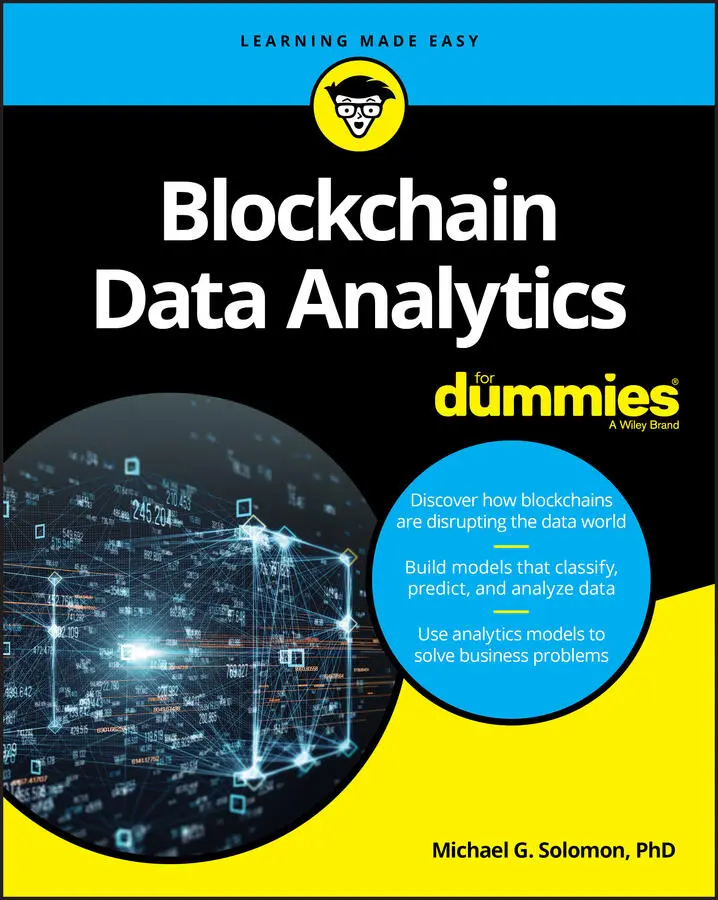
Michael G. Solomon - Blockchain Data Analytics For Dummies
Здесь есть возможность читать онлайн «Michael G. Solomon - Blockchain Data Analytics For Dummies» — ознакомительный отрывок электронной книги совершенно бесплатно, а после прочтения отрывка купить полную версию. В некоторых случаях можно слушать аудио, скачать через торрент в формате fb2 и присутствует краткое содержание. Жанр: unrecognised, на английском языке. Описание произведения, (предисловие) а так же отзывы посетителей доступны на портале библиотеки ЛибКат.
- Название:Blockchain Data Analytics For Dummies
- Автор:
- Жанр:
- Год:неизвестен
- ISBN:нет данных
- Рейтинг книги:5 / 5. Голосов: 1
-
Избранное:Добавить в избранное
- Отзывы:
-
Ваша оценка:
Blockchain Data Analytics For Dummies: краткое содержание, описание и аннотация
Предлагаем к чтению аннотацию, описание, краткое содержание или предисловие (зависит от того, что написал сам автор книги «Blockchain Data Analytics For Dummies»). Если вы не нашли необходимую информацию о книге — напишите в комментариях, мы постараемся отыскать её.
is your quick-start guide to harnessing the potential of blockchain.
Inside this book, technologists, executives, and data managers will find information and inspiration to adopt blockchain as a big data tool. Blockchain expert Michael G. Solomon shares his insight on what the blockchain is and how this new tech is poised to disrupt data. Set your organization on the cutting edge of analytics, before your competitors get there!
Learn how blockchain technologies work and how they can integrate with big data Discover the power and potential of blockchain analytics Establish data models and quickly mine for insights and results Create data visualizations from blockchain analysis Discover how blockchains are disrupting the data world with this exciting title in the trusted
line!
Blockchain Data Analytics For Dummies — читать онлайн ознакомительный отрывок
Ниже представлен текст книги, разбитый по страницам. Система сохранения места последней прочитанной страницы, позволяет с удобством читать онлайн бесплатно книгу «Blockchain Data Analytics For Dummies», без необходимости каждый раз заново искать на чём Вы остановились. Поставьте закладку, и сможете в любой момент перейти на страницу, на которой закончили чтение.
Интервал:
Закладка:
Without getting into the details quite yet, blockchain technology makes it possible for you and the rideshare provider to trust the transfer of payment for the ride without having to trust one another. The ability to pay for a ride without the driver or rider trusting one another can be disruptive to payment card processors.
Many intermediaries, such as banks, payment processors, brokers, international money transfer companies, and even music distributors, could lose revenue to blockchain. All these middlemen charge a fee by managing transfers that blockchain technology could simplify.
Doing more with blockchain
Blockchain started off as an approach to managing cryptocurrency transactions in a trustless environment. Since then it has matured to handle value transfers of many types and has grown into a viable component of an integrated enterprise infrastructure. Enterprises rely on many software and hardware components that work together to provide services to their customers and partners. Blockchain technology is no longer just a cool idea — now it has the power to improve business processes. You’ll likely see more and more businesses relying on blockchain to help run their operations. Before you look into leveraging blockchain and its new way of handling data, it helps to explore the existing blockchain landscape to get a feel of where blockchain may be beneficial.
Understanding blockchain technology
At its most basic level, a blockchain is a list of blocks connected to one another, where copies of the entire list are distributed among a set of participants, called network nodes. Each block contains a set of transactions and is connected to the block that immediately precedes it. Each transaction describes the transfer of some amount from one owner to another owner. Each transaction may have more information, but the focus is the transfer of value.
The way in which new blocks are added to the chain ensures that all copies of the chain of blocks (that’s why it’s called a blockchain) are the same. Distributing copies of data to different locations has always been difficult. Sending copies of data to multiple recipients isn’t hard, but keeping all those copies the same is very hard. Keeping distributed data in sync is another thing that blockchain technology does very well.
Comparing blockchain to something you know
One way to think of a blockchain is as a big spreadsheet that is shared among many nodes. Each row in the spreadsheet represents a transaction that records amount, from owner, and to owner columns, and sometimes contains columns with additional data. Periodically, a group of rows, called a block of rows, is added to the bottom of each copy of the spreadsheet. You can’t go back and edit any rows in the spreadsheet, but you can add new rows. That analogy is simple, but it gives you an idea of how blockchain transactions are similar to the familiar spreadsheet.
One of the first difficulties in maintaining copies of spreadsheets is how to control adding new rows and protecting existing rows from changes. A full discussion of blockchain integrity is beyond the scope of this book, but following is a high-level overview of how blockchains ensure integrity.
Using cryptography with blockchain
Blockchain technology is based on the concept of linking blocks together using a cryptographic hash. A cryptographic hash function takes any characters as input and creates a fixed-length output that represents the input. Calculating a hash value is easy, but finding the original input from the hash is extremely difficult. If the input changes at all, the hash function will calculate a different hash value.
Blockchain nodes calculate the hash value of a block and store that value in the next block on the chain. That process links the blocks and also detects changes in blocks. If any data in any block gets changed, the hash value of the block changes and makes the next block’s link (remember it was the original block’s hash value) invalid. Any change breaks the chain.
Achieving consensus among network nodes
Blockchain network nodes submit transactions, and then special nodes called miners assemble the transactions into blocks and then compete with other miners to be the first to solve a mathematical puzzle that makes a block easy to verify by all other nodes. The first miner to solve the puzzle gets a small reward for the work.
Each blockchain can define a different method its nodes use to verify blocks, but all the nodes in a specific blockchain network use the same block verification method. Methods that blockchains use to verify the validity of new blocks are called consensus algorithms. A common consensus algorithm is the Proof of Work (PoW) algorithm, which asks miners to expend energy to solve mathematical puzzles in exchange for a prize.
Regardless of the type of consensus a blockchain uses, more than 50 percent of the nodes must agree that a new submitted block is the so-called truth. When a majority agrees, all nodes add the new block to their blockchain. Through consensus and guarantees that no previous data has changed, blockchain technology ensures that all copies of the blockchain are identical and can be trusted.
Reviewing blockchain’s family tree
Blockchain technology is only a decade old, but its effect is already being felt across many types of businesses. In just a few short years, blockchain implementations have matured through three generations. Classifying blockchain development by generation helps to uncover blockchain’s short history, and where it may be headed. Note, however, that some developments overlap and others may fit in more than one category.
Introducing blockchain’s first generation
Blockchain technology was introduced with the release of Satoshi Nakamoto’s paper, “Bitcoin: A Peer-to-Peer Electronic Cash System” in 2008. The paper proposed a completely new approach to handling electronic currency. It described a structured data repository that consisted of a chain of special blocks, called a block chain. This new approach made it possible for many nodes that do not trust one another to exchange currency without relying on a central authority. Blockchain’s first-generation goals focused on managing transactions between nodes that do not trust one another. Trust, not performance, was the central issue.
Adding blockchain features in the second generation
Bitcoin did just what it was supposed to do and provided a new way to exchange value. With Bitcoin, many individuals and small business could interact directly with customers or one another without involving banks or payment processors. It didn’t take long for other blockchain implementations to emerge, each with its own cryptocurrency. As blockchain become more popular, developers and researchers started looking for other ways to use the new technology. They found that with just a few changes, blockchain technology could do far more than just trade cryptocurrency.
Just five short years after Nakamoto’s paper was released, Vitalik Buterin, the cofounder of Bitcoin Magazine, published a whitepaper that proposed the use of Ethereum, a new, more functional blockchain implementation that could do much more than just exchange cryptocurrency. Buterin had a plan for Ethereum and built a base of interest and financial support for this new generation of blockchain. The Ethereum Foundation, a Swiss non-profit organization, was founded and Buterin became the primary developer of Ethereum.
Ethereum was designed to be different than previous blockchain implementations. The two primary differences are Ethereum's smart contract and native cryptocurrency, ether. In Ethereum, you can access blockchain data only by executing a smart contract. Smart contracts provide rich functionality and blockchain data integrity, and make it possible for blockchain technology to do much more than first-generation implementations. With the release of Ethereum, blockchains could carry out a wide range of business transactions beyond just handling payments, such as automating many business decisions or even carrying out entire transactions automatically. Imagine a ridesharing app that sends an autonomous (driverless) car to transport you to your destination and then automatically transfers payment for the ride from your account into its own account — all automatically! That’s just one example of what is possible in Ethereum.
Читать дальшеИнтервал:
Закладка:
Похожие книги на «Blockchain Data Analytics For Dummies»
Представляем Вашему вниманию похожие книги на «Blockchain Data Analytics For Dummies» списком для выбора. Мы отобрали схожую по названию и смыслу литературу в надежде предоставить читателям больше вариантов отыскать новые, интересные, ещё непрочитанные произведения.



Обсуждение, отзывы о книге «Blockchain Data Analytics For Dummies» и просто собственные мнения читателей. Оставьте ваши комментарии, напишите, что Вы думаете о произведении, его смысле или главных героях. Укажите что конкретно понравилось, а что нет, и почему Вы так считаете.