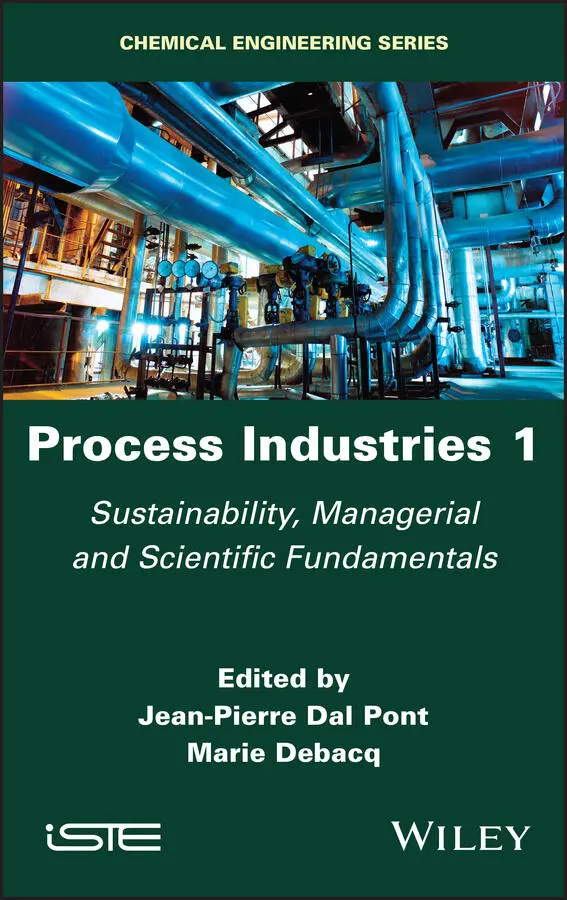
Process Industries 1
Здесь есть возможность читать онлайн «Process Industries 1» — ознакомительный отрывок электронной книги совершенно бесплатно, а после прочтения отрывка купить полную версию. В некоторых случаях можно слушать аудио, скачать через торрент в формате fb2 и присутствует краткое содержание. Жанр: unrecognised, на английском языке. Описание произведения, (предисловие) а так же отзывы посетителей доступны на портале библиотеки ЛибКат.
- Название:Process Industries 1
- Автор:
- Жанр:
- Год:неизвестен
- ISBN:нет данных
- Рейтинг книги:4 / 5. Голосов: 1
-
Избранное:Добавить в избранное
- Отзывы:
-
Ваша оценка:
Process Industries 1: краткое содержание, описание и аннотация
Предлагаем к чтению аннотацию, описание, краткое содержание или предисловие (зависит от того, что написал сам автор книги «Process Industries 1»). Если вы не нашли необходимую информацию о книге — напишите в комментариях, мы постараемся отыскать её.
Process Industries 1 — читать онлайн ознакомительный отрывок
Ниже представлен текст книги, разбитый по страницам. Система сохранения места последней прочитанной страницы, позволяет с удобством читать онлайн бесплатно книгу «Process Industries 1», без необходимости каждый раз заново искать на чём Вы остановились. Поставьте закладку, и сможете в любой момент перейти на страницу, на которой закончили чтение.
Интервал:
Закладка:
Table of Contents
1 Cover
2 Title Page Series Editor Jean-Claude Charpentier
3 Copyright Page First published 2020 in Great Britain and the United States by ISTE Ltd and John Wiley 8 Sons, Inc. Apart from any fair dealing for the purposes of research or private study, or criticism or review, as permitted under the Copyright, Designs and Patents Act 1988, this publication may only be reproduced, stored or transmitted, in any form or by any means, with the prior permission in writing of the publishers, or in the case of reprographic reproduction in accordance with the terms and licenses issued by the CLA. Enquiries concerning reproduction outside these terms should be sent to the publishers at the undermentioned address: ISTE Ltd 27-37 St George’s Road London SW19 4EU UK www.iste.co.uk John Wiley & Sons, Inc. 111 River Street Hoboken, NJ 07030 USA www.wiley.com © ISTE Ltd 2020 The rights of Jean-Pierre Dal Pont and Marie Debacq to be identified as the authors of this work have been asserted by them in accordance with the Copyright, Designs and Patents Act 1988. Library of Congress Control Number: 2020940663 British Library Cataloguing-in-Publication Data A CIP record for this book is available from the British Library ISBN 978-1-78630-442-1
4 Foreword by Laurent Baseilhac
5 Foreword by Vincent Laflèche
6 Foreword by June C. Wispelwey
7 Introduction
8 1 Industries, Businesses and People
1.1. Manufacturing, process, and service industries 1.1. Manufacturing, process, and service industries 1.1.1. Manufacturing industries We define these as activities whose production is said to be discrete, because they offer identified objects. It is the field of the automotive and aeronautics industries, and household appliances. They often call on the chemical industries: an automobile, for example, is riddled with chemicals (windshield, dashboard, seats, pipes, sheath of electric cables, etc.).
1.2. Founding fathers of the industrial enterprise 1.3. Anatomy of an industrial enterprise 1.4. Industrial strategy: the business plan 1.5. Systemic vision of the enterprise: the enterprise and flows 1.6. The two operating modes of the enterprise: operational and entrepreneurial 1.7. Governance 1.8. Operations abroad 1.9. References
9 2 Earth, Our Habitat: Products by the Millions, the Need for Awareness 2.1. Population explosion 2.2. Systemic analysis and the concept of a system 2.3. Earth, a complex system 2.4. Awareness, sustainable development 2.5. Products by the millions 2.6. Resource Earth, garbage Earth: towards a circular economy 2.7. Materials science 2.8. Product formulation and engineering 2.9. Product toxicology and ecotoxicology 2.10. Product packaging and ergonomics 2.11. New consumer requirements 2.12. Boxes 2.13. References
10 3 Designing Chemical Products3.1. Introduction 3.2. Basic technologies 3.3. Products 3.4. Product design 4.0 3.5. References
11 4 Chemical Engineering: Introduction and Fundamentals4.1. Introduction: definitions, history, and challenges 4.2. Fundamentals of chemical engineering 4.3. Box 4.4. References
12 5 Chemical Engineering: Unit Operations 5.1. Distillation 5.2. Fluid-solid mechanical separations 5.3. Stirring 5.4. Heat exchangers 5.5. Reactors 5.6. Conclusion 5.7. Boxes 5.8. Glossary 5.9. References
13 List of Authors
14 Index
15 Summary of Volume 2
16 Other titles from ISTE in Chemical Engineering
17 End User License Agreement
List of Tables
1 Chapter 2 Table 2.1. Simplified systemic analysis of a city: inputs and outputsTable 2.2. Applications of virgin plasticsTable 2.3. Steps of the “product engineering" methodology proposed by Cussler an...
2 Chapter 3Table 3.1. History of Aspirin ®
3 Chapter 4Table 4.1. Conductivities of matter (Pick’s law), heat (Fourier’s law), and mome...
4 Chapter 5Table 5.1. Reynolds number and fall velocity (the particle Reynolds number as ca...Table 5.2. Power and pumping numbers of various impellers in the turbulent regim...
List of Illustrations
1 Chapter 1 Figure 1.1. Portraits of the fathers of the modern enterprise (from left to ... Figure 1.2. a) Product life cycle; b) company turnover versus products Figure 1.3. Principle of strategic analysis of a company (technical aspects)... Figure 1.4. Systemic vision of the enterprise Figure 1.5. The enterprise and its flows Figure 1.6. Schema of the ISO 26000 standard
2 Chapter 2 Figure 2.1. Our habitat as seen from space. For a color version of this figu... Figure 2.2. Population explosion Figure 2.3. Population change by country by 2050. For a color version of thi... Figure 2.4. Estimated World Population in 2100: Population Growth by Region.... Figure 2.5. Schematization of a system Figure 2.6. Water cycle (source: Wikimedia Common4). For a color version of ... Figure 2.7. Rachel Carson (1907-1964), inventor of sustainability Figure 2.8. Conceptualization of sustainable development. For a color versio... Figure 2.9. Sustainability and metricsFigure 2.10. a) The product as seen by the customer; b) the product seen by ...Figure 2.11. Resource Earth, garbage Earth. For a color version of this figu...Figure 2.12. Lifecycle of a product (Dal Pont 2012, p. 244)Figure 2.13. Example of a Smart City. For a color version of this figure, se...Figure 2.14. Interconnectivity. For a color version of this figure, see www....Figure 2.15. The consumer and related services. For a color version of this ...Figure 2.16. Connected city, a view of central data. For a color version of ...Figure 2.17. Connected city, a view of central dataFigure 2.18. Everyday connected objects. For a color version of this figure,...Figure 2.19. Main standards based on applications (source: microcontrollerti...Figure 2.20. Examples of smart objects in the urban area. For a color versio...Figure 2.21. Example of communicative street furniture (source: Avestone). F...Figure 2.22. Some objects in a Smart City. For a color version of this figur...Figure 2.23. Tools of a Digital City. For a color version of this figure, se...Figure 2.24. Main challenges of Smart City projects main for the decision-ma...Figure 2.25. Success factors of a city's transformation. For a color version...Figure 2.26. Example of the city of NiceFigure 2.27. Mobile convergence solutions: local communication, weather, tra...Figure 2.28. Return on Investment (ROI)Figure 2.29. Key steps in an LCA approach (source: Ecoinvent). For a color v...Figure 2.30. Coupling process modeling, multiobjective optimization, and mul...Figure 2.31. Absorption, distribution, metabolization, and excretion (ADME)....Figure 2.32. Lifecycle of a chemical substance. For a color version of this ...Figure 2.33. Aquatic food chain and transfer of pollution. For a color versi...Figure 2.34. Examples of 1D and 2D pharma codes. Note that since February 9,...Figure 2.35. Examples of UHF and HF RFID tags. The UHF tag has a dipole type...Figure 2.36. Lifecycle (source: Agathe Pernet). For a color version of this ...Figure 2.37. Typical feeds for Vegan ®technologyFigure 2.38. Details of a lipid feedFigure 2.39. Schematic diagram of Vegan® technology. For a color version of ...Figure 2.40. Evolution of product quality during various stages of the Vegan...Figure 2.41. Advantages of HVO product compared to biodiesel (FAME/VOME). Fo...Figure 2.42. Vegan® process. For a color version of this figure, see www.ist...Figure 2.43. Schematic diagram of an EquiFlow™ Hy-Tray™ dispenser...Figure 2.44. 3D view of an EquiFlow™ tray installed in a reactor. For a colo...Figure 2.45. Representation of the scales involved in product designFigure 2.46. End use properties resulting from formulation and process imple...Figure 2.47. Product development process
Читать дальшеИнтервал:
Закладка:
Похожие книги на «Process Industries 1»
Представляем Вашему вниманию похожие книги на «Process Industries 1» списком для выбора. Мы отобрали схожую по названию и смыслу литературу в надежде предоставить читателям больше вариантов отыскать новые, интересные, ещё непрочитанные произведения.







Обсуждение, отзывы о книге «Process Industries 1» и просто собственные мнения читателей. Оставьте ваши комментарии, напишите, что Вы думаете о произведении, его смысле или главных героях. Укажите что конкретно понравилось, а что нет, и почему Вы так считаете.