Siegfried Siegesmund - Monument Future
Здесь есть возможность читать онлайн «Siegfried Siegesmund - Monument Future» — ознакомительный отрывок электронной книги совершенно бесплатно, а после прочтения отрывка купить полную версию. В некоторых случаях можно слушать аудио, скачать через торрент в формате fb2 и присутствует краткое содержание. Жанр: unrecognised, на немецком языке. Описание произведения, (предисловие) а так же отзывы посетителей доступны на портале библиотеки ЛибКат.
- Название:Monument Future
- Автор:
- Жанр:
- Год:неизвестен
- ISBN:нет данных
- Рейтинг книги:4 / 5. Голосов: 1
-
Избранное:Добавить в избранное
- Отзывы:
-
Ваша оценка:
Monument Future: краткое содержание, описание и аннотация
Предлагаем к чтению аннотацию, описание, краткое содержание или предисловие (зависит от того, что написал сам автор книги «Monument Future»). Если вы не нашли необходимую информацию о книге — напишите в комментариях, мы постараемся отыскать её.
Alle vier Jahre treffen sich auf einer internationalen Tagung Experten, die sich mit den entsprechenden Sachfragen beschäftigen. Der „14th International Congress on the Deterioration and Conservation of Stone“ findet im September 2020 in Göttingen statt. Er ist die wichtigste Veranstaltung zur Verbreitung des Wissens von Praktikern und Forschern, die im Bereich der Steinkonservierung zur Erhaltung des baulichen Kulturerbes arbeiten: Geowissenschaftler, Architekten, Bauspezialisten, Ingenieure, Restauratoren, Denkmalpfleger und Bauherren.
Der Tagungsband mit über 150 wissenschaftlichen Beiträgen repräsentiert und erfasst den neuesten Stand der Technik auf diesem Gebiet.
Themen sind:
– Charakterisierung von Schadensphänomenen von Steinen und verwandten Baumaterialien (Stuck, Putz, Mörtel usw.)
– Methoden zur Untersuchung des Steinverfalls in situ und zerstörungsfreie Prüfung
– Langzeitüberwachung von Steindenkmälern und Gebäuden
– Simulation und Modellierung des Zerfalls
– Technologien und Entwicklung verbesserter Bearbeitung und Verwendung von Stein in Neubauten
– Bewertung der Langzeitwirkung von Bearbeitungstechniken
– Auswirkungen des Klimawandels auf die Steinverwitterung des Kulturerbes
– Berichte zur Steinkonservierung: Fallstudien und Projekte
– Digitalisierung und Dokumentation von Steinkonservierung
–
The 14th International Congress on the Deterioration and Conservation of Stone, entitled MONUMENT FUTURE: DECAY AND CONSERVATION OF STONE is a quadrennial event that brings together a world-wide community of geoscientists, architects, building specialists, engineers, conservators, restorators, monument curators and building owners who are concerned about the conservation of cultural stone structures and objects. Since antiquity, the weathering and deterioration of historical buildings, masonry, monuments, sculptures etc. using natural stones has been a very well-known problem.
This conference is the main gathering for the dissemination of knowledge in the field of stone deterioration issues. It represents and captures the state-of-the-art in the field of stone conservation and cultural heritage conservation with regards to the following topics:
– Characterisation of damage phenomena of stone and related building materials (plaster, rendering, mortar etc.)
– Methods for the investigation of stone decay; in-situ and non-destructive testing
– Long-term monitoring of stone monuments and buildings
– Simulation and modelling of decay
– Technology and development of improved treatments and use of stone in new buildings
– Assessment of long-term effects of treatments
– Impact of climate change on stone decay of Cultural Heritage
– Reports about stone conservation: case studies and projects
– Digitalization and documentation in stone conservation
Monument Future — читать онлайн ознакомительный отрывок
Ниже представлен текст книги, разбитый по страницам. Система сохранения места последней прочитанной страницы, позволяет с удобством читать онлайн бесплатно книгу «Monument Future», без необходимости каждый раз заново искать на чём Вы остановились. Поставьте закладку, и сможете в любой момент перейти на страницу, на которой закончили чтение.
Интервал:
Закладка:
a) Mapping
Seven types of decay patterns were mainly identified in the close examination of the reliefs (Figure 2).
b) Historical documents
A considerably high number of historical records were identified about the preservation condition of the reliefs. This is due to the fact that the site was very popular among western scholars between 17th and 20th centuries.
Among the identified material, some decay phenomena were described in detail. A critical approach in reading the precedent visitors’ works was especially noted among most of the authors, which make it possible to follow the events through history. According to the first notes written about the site by Pietro Della Valle, the Italian traveler in 17th century (Masetti, 2018) “the very little fragility of the sculptures shows that they are so strong that can last as long as the mountains themselves” (Della Valle, 1843, p. 261). This condition as the beginning point of the survey may be compared with the evidence of decay, which are traced in the early 20th century photos and even the drawings from 18th and 19th centuries. However, it is more 74precise to compare the graphic resources with the present mapped condition. Figure 3 shows examples of specific phenomena, which were discovered.
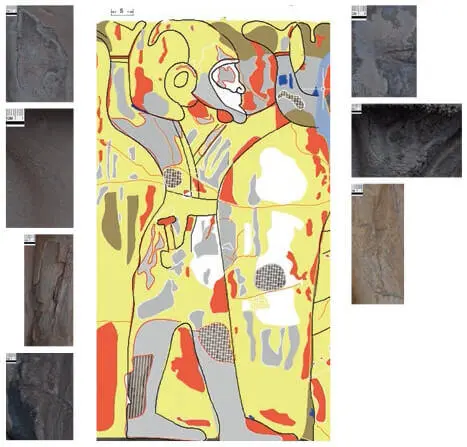
Figure 2:Example of decay map of the rock reliefs decorations on the façade of Xerxes’s tomb.
c) Laboratory Analysis
The rock substance in Naqshe-Rustam is composed of calcite with little amount of magnesian calcite and even minor phases of quartz (Figure 4). According to the results of mapping activities, the external surface of rock-reliefs is mainly covered by encrustations.
Field observation and also the historical photos showed the link between the movement of water on the stone surface through cracks and fissures in the rock and the formation of crusts. We focus here on this phenomenon and through the results of the analytical approach will discuss the link among it and other forms of decay.
Encrustations are formed as several superimposed layers (with an overall thickness between 0.1 to 0.5 mm). While the intact stone has a color similar to white marble, the crusts color range between dark orange to bright ochres (Figure 5). The SEMEDX analyses showed that these encrustations are composed of Ca, Si, Al, with minor variations.
It was seen in the maps (Figure 2) that a kind of dark coloration is developing as small to medium size patches on the reliefs, especially on the previously encrusted surfaces. This feature is present as a very thin layer, rich in Sulphur, which is formed on the external surface of the overall encrustation. While the older encrustations are basically close to the rock composition with small amounts of aluminum-silicates contamination, the newer phenomenon is connected with a composition of gypsum and bassanite highlighted as minor phases in XRD analyses.
The appearance of crusts in these cases does not change so much (Figure 6). However, the progressive formation of sulphate layers can lead to black crust formation, as an impact of high atmospheric pollution (Fronteau et al., 2010). We still need to complete our studies on the air pollution data for this area.
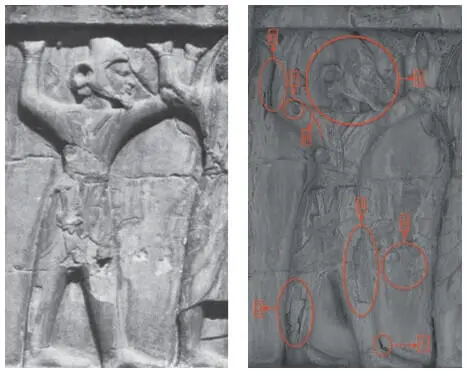
Figure 3:Comparison between an old photo shot no later than 1939 (Schmidt, 1970) and recent condition of the reliefs, showing the progress of weathering and material loss.
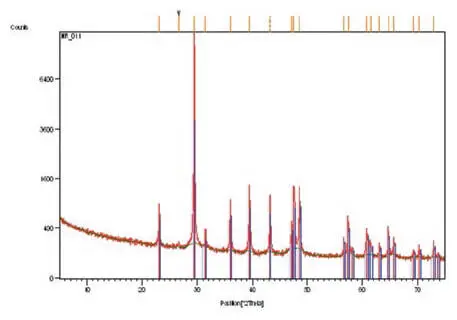
Figure 4:XRD patterns of rock samples of Xerxes’s tomb. Main phases: calcite, minor phases: magnesian calcite.
75 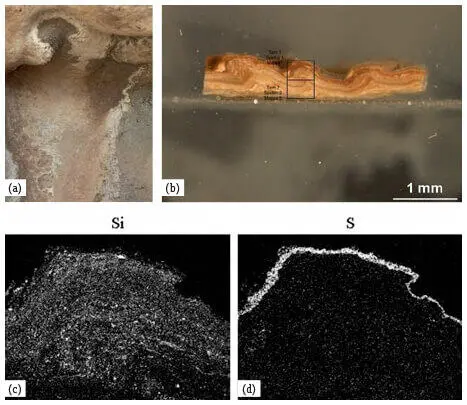
Figure 5:Encrustation on the reliefs, (a) Sampling location in the pathway of moisture with crusts of different colors, (b) the polished cross section of crusts, (c) and (d) SEM elemental maps of Si and S for the same sample.
Another secondary decay phenomenon related to the formation of crusts regards the presence of microrganisms. They form a dark film, which is also accompanied by pitting effects (Sohrabi et al., 2017). Microscopic observations showed that this is originally the same encrustation layer which is then contaminated with biological growth. The presence of micro-organisms in the pores of the encrustation layer caused a greyish or darker color. In places near the cracks and fissures conducting the rainwater, it went deeper and caused the detachment of stone pieces from the rock. Therefore, cross sections showed the presence of biologic material not only on the surface layer but also on the opposite side of the sample (Figure 6).
Finally, a very interesting feature was identified in a few samples under the encrustation. SEM/EDX analysis shows a considerable amount of phosphorous in this layer (Figure 7). It is found that this feature is linked to the technique, which was used for polychrome decoration. The first finding of such feature was given nearly two centuries ago by the French archaeologist who discovered traces of blue paint on Darius tomb, under a thick layer of what was described as a calcareous cover, but currently we may classify as a crust layer (Dieulafoy, 1885: 227) . There was no report about the polychromy on other tombs of Naqshe-Rustam, especially the Xerxes’s. However, during the conservation activities in the site a few traces of red paint were identified on the rock reliefs, which was given to the authors for analytical studies. We found the same layer with a high amount of P, interpreted as a ground under the paint in those samples.
Similar phosphorous containing material, probably as a product of burning bones, was found in Persepolis, as a ground layer for painting, in constructions attributed to Xerxes era (Ridolfi et al., 2018).
We need to continue the mapping and also to 76compare analytically our findings on Xerxes tomb with the earlier polychromy on the tomb of Darius. Moreover, this discovery enabled us to distinguish the traces of P-rich ground layer of the original polychromy from other superficial depositions on the rock reliefs. This provides an important measure for future conservation works in order to avoid errors such as overcleaning.

Figure 6:Black Biofilm on the reliefs, (a) sampling location, (b) the cross-section of the stone surface with biofilm, (c) and (d) SEM graphs of the surface of same sample showing the biological growth in the porous structure of the crusted surface.

Figure 7: White layer with traces of polychromy on the surface of reliefs, (a) sampling location, (b) cross-section of sample showing traces of red color on the surface with a ground layer between paint and stone, (c) SEM elemental map for Phosphorous.
Читать дальшеИнтервал:
Закладка:
Похожие книги на «Monument Future»
Представляем Вашему вниманию похожие книги на «Monument Future» списком для выбора. Мы отобрали схожую по названию и смыслу литературу в надежде предоставить читателям больше вариантов отыскать новые, интересные, ещё непрочитанные произведения.











Обсуждение, отзывы о книге «Monument Future» и просто собственные мнения читателей. Оставьте ваши комментарии, напишите, что Вы думаете о произведении, его смысле или главных героях. Укажите что конкретно понравилось, а что нет, и почему Вы так считаете.