Kim Stanley Robinson - Blue Mars
Здесь есть возможность читать онлайн «Kim Stanley Robinson - Blue Mars» — ознакомительный отрывок электронной книги совершенно бесплатно, а после прочтения отрывка купить полную версию. В некоторых случаях можно слушать аудио, скачать через торрент в формате fb2 и присутствует краткое содержание. Жанр: unrecognised, на английском языке. Описание произведения, (предисловие) а так же отзывы посетителей доступны на портале библиотеки ЛибКат.
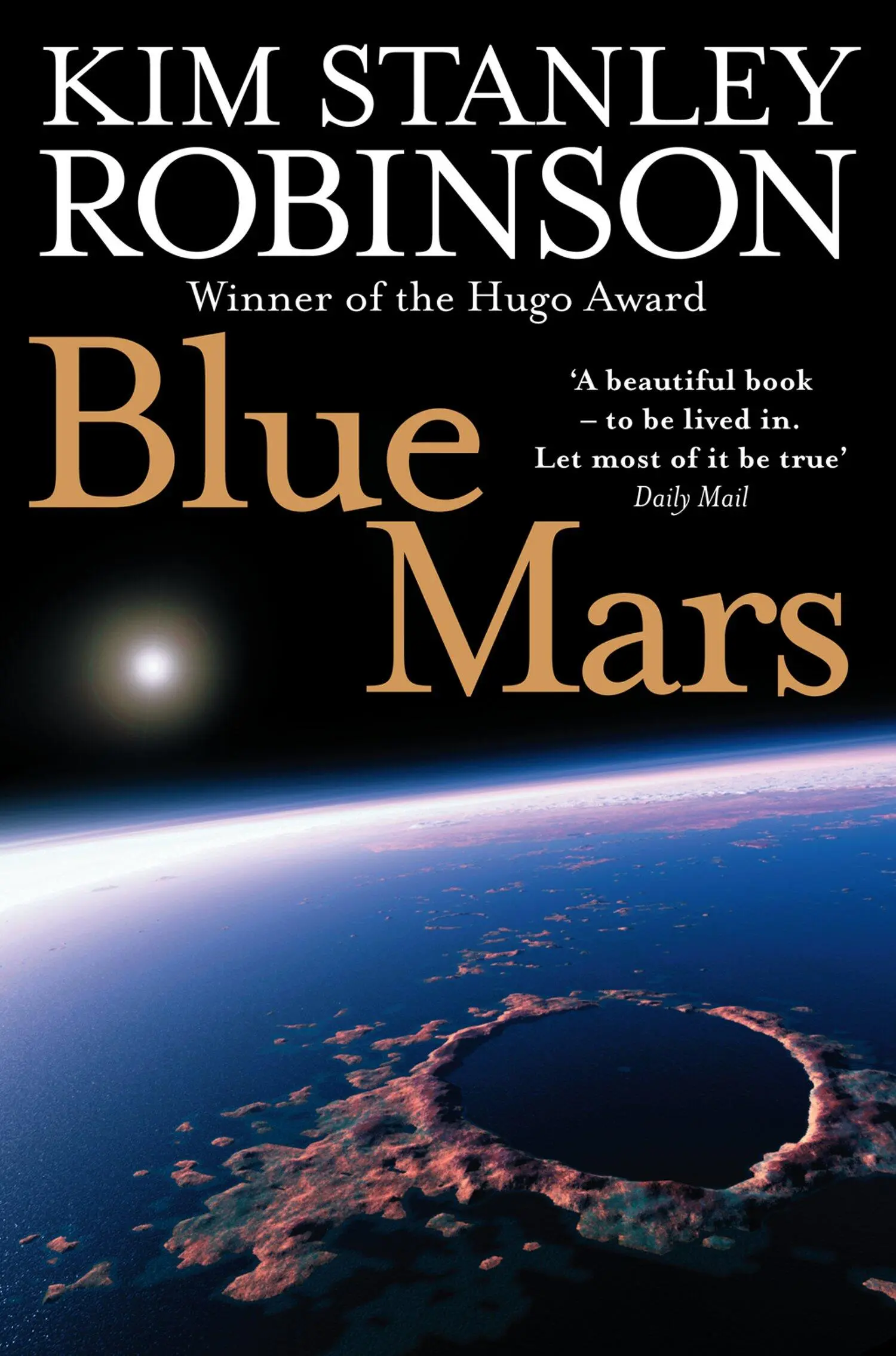
- Название:Blue Mars
- Автор:
- Жанр:
- Год:неизвестен
- ISBN:нет данных
- Рейтинг книги:5 / 5. Голосов: 1
-
Избранное:Добавить в избранное
- Отзывы:
-
Ваша оценка:
Blue Mars: краткое содержание, описание и аннотация
Предлагаем к чтению аннотацию, описание, краткое содержание или предисловие (зависит от того, что написал сам автор книги «Blue Mars»). Если вы не нашли необходимую информацию о книге — напишите в комментариях, мы постараемся отыскать её.
Blue Mars — читать онлайн ознакомительный отрывок
Ниже представлен текст книги, разбитый по страницам. Система сохранения места последней прочитанной страницы, позволяет с удобством читать онлайн бесплатно книгу «Blue Mars», без необходимости каждый раз заново искать на чём Вы остановились. Поставьте закладку, и сможете в любой момент перейти на страницу, на которой закончили чтение.
Интервал:
Закладка:
He plodded over the rockscape, amazed at the power of the wind to intensify cold. He had not experienced windchill like this since childhood, if then, and had forgotten how frigid one became. Staggering in the blasts, he climbed onto a low swell of the ancient lava and looked upslope. There was his rover – big, vivid green, gleaming like a spaceship – about two kilometres up the slope. A very welcome sight.
But now snow began to fly horizontally past him, giving a dramatic demonstration of the wind’s great speed. Little granular pellets clicked against his goggles. He took off toward the rover, keeping his head down and watching the snow swirl over the rocks. There was so much snow in the air that he thought his goggles were fogging up, but after a painfully cold operation to wipe the insides, it became clear that the condensation was actually out in the air. Fine snow, mist, dust, it was hard to tell.
He plodded on. The next time he looked up, the air was so thick with snow that he couldn’t see all the way to the rover. Nothing to do but press on. It was lucky the suit was well insulated and sewn through with heating elements, because even with the heat on at its highest power, the cold was cutting against his left side as if he were naked to the blast. Visibility extended now something like twenty metres, shifting rapidly depending on how much snow was passing by at the moment; he was in an amorphously expanding and contracting bubble of whiteness, which itself was shot through with flying snow, and what appeared to be a kind of frozen fog or mist. It seemed likely he was in the storm cloud itself. His legs were stiff. He wrapped his arms around his torso, his gloved hands trapped in his armpits. There was no obvious way of telling if he was still walking in the right direction. It seemed as if he was on the same course he had been when visibility had collapsed, but it also seemed as if he had gone a long way toward the rover.
There were no compasses on Mars; there were, however, APS systems in his wristpad and back in the car. He could call up a detailed map on his wristpad and then locate himself and his car on it; then walk for a while and track his positions; then make his way directly toward the car. That seemed like a great deal of work – which brought it to him that his thinking, like his body, was being affected by the cold. It wasn’t that much work, after all.
So he crouched down in the lee of a boulder and tried the method. The theory behind it was obviously sound, but the instrumentation left something to be desired; the wristpad’s screen was only five centimetres across, so small that he couldn’t see the dots on it at all well. Finally he spotted them, walked a while, and took another fix. But unfortunately his results indicated that he should be hiking at about a right angle to the direction he had been going.
This was unnerving to the point of paralysis. His body insisted that it had been going the right way; his mind (part of it, anyway) was pretty certain that it was better to trust the results on the wristpad, and assume that he had gone off course somewhere. But it didn’t feel that way; the ground was still at a slope that supported the feeling in his body. The contradiction was so intense that he suffered a wave of nausea, the internal torque twisting him until it actually hurt to stand, as if every cell in his body was twisting to the side against the pressure of what the wristpad was telling him – the physiological effects of a purely cognitive dissonance, it was amazing. It almost made one believe in the existence of an internal magnet in the body, as in the pineal glands of migrating birds – but there was no magnetic field to speak of. Perhaps his skin was sensitive to solar radiation to the point of being able to pinpoint the sun’s location, even when the sky was a thick dark grey everywhere. It had to be something like that, because the feeling that he was properly oriented was so strong!
Eventually the nausea of the disorientation passed, and in the end he stood and took off in the direction suggested by the wristpad, feeling horrible about it, listing a little uphill just to try and make himself feel better. But one had to trust instruments over instincts, that was science. And so he plodded on, traversing the slope, shading somewhat uphill, clumsier than ever. His nearly insensible feet ran into rocks that he did not see, even though they were directly beneath him; he stumbled time after time. It was surprising how thoroughly snow could obscure the vision.
After a while he stopped, and tried again to locate the rover by APS; and his wristpad map suggested an entirely new direction, behind him and to the left.
It was possible he had walked past the car. Was it? He did not want to walk back into the wind. But now that was the way to the rover, apparently. So he ducked his head down into the biting cold and persevered. His skin was in an odd state, itching under the heating elements crisscrossing his suit, numb everywhere else. His feet were numb. It was hard to walk. There was no feeling in his face; clearly frostbite was in the offing. He needed shelter.
He had a new idea. He called up Aonia, on Pavonis, and got her almost instantly.
‘Sax! Where are you?’
‘That’s what I’m calling about!’ he said. ‘I’m in a storm on Daedalia! And I can’t find my car! I was wondering if you would look at my APS and my rover’s! And see if you can tell me which direction I should go!’
He put the wristpad right against his ear. ‘Ka wow, Sax.’ It sounded like Aonia was shouting too, bless her. Her voice was an odd addition to the scene. ‘Just a second, let me check! … Okay! There you are! And your car too! What are you doing so far south? I don’t think anyone can get to you very quickly! Especially if there’s a storm!’
‘There is a storm,’ Sax said. ‘That’s why I called.’
‘Okay! You’re about three hundred and fifty metres to the west of your car.’
‘Directly west?’
‘—and a little south! But how will you orient yourself?’
Sax considered it. Mars’s lack of a magnetic field had never struck him as such a problem before, but there it was. He could assume the wind was directly out of the west, but that was just an assumption. ‘Can you check the nearest weather stations and tell me what direction the wind is coming from?’ he said.
‘Sure, but it won’t be much good for local variations! Here, just a second, I’m getting some help here from the others.’
A few long icy moments passed.
‘The wind is coming from west north west, Sax! So you need to walk with the wind at your back and a touch to your left!’
‘I know. Be quiet now, until you see what course I’m making, and then correct it.’
He walked again, fortunately almost downwind. After five or six painful minutes his wrist beeped.
Aonia said, ‘You’re right on course!’
This was encouraging, and he carried on with a bit more speed, though the wind was penetrating through his ribs right to his core.
‘Okay, Sax! Sax?’
‘Yes!’
‘You and your car are right on the same spot!’
But there was no car in view.
His heart thudded in his chest. Visibility was still some twenty metres; but no car. He had to get shelter fast. ‘Walk in an ever-increasing spiral from where you are,’ the little voice on the wrist was suggesting. A good idea in theory, but he couldn’t bear to execute it; he couldn’t face the wind. He stared dully at his black plastic wristpad console. No more help to be had there.
For a moment he could make out snowbanks, off to his left. He shuffled over to investigate, and found that the snow rested in the lee of a shoulder-high escarpment, a feature he did not remember seeing before, but there were some radial breaks in the rock caused by the Tharsis rise, and this must be one of them, protecting a snowbank. Snow was a tremendous insulator. Though it had little intrinsic appeal as shelter. But Sax knew mountaineers often dug into it to survive nights out. It got one out of the wind.
Читать дальшеИнтервал:
Закладка:
Похожие книги на «Blue Mars»
Представляем Вашему вниманию похожие книги на «Blue Mars» списком для выбора. Мы отобрали схожую по названию и смыслу литературу в надежде предоставить читателям больше вариантов отыскать новые, интересные, ещё непрочитанные произведения.










Обсуждение, отзывы о книге «Blue Mars» и просто собственные мнения читателей. Оставьте ваши комментарии, напишите, что Вы думаете о произведении, его смысле или главных героях. Укажите что конкретно понравилось, а что нет, и почему Вы так считаете.