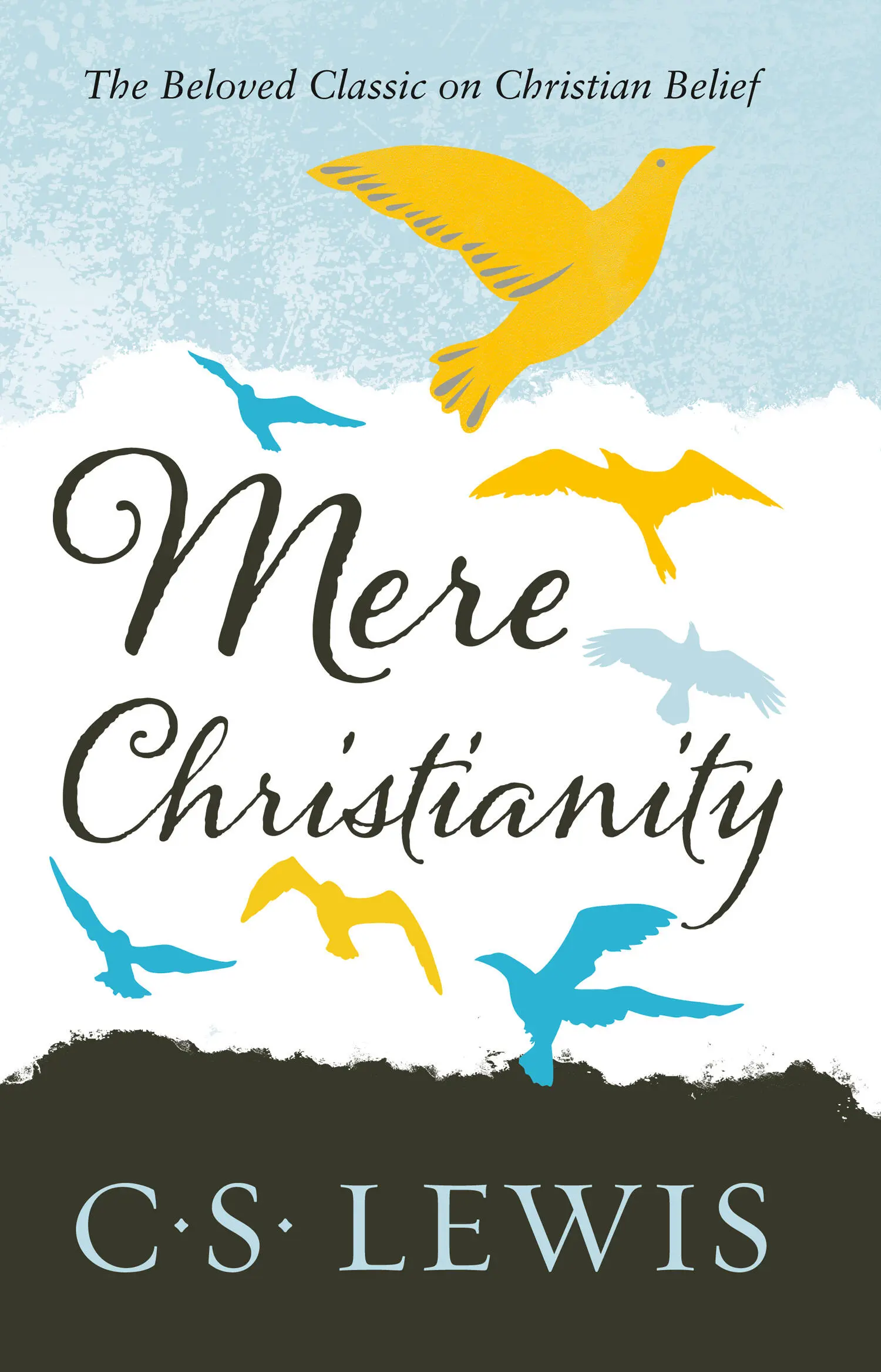
C. S. Lewis - Mere Christianity
Здесь есть возможность читать онлайн «C. S. Lewis - Mere Christianity» — ознакомительный отрывок электронной книги совершенно бесплатно, а после прочтения отрывка купить полную версию. В некоторых случаях можно слушать аудио, скачать через торрент в формате fb2 и присутствует краткое содержание. Жанр: unrecognised, на английском языке. Описание произведения, (предисловие) а так же отзывы посетителей доступны на портале библиотеки ЛибКат.
- Название:Mere Christianity
- Автор:
- Жанр:
- Год:неизвестен
- ISBN:нет данных
- Рейтинг книги:3 / 5. Голосов: 1
-
Избранное:Добавить в избранное
- Отзывы:
-
Ваша оценка:
Mere Christianity: краткое содержание, описание и аннотация
Предлагаем к чтению аннотацию, описание, краткое содержание или предисловие (зависит от того, что написал сам автор книги «Mere Christianity»). Если вы не нашли необходимую информацию о книге — напишите в комментариях, мы постараемся отыскать её.
Mere Christianity — читать онлайн ознакомительный отрывок
Ниже представлен текст книги, разбитый по страницам. Система сохранения места последней прочитанной страницы, позволяет с удобством читать онлайн бесплатно книгу «Mere Christianity», без необходимости каждый раз заново искать на чём Вы остановились. Поставьте закладку, и сможете в любой момент перейти на страницу, на которой закончили чтение.
Интервал:
Закладка:
MERE
CHRISTIANITY
C. S. LEWIS
A revised and amplified edition,
with a new introduction,
of the three books
Broadcast Talks, Christian Behaviour and Beyond Personality

Copyright
William Collins
An imprint of HarperCollins Publishers Ltd 1 London Bridge Street London SE1 9GF www.harpercollins.co.uk
MERE CHRISTIANITY. Copyright © 1952, C. S. Lewis Pte. Ltd. Copyright renewed © 1980, C. S. Lewis Pte. Ltd.
The Case for Christianity (aka Broadcast Talks) . Copyright © 1942, C. S. Lewis Pte. Ltd. Copyright restored © 1996, C. S. Lewis Pte. Ltd.
Christian Behavior . Copyright © 1943, C. S. Lewis Pte. Ltd. Copyright renewed © 1971, C. S. Lewis Pte. Ltd.
Beyond Personality . Copyright © 1944, C. S. Lewis Pte. Ltd. Copyright renewed © 1972, C. S. Lewis Pte. Ltd.
The right of C. S. Lewis to be identified as the author of this work has been asserted by him in accordance with the Copyright, Designs and Patents Act 1988
All rights reserved under International and Pan-American Copyright Conventions. By payment of the required fees, you have been granted the non-exclusive, non-transferable right to access and read the text of this ebook on-screen. No part of this text may be reproduced, transmitted, downloaded, decompiled, reverse engineered, or stored in or introduced into any information storage and retrieval system, in any form or by any means whether electronic or mechanical, now known or hereinafter invented, without the express written permission of HarperCollins ebooks.
HarperCollins Publishers has made every reasonable effort to ensure that any picture content and written content in this ebook has been included or removed in accordance with the contractual and technological constraints in operation at the time of publication.
Source ISBN: 9780007131860
Ebook Edition 2009 ISBN: 9780007332243
Version: 2019-04-08
CONTENTS
Cover
Title Page
Copyright
PREFACE
FOREWORD
BOOK 1. RIGHT AND WRONG AS A CLUE TO THE MEANING OF THE UNIVERSE
Chapter 1 - THE LAW OF HUMAN NATURE
Chapter 2 - SOME OBJECTIONS
Chapter 3 - THE REALITY OF THE LAW
Chapter 4 - WHAT LIES BEHIND THE LAW
Chapter 5 - WE HAVE CAUSE TO BE UNEASY
BOOK 2. WHAT CHRISTIANS BELIEVE
Chapter 1 - THE RIVAL CONCEPTIONS OF GOD
Chapter 2 - THE INVASION
Chapter 3 - THE SHOCKING ALTERNATIVE
Chapter 4 - THE PERFECT PENITENT
Chapter 5 - THE PRACTICAL CONCLUSION 60
BOOK 3. CHRISTIAN BEHAVIOUR
Chapter 1 - THE THREE PARTS OF MORALITY
Chapter 2 - THE ‘CARDINAL VIRTUES’
Chapter 3 - SOCIAL MORALITY
Chapter 4 - MORALITY AND PSYCHOANALYSIS
Chapter 5 - SEXUAL MORALITY
Chapter 6 - CHRISTIAN MARRIAGE
Chapter 7 - FORGIVENESS
Chapter 8 - THE GREAT SIN
Chapter 9 - CHARITY
Chapter 10 - HOPE
Chapter 11 - FAITH
Chapter 12 - FAITH
BOOK 4. BEYOND PERSONALITY: OR FIRST STEPS IN THE DOCTRINE OF THE TRINITY
Chapter 1 - MAKING AND BEGETTING
Chapter 2 - THE THREE-PERSONAL GOD
Chapter 3 - TIME AND BEYOND TIME
Chapter 4 - GOOD INFECTION
Chapter 5 - THE OBSTINATE TOY SOLDIERS
Chapter 6 - TWO NOTES
Chapter 7 - LET’S PRETEND
Chapter 8 - IS CHRISTIANITY HARD OR EASY?
Chapter 9 - COUNTING THE COST
Chapter 10 - NICE PEOPLE OR NEW MEN
Chapter 11 - THE NEW MEN
Keep Reading
About the Publisher
PREFACE
The contents of this book were first given on the air, and then published in three separate parts as Broadcast Talks (1942), Christian Behaviour (1943) and Beyond Personality (1944). In the printed versions I made a few additions to what I had said at the microphone, but otherwise left the text much as it had been. A ‘talk’ on the radio should, I think, be as like real talk as possible, and should not sound like an essay being read aloud. In my talks I had therefore used all the contractions and colloquialisms I ordinarily use in conversation. In the printed version I reproduced this, putting don’t and we’ve for do not and we have . And wherever, in the talks, I had made the importance of a word clear by the emphasis of my voice, I printed it in italics. I am now inclined to think that this was a mistake—an undesirable hybrid between the art of speaking and the art of writing. A talker ought to use variations of voice for emphasis because his medium naturally lends itself to that method: but a writer ought not to use italics for the same purpose. He has his own, different, means of bringing out the key words and ought to use them. In this edition I have expanded the contractions and replaced most of the italics by a recasting of the sentences in which they occurred: but without altering, I hope, the ‘popular’ or ‘familiar’ tone which I had all along intended. I have also added and deleted where I thought I understood any part of my subject better now than ten years ago or where I knew that the original version had been misunderstood by others.
The reader should be warned that I offer no help to anyone who is hesitating between two Christian ‘denominations’. You will not learn from me whether you ought to become an Anglican, a Methodist, a Presbyterian, or a Roman Catholic. This omission is intentional (even in the list I have just given the order is alphabetical). There is no mystery about my own position. I am a very ordinary layman of the Church of England, not especially ‘high’, nor especially ‘low’, nor especially anything else. But in this book I am not trying to convert anyone to my own position. Ever since I became a Christian I have thought that the best, perhaps the only, service I could do for my unbelieving neighbours was to explain and defend the belief that has been common to nearly all Christians at all times. I had more than one reason for thinking this. In the first place, the questions which divide Christians from one another often involve points of high Theology or even of ecclesiastical history, which ought never to be treated except by real experts. I should have been out of my depth in such waters: more in need of help myself than able to help others. And secondly, I think we must admit that the discussion of these disputed points has no tendency at all to bring an outsider into the Christian fold. So long as we write and talk about them we are much more likely to deter him from entering any Christian communion than to draw him into our own. Our divisions should never be discussed except in the presence of those who have already come to believe that there is one God and that Jesus Christ is His only Son. Finally, I got the impression that far more, and more talented, authors were already engaged in such controversial matters than in the defence of what Baxter calls ‘mere’ Christianity. That part of the line where I thought I could serve best was also the part that seemed to be thinnest. And to it I naturally went.
So far as I know, these were my only motives, and I should be very glad if people would not draw fanciful inferences from my silence on certain disputed matters.
For example, such silence need not mean that I myself am sitting on the fence. Sometimes I am. There are questions at issue between Christians to which I do not think we have been told the answer. There are some to which I may never know the answer: if I asked them, even in a better world, I might (for all I know) be answered as a far greater questioner was answered: ‘What is that to thee? Follow thou Me.’ But there are other questions as to which I am definitely on one side of the fence, and yet say nothing. For I am not writing to expound something I could call ‘my religion’, but to expound ‘mere’ Christianity, which is what it is and what it was long before I was born and whether I like it or not.
Читать дальшеИнтервал:
Закладка:
Похожие книги на «Mere Christianity»
Представляем Вашему вниманию похожие книги на «Mere Christianity» списком для выбора. Мы отобрали схожую по названию и смыслу литературу в надежде предоставить читателям больше вариантов отыскать новые, интересные, ещё непрочитанные произведения.


Обсуждение, отзывы о книге «Mere Christianity» и просто собственные мнения читателей. Оставьте ваши комментарии, напишите, что Вы думаете о произведении, его смысле или главных героях. Укажите что конкретно понравилось, а что нет, и почему Вы так считаете.