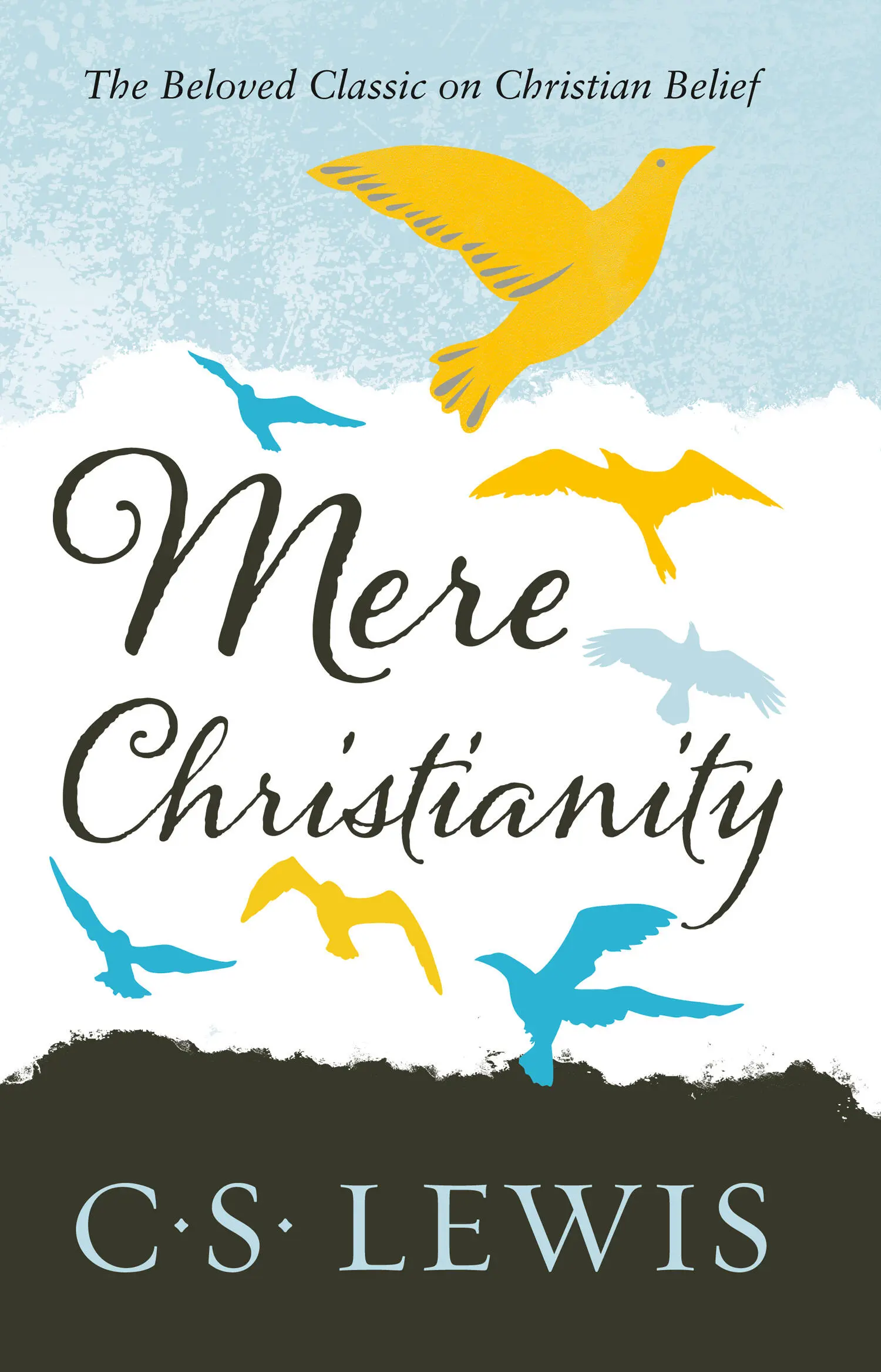
C. S. Lewis - Mere Christianity
Здесь есть возможность читать онлайн «C. S. Lewis - Mere Christianity» — ознакомительный отрывок электронной книги совершенно бесплатно, а после прочтения отрывка купить полную версию. В некоторых случаях можно слушать аудио, скачать через торрент в формате fb2 и присутствует краткое содержание. Жанр: unrecognised, на английском языке. Описание произведения, (предисловие) а так же отзывы посетителей доступны на портале библиотеки ЛибКат.
- Название:Mere Christianity
- Автор:
- Жанр:
- Год:неизвестен
- ISBN:нет данных
- Рейтинг книги:3 / 5. Голосов: 1
-
Избранное:Добавить в избранное
- Отзывы:
-
Ваша оценка:
Mere Christianity: краткое содержание, описание и аннотация
Предлагаем к чтению аннотацию, описание, краткое содержание или предисловие (зависит от того, что написал сам автор книги «Mere Christianity»). Если вы не нашли необходимую информацию о книге — напишите в комментариях, мы постараемся отыскать её.
Mere Christianity — читать онлайн ознакомительный отрывок
Ниже представлен текст книги, разбитый по страницам. Система сохранения места последней прочитанной страницы, позволяет с удобством читать онлайн бесплатно книгу «Mere Christianity», без необходимости каждый раз заново искать на чём Вы остановились. Поставьте закладку, и сможете в любой момент перейти на страницу, на которой закончили чтение.
Интервал:
Закладка:
But the most remarkable thing is this. Whenever you find a man who says he does not believe in a real Right and Wrong, you will find the same man going back on this a moment later. He may break his promise to you, but if you try breaking one to him he will be complaining ‘It’s not fair’ before you can say Jack Robinson. A nation may say treaties don’t matter; but then, next minute, they spoil their case by saying that the particular treaty they want to break was an unfair one. But if treaties do not matter, and if there is no such thing as Right and Wrong—in other words, if there is no Law of Nature—what is the difference between a fair treaty and an unfair one? Have they not let the cat out of the bag and shown that, whatever they say, they really know the Law of Nature just like anyone else?
It seems, then, we are forced to believe in a real Right and Wrong. People may be sometimes mistaken about them, just as people sometimes get their sums wrong; but they are not a matter of mere taste and opinion any more than the multiplication table. Now if we are agreed about that, I go on to my next point, which is this. None of us are really keeping the Law of Nature. If there are any exceptions among you, I apologise to them. They had much better read some other book, for nothing I am going to say concerns them. And now, turning to the ordinary human beings who are left:
I hope you will not misunderstand what I am going to say. I am not preaching, and Heaven knows I do not pretend to be better than anyone else. I am only trying to call attention to a fact; the fact that this year, or this month, or, more likely, this very day, we have failed to practise ourselves the kind of behaviour we expect from other people. There may be all sorts of excuses for us. That time you were so unfair to the children was when you were very tired. That slightly shady business about the money—the one you have almost forgotten—came when you were very hard-up. And what you promised to do for old So-and-so and have never done—well, you never would have promised if you had known how frightfully busy you were going to be. And as for your behaviour to your wife (or husband) or sister (or brother) if I knew how irritating they could be, I would not wonder at it—and who the dickens am I, anyway? I am just the same. That is to say, I do not succeed in keeping the Law of Nature very well, and the moment anyone tells me I am not keeping it, there starts up in my mind a string of excuses as long as your arm. The question at the moment is not whether they are good excuses. The point is that they are one more proof of how deeply, whether we like it or not, we believe in the Law of Nature. If we do not believe in decent behaviour, why should we be so anxious to make excuses for not having behaved decently? The truth is, we believe in decency so much—we feel the Rule of Law pressing on us so—that we cannot bear to face the fact that we are breaking it, and consequently we try to shift the responsibility. For you notice that it is only for our bad behaviour that we find all these explanations. It is only our bad temper that we put down to being tired or worried or hungry; we put our good temper down to ourselves.
These, then, are the two points I wanted to make. First, that human beings, all over the earth, have this curious idea that they ought to behave in a certain way, and cannot really get rid of it. Secondly, that they do not in fact behave in that way. They know the Law of Nature; they break it. These two facts are the foundation of all clear thinking about ourselves and the universe we live in.
2 SOME OBJECTIONS
If they are the foundation, I had better stop to make that foundation firm before I go on. Some of the letters I have had show that a good many people find it difficult to understand just what this Law of Human Nature, or Moral Law, or Rule of Decent Behaviour is.
For example, some people wrote to me saying, ‘Isn’t what you call the Moral Law simply our herd instinct and hasn’t it been developed just like all our other instincts?’ Now I do not deny that we may have a herd instinct: but that is not what I mean by the Moral Law. We all know what it feels like to be prompted by instinct—by mother love, or sexual instinct, or the instinct for food. It means that you feel a strong want or desire to act in a certain way. And, of course, we sometimes do feel just that sort of desire to help another person: and no doubt that desire is due to the herd instinct. But feeling a desire to help is quite different from feeling that you ought to help whether you want to or not. Supposing you hear a cry for help from a man in danger. You will probably feel two desires—one a desire to give help (due to your herd instinct), the other a desire to keep out of danger (due to the instinct for self-preservation). But you will find inside you, in addition to these two impulses, a third thing which tells you that you ought to follow the impulse to help, and suppress the impulse to run away. Now this thing that judges between two instincts, that decides which should be encouraged, cannot itself be either of them. You might as well say that the sheet of music which tells you, at a given moment, to play one note on the piano and not another, is itself one of the notes on the keyboard. The Moral Law tells us the tune we have to play: our instincts are merely the keys.
Another way of seeing that the Moral Law is not simply one of our instincts is this. If two instincts are in conflict, and there is nothing in a creature’s mind except those two instincts, obviously the stronger of the two must win. But at those moments when we are most conscious of the Moral Law, it usually seems to be telling us to side with the weaker of the two impulses. You probably want to be safe much more than you want to help the man who is drowning: but the Moral Law tells you to help him all the same. And surely it often tells us to try to make the right impulse stronger than it naturally is? I mean, we often feel it our duty to stimulate the herd instinct, by waking up our imaginations and arousing our pity and so on, so as to get up enough steam for doing the right thing. But clearly we are not acting from instinct when we set about making an instinct stronger than it is. The thing that says to you, ‘Your herd instinct is asleep. Wake it up,’ cannot itself be the herd instinct. The thing that tells you which note on the piano needs to be played louder cannot itself be that note.
Here is a third way of seeing it. If the Moral Law was one of our instincts, we ought to be able to point to some one impulse inside us which was always what we call ‘good,’ always in agreement with the rule of right behaviour. But you cannot. There is none of our impulses which the Moral Law may not sometimes tell us to suppress, and none which it may not sometimes tell us to encourage. It is a mistake to think that some of our impulses—say mother love or patriotism—are good, and others, like sex or the fighting instinct, are bad. All we mean is that the occasions on which the fighting instinct or the sexual desire need to be restrained are rather more frequent than those for restraining mother love or patriotism. But there are situations in which it is the duty of a married man to encourage his sexual impulse and of a soldier to encourage the fighting instinct. There are also occasions on which a mother’s love for her own children or a man’s love for his own country have to be suppressed or they will lead to unfairness towards other people’s children or countries. Strictly speaking, there are no such things as good and bad impulses. Think once again of a piano. It has not got two kinds of notes on it, the ‘right’ notes and the ‘wrong’ ones. Every single note is right at one time and wrong at another. The Moral Law is not any one instinct or set of instincts: it is something which makes a kind of tune (the tune we call goodness or right conduct) by directing the instincts.
Читать дальшеИнтервал:
Закладка:
Похожие книги на «Mere Christianity»
Представляем Вашему вниманию похожие книги на «Mere Christianity» списком для выбора. Мы отобрали схожую по названию и смыслу литературу в надежде предоставить читателям больше вариантов отыскать новые, интересные, ещё непрочитанные произведения.





Обсуждение, отзывы о книге «Mere Christianity» и просто собственные мнения читателей. Оставьте ваши комментарии, напишите, что Вы думаете о произведении, его смысле или главных героях. Укажите что конкретно понравилось, а что нет, и почему Вы так считаете.