A Dictionary of British and Irish History
Здесь есть возможность читать онлайн «A Dictionary of British and Irish History» — ознакомительный отрывок электронной книги совершенно бесплатно, а после прочтения отрывка купить полную версию. В некоторых случаях можно слушать аудио, скачать через торрент в формате fb2 и присутствует краткое содержание. Жанр: unrecognised, на английском языке. Описание произведения, (предисловие) а так же отзывы посетителей доступны на портале библиотеки ЛибКат.
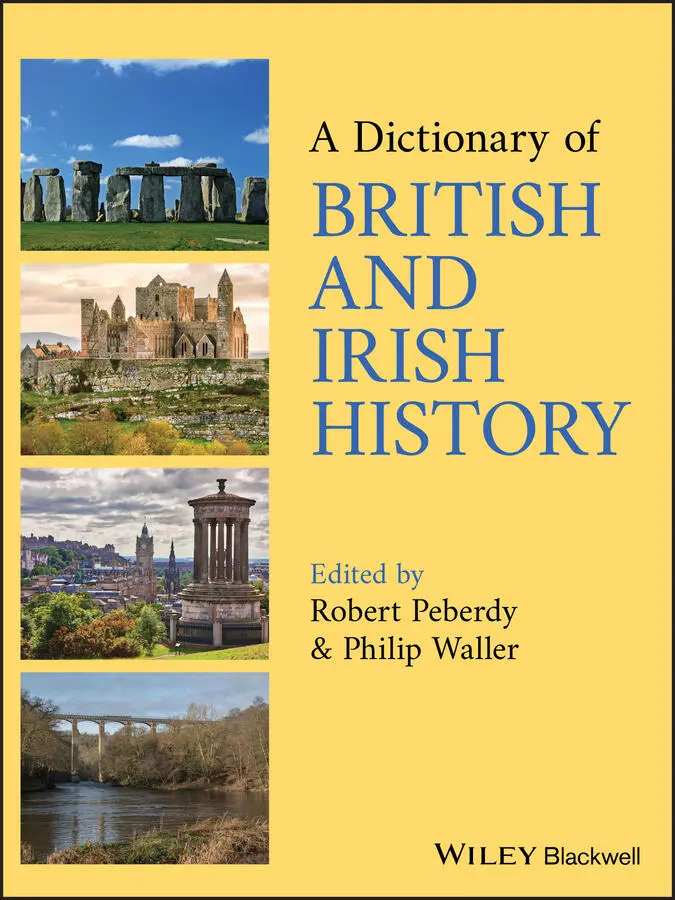
- Название:A Dictionary of British and Irish History
- Автор:
- Жанр:
- Год:неизвестен
- ISBN:нет данных
- Рейтинг книги:4 / 5. Голосов: 1
-
Избранное:Добавить в избранное
- Отзывы:
-
Ваша оценка:
A Dictionary of British and Irish History: краткое содержание, описание и аннотация
Предлагаем к чтению аннотацию, описание, краткое содержание или предисловие (зависит от того, что написал сам автор книги «A Dictionary of British and Irish History»). Если вы не нашли необходимую информацию о книге — напишите в комментариях, мы постараемся отыскать её.
British and Irish history
Quickly access basic information on the history of the British Isles from this reliable resource.
provides concise information covering all periods of prehistory and history for every part of the British Isles. Within this one book, you’ll find summary accounts of events, biographies, definitions of terms, and far more.
Using alphabetically organized headwords, readers will easily locate the content and details they seek.
not only serves as a reference tool, but also stimulates broader learning. Entries are interrelated and cross-referenced to help you expand your knowledge of different areas of history.
Discover comparable entries on England, Ireland, Scotland, and Wales See overviews of major topics and historical events Get facts instantly or browse entries Use the Dictionary as an information source or a launch point for expanding knowledge This reference book will become an essential resource for students of British and Irish history as well as for professionals, journalists, teachers, and those who use historical information in their work. Further, anyone wanting to establish the basics of the history of the British Isles will find this a valuable addition to their library.
A Dictionary of British and Irish History — читать онлайн ознакомительный отрывок
Ниже представлен текст книги, разбитый по страницам. Система сохранения места последней прочитанной страницы, позволяет с удобством читать онлайн бесплатно книгу «A Dictionary of British and Irish History», без необходимости каждый раз заново искать на чём Вы остановились. Поставьте закладку, и сможете в любой момент перейти на страницу, на которой закончили чтение.
Интервал:
Закладка:
The capital city of Northern Ireland, by the R. Lagan; from Irish Béal Feirste, meaning ‘Mouth of Farset stream’.
Belfast town was developed from 1603 by the English soldier Sir Arthur CHICHESTER (granted charter of self‐government by King JAMES VI/I in 1613). In the later 17th century it became the centre of the rural Ulster LINEN INDUSTRY and an important port (Ireland’s fourth‐largest town in 1680s).
Late 18th‐century Belfast became an industrial centre. Cotton‐spinning factories flourished in and around Belfast c .1780–1870s. (By 1811, 15 of 33 Belfast factories were steam powered.) Flax‐spinning mills operated from the 1820s (29 by 1850), and linen weaving was mechanized in factories from the 1850s. SHIP BUILDING became substantial with the expansion of Harland and Wolff (from 1860s). By the 1880s Belfast produced a third of Ireland’s net industrial output and two‐thirds of industrial exports. It received city status in 1888 and became the capital of NORTHERN IRELAND in 1921.
Aircraft manufacturing was started in 1937, but Belfast’s economy declined from the 1960s and life was disrupted 1969– c .2000 by sectarian conflict ( see TROUBLES). See also INDUSTRY, NORTHERN IRELAND.
Est. popn: 1800, 20,000; 1900, 349,000; 2000, 280,000.
BELFAST AGREEMENTSigned on 10 April 1998 (Good Friday) at BELFAST, Northern Ireland, by representatives of the British and Irish governments and of eight political parties; part of Northern Ireland’s PEACE PROCESS. It provided for an elected ASSEMBLY and devolved power‐sharing EXECUTIVE in Northern Ireland; bodies representing both Northern Ireland and the Republic of Ireland; and a British–Irish Council. Prisoners associated with PARAMILITARY ORGANIZATIONS would be released, and the Republic would revoke its constitutional claim on Northern Ireland. The Agreement was endorsed by referendums in Northern Ireland and the Republic of Ireland on 22 May. See also NORTHERN IRELAND. BELGAEA confederation of Gallic tribes in NW Europe (between the Rivers Rhine, Seine and Marne) which was defeated by the Roman general CAESAR (57, 52 BC). Commius, leader of the Atrebates tribe, fled to Britain, establishing a Belgic kingdom of the Atrebates in S Britain. His son Verica's expulsion by the CATUVELLAUNI provided the pretext for the Roman invasion of AD 43 (see CLAUDIAN INVASION). In Roman Britain (1st–5th centuries), the Atrebates' territory comprised two civitates, named for the Atrebates and Belgae (see CIVITAS ). See also IRON AGE TRIBES, BRITAIN; WINCHESTER. BELGIUM (SOUTHERN NETHERLANDS), ENGLISH AND BRITISH RELATIONS WITH
From 1689 England (Great Britain from 1707) fought repeatedly to prevent French domination of the (largely Catholic) southern Netherlands (Spanish ruled to 1714, then Austrian ruled). But they were conquered by the French in 1794 (annexed 1795). In 1815, following the fall of the French emperor Napoleon Bonaparte, the British foreign secretary Viscount CASTLEREAGH arranged their unification with the (mainly Protestant) northern (Dutch) NETHERLANDS in a ‘United Kingdom of the Netherlands’. When the southern Netherlands revolted in 1830, Lord PALMERSTON recognized their independence, as ‘Belgium’, rather than drive them into the arms of FRANCE. Having forced a Dutch withdrawal, he later sponsored international guarantees of neutrality (by treaty of London, 1839).
Revulsion at King Leopold’s misrule in the Belgian Congo was overlaid when Germany invaded Belgium on 4 Aug. 1914, in violation of the 1839 treaty. This became the immediate cause of British entry into WORLD WAR I. Belgian troops operated with the Allies (1914–18). Having guaranteed the Belgian–German frontier under the treaty of LOCARNO (1925), Britain briefly intervened in May 1940 (early in WORLD WAR II), following sudden Belgian capitulation to Germany. British forces participated in Belgium’s liberation in 1944, and from 1949 both countries were allies within the NORTH ATLANTIC TREATY ORGANIZATION.
BELIZEsee BRITISH HONDURAS BELL, ALEXANDER GRAHAM
(b. 3 March 1847 at Edinburgh, Scotland; d. 2 Aug. 1922 at Beinn Bhreagh, Nova Scotia, Canada, aged 75). After brief periods in Scotland and England as a teacher, university student and elocutionist, Bell emigrated with his parents to CANADA (1870). He moved to the USA, becoming professor of vocal physiology and elocution at Boston University (1873) and a citizen (1874).
Interested in telegraphy and familiar with types of apparatus that turned sound into images, Bell produced an ‘ear phonautograph’ (1874), a machine that recorded speech on glass employing a human ear and part of a skull. It stimulated the idea of using a membrane to transmit speech electrically. In 1876 and 1877 he filed the fundamental patents that established him as inventor of the telephone. Bell also developed a ‘photophone’ for transmission of speech by light beam, and was interested in numerous other scientific matters (e.g., aeroplanes). See also ELECTRONIC COMMUNICATIONS, GREAT BRITAIN/IRELAND.
BELL, HENRY(b. 7 April 1767 at Torpichen, Linlithgowshire, Scotland; d. 14 Nov. 1830 at Helensburgh, Dunbartonshire, Scotland, aged 63). In 1807, after working as a stonemason, millwright, engineer and builder, Bell opened the Baths Inn at Helensburgh on the Clyde estuary. Interested in applying steam propulsion to ships, he designed and built Comet, which was launched on the Clyde in 1812. Propelled by paddles, it was the first successful steam‐powered passenger vessel in Europe (wrecked 1820). Bell sought to develop steamship services, and in 1825 inaugurated a service from GLASGOW to Inverness via the Caledonian Canal. See also HOLIDAYS; CANALS, SCOTLAND. BEND OF THE BOYNEAn island‐like area by the R. Boyne, Co. Meath (E Ireland), where the river changes course. Known in Irish as Brú na Boinne, this was a focus of NEOLITHIC settlement. Around 3000 BC, the large passage tombs at KNOWTH, Dowth and NEWGRANGE were constructed. Ceremonial activity later shifted to open‐air enclosures and HENGES. BENEDICT BISCOP(b. c.628 in Bernicia; d. 12 Jan. 689, probably at Monkwearmouth, Northumbria, aged about 61). An Anglian nobleman who entered monastic life in Francia (mid 660s), Biscop founded (673 or 674) St Peter's monastery at Monkwearmouth in BERNICIA (NE England). A ‘twin' house, St Paul's, was founded at Jarrow (681 or 682). Using books acquired in Rome (671–2, 685), Biscop created one of the finest libraries in Europe. It made possible the work of BEDE. See also EDUCATION AND LEARNING, ENGLAND BEFORE 1066. BENEFIT OF CLERGY
The principle that clergy should be tried in Church courts. It was conceded in England for some felonies by King HENRY II in 1176, following the murder of Thomas BECKET (1170), but remained contentious. By the mid 14th century, clergy were commonly transferred from royal to Church courts if found guilty in the former, enabling them to be acquitted or convicted with a lesser punishment in the latter. By 1400 reading was used as a test of clerical status, enabling laity to claim it.
The benefit was removed for murder and theft from churches in 1532 by the REFORMATION PARLIAMENT. Burglary and rape were excluded in 1566. The benefit was largely abolished in 1827. See also CHURCH, MEDIEVAL ENGLAND.
BENN, TONY
(b. 3 April 1925 at London, England; d. 14 March 2014 at London, aged 88). A Labour MP from 1950 and heir to a viscountcy (and membership of the UK House of Lords), Benn sought to renounce his succession. On becoming (2nd) Viscount Stansgate (1960), he was barred from the House of Commons (ban maintained after re‐election in by‐election, 1961). He succeeded in obtaining the Peerage Act (1963), under which he disclaimed his peerage. He was re‐elected as an MP (held seats 1963–83, 1984–2005).
Читать дальшеИнтервал:
Закладка:
Похожие книги на «A Dictionary of British and Irish History»
Представляем Вашему вниманию похожие книги на «A Dictionary of British and Irish History» списком для выбора. Мы отобрали схожую по названию и смыслу литературу в надежде предоставить читателям больше вариантов отыскать новые, интересные, ещё непрочитанные произведения.


Обсуждение, отзывы о книге «A Dictionary of British and Irish History» и просто собственные мнения читателей. Оставьте ваши комментарии, напишите, что Вы думаете о произведении, его смысле или главных героях. Укажите что конкретно понравилось, а что нет, и почему Вы так считаете.