Museum Transformations
Здесь есть возможность читать онлайн «Museum Transformations» — ознакомительный отрывок электронной книги совершенно бесплатно, а после прочтения отрывка купить полную версию. В некоторых случаях можно слушать аудио, скачать через торрент в формате fb2 и присутствует краткое содержание. Жанр: unrecognised, на английском языке. Описание произведения, (предисловие) а так же отзывы посетителей доступны на портале библиотеки ЛибКат.
- Название:Museum Transformations
- Автор:
- Жанр:
- Год:неизвестен
- ISBN:нет данных
- Рейтинг книги:4 / 5. Голосов: 1
-
Избранное:Добавить в избранное
- Отзывы:
-
Ваша оценка:
Museum Transformations: краткое содержание, описание и аннотация
Предлагаем к чтению аннотацию, описание, краткое содержание или предисловие (зависит от того, что написал сам автор книги «Museum Transformations»). Если вы не нашли необходимую информацию о книге — напишите в комментариях, мы постараемся отыскать её.
Museum Transformations — читать онлайн ознакомительный отрывок
Ниже представлен текст книги, разбитый по страницам. Система сохранения места последней прочитанной страницы, позволяет с удобством читать онлайн бесплатно книгу «Museum Transformations», без необходимости каждый раз заново искать на чём Вы остановились. Поставьте закладку, и сможете в любой момент перейти на страницу, на которой закончили чтение.
Интервал:
Закладка:
The display of the exhibition is marked by an understated elegance and a polished use of graphic design. The professionalism seen in the exhibition’s design is also visible in the curatorial plan. The text of each section is presented as the first-person narration of an exiled Tibetan who has experienced the things he or she describes. The section on “Human Rights Violations in Tibet,” for instance, is narrated by Rinzin Choenyi, a nun formerly from the Shungseb Nunnery in Tibet. After attending a peaceful demonstration in Lhasa, Choenyi was arrested. “We were hung from the ceiling, cigarettes were stubbed on our bodies,” she says. “Some female prisoners had electric batons inserted in their private parts.” Choenyi was sentenced to seven years’ imprisonment. She ran away to India after her release (Tibet Museum 2000, 33). Migmar Tsering, the monk from Dhargyeling monastery in central Tibet who narrates the section on “Escape,” describes being caught in a snowstorm on the way to India. Nomads rescued him but he eventually lost his legs and some fingers to frostbite. “I was more worried about being reported to the Chinese than about my health,” he says: “When we reached Dharamsala we were taken for an audience with His Holiness. I cannot remember anything that happened there. I just cried” (Tibet Museum 2000, 41).
Relying on memories, building its story out of fragments uttered by multiple voices, the museum allies itself with postmodern forms of narration. Unlike conventional histories whose facts can be disputed, these personal and moving narratives are also incontrovertible, for they are the lived experiences of individuals. The few objects in the exhibition support these stories of terrible suffering. They include the blood-spattered shirt of a Tibetan prisoner (Figure 2.5) and a case full of “implements of torture” used by Chinese soldiers. In one room, a TV monitor plays a video showing the 1989 Lhasa Uprising and interviews with escapees.
Each narrator who shared his or her memories for the exhibition was also asked to select photographs from the DIIR’s archives that would visually represent their experiences, thus becoming responsible for the section as a whole. Thus the 11 Tibetans are not just the narrators but are described as the curators of the exhibition. Distributing authorship among the community, the Tibet Museum allies itself with the cutting edge of a new participative museology that makes members the subjects rather than the objects of the museum gaze. In fact, when the exhibit opened, it invited even more voices to join in the telling, for it had a Testimony Corner where a desk with a tape recorder and writing materials encouraged community members to share their own experiences and their memories. Whether or not visitors used the Testimony Corner, its presence in the museum underlined the fact that Tibet’s is a tragedy that continues.
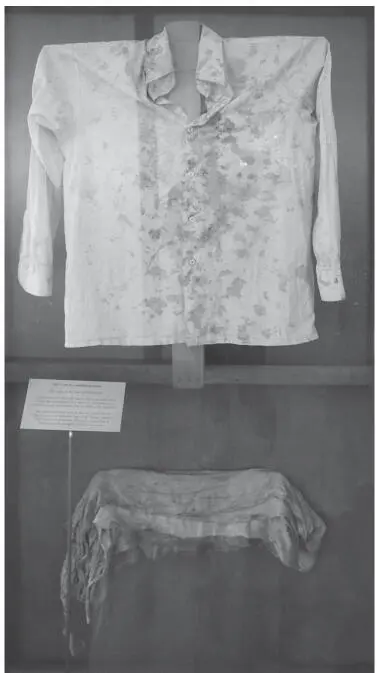
FIGURE 2.5The Tibet Museum, McLeodganj (upper Dharamsala). Gallery case showing the bloodstained shirt of an escapee from China, 2012.
Photo: Imogen Clark.
There is no mistaking it: in the elegance of its design and execution, and in the sophistication of its forms of narration and its approach to history, the Tibet Museum is a museologically up-to-date establishment that combines lessons learned from holocaust museums and participatory community museums across the world. What accounts for the presence of this theoretically sophisticated institution in Dharamsala, where the other museums that house historic artifacts are conventional and even conservative in their approach? 16
Two thousand years of exile
“The idea of Tibet Museum is influenced by the Holocaust Museum in Washington DC,” Thubten Samphel told me. Samphel is the secretary of the Department of Information and International Relations of the Tibetan government-in-exile. “In 1984 the Tibetan government-in-exile conducted a survey,” he continued: “The survey estimated that 1.2 million Tibetans had died since 1959 through direct and indirect consequences of Chinese Occupation.” But a new generation of Tibetan exiles was growing up in India with no knowledge of their homeland, and no understanding of the perils and misery that the previous generation had faced. The Tibet Museum, then, was “our attempt to pass on to the new generation of Tibetans the suffering of their parents and grandparents” (interview with Thubten Samphel, 2007).
Though the Tibet Museum may claim as its model the Holocaust Memorial Museum in Washington, DC, the impulse to make a Tibetan museum of trauma came when the Dalai Lama visited Yad Vashem in 1994. On seeing its displays, he too expressed the desire to have a similar museum that would relate the tragedy of Tibet. But, as the coordinator of the museum project recalls, the Tibetan leaders who hired him had said, “We want a Holocaust Museum. Not a Yad Vashem.” T. C. Tethong, the DIIR minister who initiated the project, felt that Yad Vashem was too strident in its message leaving the viewer with feelings of anger and despair. Instead, Tethong asked for a museum that would communicate the Tibetan tragedy, but “since the Tibetan story did not yet have an ending, he also wanted room for hope” (interview with Michael Ginguld, 2007).
On traveling to see a number of such trauma museums, Tethong and his small committee found a suitable model in the Holocaust museum in Washington, DC. And despite the great disparities in the scale of the two museums, one is able to see how the Tibet Museum echoes the narrative form of the American institution, since both museums lead viewers through tales of terrible trauma but end on a note of hope. In fact, in the brief developed for the Tibet Museum, the affective spectrum was even calibrated by its planners, with 20 percent of the narrative set aside for joy, 60 percent for pain and angst, and 20 percent for hope for the future.
Although the DIIR may have chosen the Holocaust museum in Washington as its model, the highly skilled individuals who brought new curatorial models and a refined sense of design to this museum mostly came not from the United States but from Israel, and they impressed on it the lessons they had learned from the making of Yad Vashem. The key figure connecting these two circles was Michael Ginguld, an Israeli agronomist now resident in Dharamsala. As a student, Ginguld had been backpacking through Tibet when he witnessed the 1989 Lhasa Uprising and the harsh Chinese reprisals that followed. He was invited to Dharamsala to brief the Dalai Lama on what he had seen. This encounter led to a sustained involvement with the Tibetan exile community and, for much of the time since then, Ginguld has made Dharamsala his home and has led several development projects in the area. 17
In about 1998 Ginguld was asked by the DIIR to help it set up a museum about the traumas faced by Tibet in the recent past. He plunged into the project, and was its coordinator over the next two years. Growing up in Israel, Ginguld was conversant with Israel’s many public memory projects, and had even worked in Yad Vashem as a volunteer. But now he prepared himself for this task by consulting “a stack of recent publications sent by a friend at the Smithsonian Institution … and became well-versed in issues of cultural property, access, accountability, and giving a voice to those who had been excluded in the past” (Harris 2012, 170). Ginguld set about identifying the site and the architect and developing a storyline and an aesthetic vision for the project.
As it was to be a museum dealing with somber memories, Ginguld felt it needed to be sparse and uncluttered with a limited chromatic range – so different from the vivid colors usually seen in Tibetan-themed interiors. To develop an appropriate form for the museum, he pulled together an international team of museum consultants and designers. Among them were Debby Hershman, a curator from the Israel Museum in Jerusalem; Galit Gaon, a celebrated Israeli exhibition designer and now director of the Design Museum in Holon, Israel; Yael Amit, a young Israeli curator; Markus Strumpel, a German graphic designer; and Jordhen Chazotsang, a Tibetan-origin graphic designer from Toronto. The Israeli specialists in this group had all, in one way or another, been involved with the central memorial project in Israel, Yad Vashem, and they brought with them a deeply ingrained understanding of the methods and modes of Holocaust memorialization. Drawing on their prior experience and responding to the DIIR’s needs, this group should be credited with the sophisticated display that we see in the Tibet Museum. However, Ginguld and the team of experts saw themselves only as facilitators, and the voices leading the exhibit had to come from the within the Tibetan community. Thus the 11 “speakers” of the exhibition’s sections were also asked to shape its visual narrative and become its curators (interview with Ginguld, 2007).
Читать дальшеИнтервал:
Закладка:
Похожие книги на «Museum Transformations»
Представляем Вашему вниманию похожие книги на «Museum Transformations» списком для выбора. Мы отобрали схожую по названию и смыслу литературу в надежде предоставить читателям больше вариантов отыскать новые, интересные, ещё непрочитанные произведения.





Обсуждение, отзывы о книге «Museum Transformations» и просто собственные мнения читателей. Оставьте ваши комментарии, напишите, что Вы думаете о произведении, его смысле или главных героях. Укажите что конкретно понравилось, а что нет, и почему Вы так считаете.