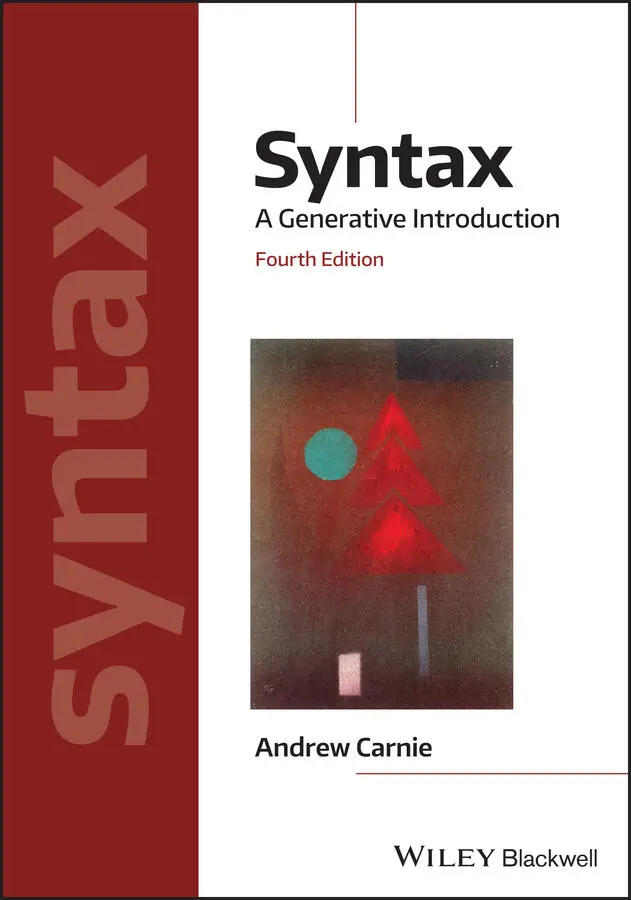
Andrew Carnie - Syntax
Здесь есть возможность читать онлайн «Andrew Carnie - Syntax» — ознакомительный отрывок электронной книги совершенно бесплатно, а после прочтения отрывка купить полную версию. В некоторых случаях можно слушать аудио, скачать через торрент в формате fb2 и присутствует краткое содержание. Жанр: unrecognised, на английском языке. Описание произведения, (предисловие) а так же отзывы посетителей доступны на портале библиотеки ЛибКат.
- Название:Syntax
- Автор:
- Жанр:
- Год:неизвестен
- ISBN:нет данных
- Рейтинг книги:4 / 5. Голосов: 1
-
Избранное:Добавить в избранное
- Отзывы:
-
Ваша оценка:
Syntax: краткое содержание, описание и аннотация
Предлагаем к чтению аннотацию, описание, краткое содержание или предисловие (зависит от того, что написал сам автор книги «Syntax»). Если вы не нашли необходимую информацию о книге — напишите в комментариях, мы постараемся отыскать её.
remains the leading introduction to the rules, principles, and processes that determine the structure of sentences in language. Comprehensive yet accessible, the text provides a well-balanced, student-friendly introduction to syntactic theory. Topics include phrase structure, the lexicon, binding theory, case theory, movement, covert movement, locality conditions, ditransitives, verbal inflection and auxiliaries, ellipsis, control theory, non-configurational languages, and more. Students are provided with numerous exercises and pedagogical features designed to strengthen comprehension, review learning objectives, test knowledge, and highlight major issues in the field.
The
features revised material throughout, including a new section on Chomsky's Merge and additional problem sets in every chapter, while new examples throughout the text broaden the appeal and relatability of the text to a more diverse set of students. The optional
has also been thoroughly revised and expanded to offer students the opportunity to practice the skills and concepts introduced in the primary text. This classic textbook:
Presents authoritative and comprehensive coverage of basic, intermediate, and advanced topics Includes ample exercises and clear explanations using straightforward language Offers extensive online student and instructor resources, including problem sets, PowerPoint slides, an updated instructor's manual, author-created videos, online-only chapters, and other supplementary material Features a wealth of learning tools, including learning objectives, discussion questions, and problems of varying levels of difficulty In the new fourth edition,
remains an essential textbook for beginning syntacticians, perfect for undergraduate and graduate course in linguistics, grammar, language, and second language teaching.
Available as a set with
, 2nd Edition
Syntax — читать онлайн ознакомительный отрывок
Ниже представлен текст книги, разбитый по страницам. Система сохранения места последней прочитанной страницы, позволяет с удобством читать онлайн бесплатно книгу «Syntax», без необходимости каждый раз заново искать на чём Вы остановились. Поставьте закладку, и сможете в любой момент перейти на страницу, на которой закончили чтение.
Интервал:
Закладка:
In syntax, hypotheses are called rules, and the group of hypotheses that describe a language’s syntax is called a grammar. The term grammar can strike terror into the hearts of people. But you should note that there are two ways to go about writing grammatical rules. One is to tell people how they should speak (this is of course the domain of English teachers and copy-editors); we call these kinds of rules prescriptive rules(as they prescribe how people should speak according to some standard). Some examples of prescriptive rules include “never end a sentence with a preposition”, “use whom not who ” and “don’t split infinitives”. These rules tell us how we are supposed to use our language. The other approach is to write rules that describe how people actually speak, whether or not they are speaking “correctly”. These are called descriptive rules. Consider for a moment the approach we’re taking in this book. Which of the two types (descriptive or prescriptive) is more scientific? Which kind of rule is more likely to give us insight into how the mind uses language? We are going to focus on descriptive rules. This doesn’t mean that prescriptive rules aren’t important (in fact, in the problem sets section of this chapter you are asked to critically examine the question of descriptive vs. prescriptive rules), but for our purposes descriptive rules are more important.
You now have enough information to answer General Problem Sets GPS1 & 2, as well as Challenge Problem Set CPS1 at the end of this chapter. For practice try Workbook Exercise WBE1 in chapter 1 of The Syntax Workbook, 2nd Edition , an optional companion book to this text .
Do Abstract Rules Really Exist?
As discussed in detail later in this chapter, the approach to grammar we are using here is supposed to be part cognitive psychology, so it’s reasonable to ask whether formal rules really exist in the brain/minds of speakers. After all, a brain is a mass of neurons firing away, so how can abstract rules exist up there? Remember, however, that we are attempting to model language; we aren’t trying to describe language exactly. This question confuses two disciplines: psychology and neurology. Psychology is concerned with the mind, which represents the output and the abstract organization of the brain.
Neurology is concerned with the actual firing of the neurons and the physiology of the brain. Our approach doesn’t try to be a theory of neurology. Instead it is a model of the psychology of language. Obviously, the rules per se don’t exist in our brains, but they do model the external behavior of the mind. For more discussion of this issue, look at the readings in the further reading section of this chapter.
3.1 An Example of the Scientific Method as Applied to Syntax
Let’s turn now to a real-world application of the scientific method to some language data. The following data concern the form of a specific kind of noun, called an anaphor(plural: anaphors; the phenomenon is called anaphora). These include the nouns that end with - self (e.g., himself, herself, itself ). In chapter 5, we look at the distribution of anaphors in detail; here we’ll only consider one superficial aspect of them. In the following sentences, as is standard in the syntactic literature, a sentence that isn’t well-formed is marked with an asterisk(*) before it. For these sentences assume that Bill is male and Sally is female.
2)
1 Bill kissed himself.
2 *Bill kissed herself.
3 Sally kissed herself.
4 *Sally kissed himself.
5 *Kiss himself.
Under the assumption that Bill is a cisgender male and Sally is a cisgender female, the ill- formed sentences in (2b and d) just look silly. It is obvious that Bill can’t kiss herself, because Bill is male. There is a clear generalization about the distribution of anaphors here. In particular, the generalization we can draw about the sentences in (2) is that an anaphor must agree in grammatical genderwith the noun it refers to (its antecedent). So. in (2a & b) we see that the anaphor must agree in gender with Bill , its antecedent. The anaphor must take the masculine form himself . The situation in (2c & d) is the same; the anaphor must take the form herself so that it agrees in gender with the feminine Sally . Note further that a sentence like (2e) shows us that anaphors must have an antecedent. An anaphor without an antecedent is unacceptable. A plausible hypothesis (or rule) given the data in (2), then, is stated in (3):
3) An anaphor must (i) have an antecedent and (ii) agree in grammatical gender (masculine, feminine, or neuter) with that antecedent.
The next step in the scientific method is to test this hypothesis against more data. Consider the additional data in (4):
4)
1 The robot kissed itself.
2 She knocked herself on the head with a zucchini.
3 *She knocked himself on the head with a zucchini.
4 The snake flattened itself against the rock.
5 ?The snake flattened himself/herself against the rock.
6 The Joneses think themselves the best family on the block.
7 *The Joneses think himself the wealthiest guy on the block.
8 Gary and Kevin ran themselves into exhaustion.
9 *Gary and Kevin ran himself into exhaustion.
Grammatical Gender vs. Sex vs. Personal Gender
Gender can be a politically charged and deeply personal issue for many people. In this chapter, I am talking about primarily about grammatical gender. Grammatical gender is often confused with sex assigned at birth and with the gender identity/expression of the individual. This is because people often use grammatical gender to signal their sex or gender identity to others. But in the context that I’m using it here, it’s a purely formal feature of words. In many languages grammatical gender, also called noun class, has nothing to with actual sex or gender identity. For example, in Navajo grammatical gender is determined by shape, consistency and animacy and is quite distinct from their cultural understanding of gender identity. In other languages, grammatical gender does not need to correspond to gender expression – it can even be the opposite. In Modern Irish, for example, the word cailín ‘girl’ is masculine and the word stail ‘stallion’ is feminine.
Despite the objections of prescriptive language gurus, English has long used the pronoun they to refer to humans in a gender-neutral way. Recently this usage has been extended more regularly to people whose gender identity is non-binary. This new usage has some really interesting effects on the phenomenon of anaphora – in particular a new anaphor, themself , has been added to the grammatical system of many people, particularly younger speakers. General Problem Set GPS3 gives you a chance to explore the interplay of grammatical gender and personal gender with English anaphora and verb agreement.
Sentences (4a, b, & c) are all consistent with our hypothesis that anaphors must agree in gender with their antecedents, which at least confirms that the hypothesis is on the right track. What about the data in (4d & e)? It appears as if any gender is compatible with the antecedent the snake . This appears, on the surface, to be a contradiction to our hypothesis. Think about these examples a little more closely, however. Whether sentence (4e) is well- formed or not depends upon your assumptions about the gender of the snake. If you assume (or know) the snake to be male, then The snake flattened himself against the rock is perfectly well-formed. But under the same assumption, the sentence The snake flattened herself against the rock seems very odd indeed, although it is fine if you assume the snake is female. So, it appears as if this example also meets the generalization in (3); the vagueness about its well-formedness has to do with the fact that we are rarely sure what gender a snake is and not about the actual structure of the sentence.
Читать дальшеИнтервал:
Закладка:
Похожие книги на «Syntax»
Представляем Вашему вниманию похожие книги на «Syntax» списком для выбора. Мы отобрали схожую по названию и смыслу литературу в надежде предоставить читателям больше вариантов отыскать новые, интересные, ещё непрочитанные произведения.









Обсуждение, отзывы о книге «Syntax» и просто собственные мнения читателей. Оставьте ваши комментарии, напишите, что Вы думаете о произведении, его смысле или главных героях. Укажите что конкретно понравилось, а что нет, и почему Вы так считаете.