Bioethics
Здесь есть возможность читать онлайн «Bioethics» — ознакомительный отрывок электронной книги совершенно бесплатно, а после прочтения отрывка купить полную версию. В некоторых случаях можно слушать аудио, скачать через торрент в формате fb2 и присутствует краткое содержание. Жанр: unrecognised, на английском языке. Описание произведения, (предисловие) а так же отзывы посетителей доступны на портале библиотеки ЛибКат.
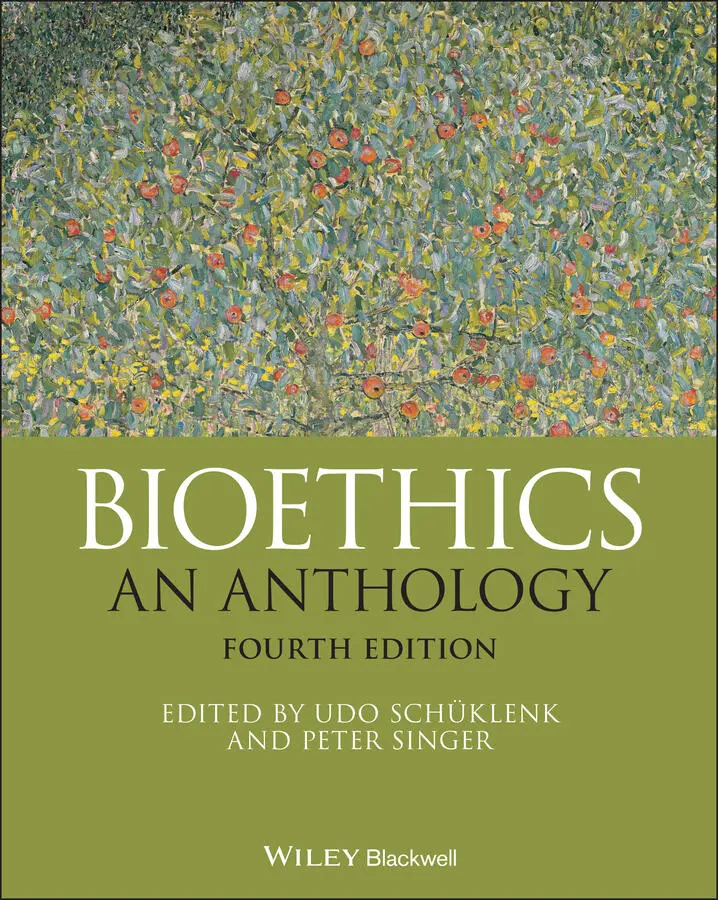
- Название:Bioethics
- Автор:
- Жанр:
- Год:неизвестен
- ISBN:нет данных
- Рейтинг книги:4 / 5. Голосов: 1
-
Избранное:Добавить в избранное
- Отзывы:
-
Ваша оценка:
Bioethics: краткое содержание, описание и аннотация
Предлагаем к чтению аннотацию, описание, краткое содержание или предисловие (зависит от того, что написал сам автор книги «Bioethics»). Если вы не нашли необходимую информацию о книге — напишите в комментариях, мы постараемся отыскать её.
For more than two decades,
has been widely regarded as the definitive single-volume compendium of seminal readings on both traditional and cutting-edge ethical issues in biology and medicine. Acclaimed for its scope and depth of coverage, this landmark work brings together compelling writings by internationally-renowned bioethicist to help readers develop a thorough understanding of the central ideas, critical issues, and current debate in the field.
Now fully revised and updated, the fourth edition contains a wealth of new content on ethical questions and controversies related to the COVID-19 pandemic, advances in CRISPR gene editing technology, physician-assisted death, public health and vaccinations, transgender children, medical aid in dying, the morality of ending the lives of newborns, and much more. Throughout the new edition, carefully selected essays explore a wide range of topics and offer diverse perspectives that underscore the interdisciplinary nature of bioethical study. Edited by two of the field’s most respected scholars, Covers an unparalleled range of thematically-organized topics in a single volume Discusses recent high-profile cases, debates, and ethical issues Features three brand-new sections: Conscientious Objection, Academic Freedom and Research, and Disability Contains new essays on topics such as brain death, life and death decisions for the critically ill, experiments on humans and animals, neuroethics, and the use of drugs to ease the pain of unrequited love Includes a detailed index that allows the reader to easily find terms and topics of interest
remains a must-have resource for all students, lecturers, and researchers studying the ethical implications of the health-related life sciences, and an invaluable reference for doctors, nurses, and other professionals working in health care and the biomedical sciences.
Bioethics — читать онлайн ознакомительный отрывок
Ниже представлен текст книги, разбитый по страницам. Система сохранения места последней прочитанной страницы, позволяет с удобством читать онлайн бесплатно книгу «Bioethics», без необходимости каждый раз заново искать на чём Вы остановились. Поставьте закладку, и сможете в любой момент перейти на страницу, на которой закончили чтение.
Интервал:
Закладка:
What property might account for such a difference? That is to say, what basic moral principles might a person who accepts one of these five principles appeal to in support of his secondary moral judgment? Why should events such as the achievement of human form, or the achievement of the ability to move about, or the achievement of viability, or birth serve to endow something with a right to life? What the liberal must do is to show that these events involve changes, or are associated with changes, that are morally relevant.
Let us now consider reasons why the events involved in cutoff points (b) through (e) are not morally relevant, beginning with the last two: viability and birth. The fact that an organism is not physiologically dependent upon another organism, or is capable of such physiological independence, is surely irrelevant to whether the organism has a right to life. In defense of this contention, consider a speculative case where a fetus is able to learn a language while in the womb. One would surely not say that the fetus had no right to life until it emerged from the womb, or until it was capable of existing outside the womb. A less speculative example is the case of Siamese twins who have learned to speak. One doesn’t want to say that since one of the twins would die were the two to be separated, it therefore has no right to life. Consequently it seems difficult to disagree with the conservative’s claim that an organism which lacks a right to life before birth or before becoming viable cannot acquire this right immediately upon birth or upon becoming viable.
This does not, however, completely rule out viability as a line of demarcation. For instead of defending viability as a cutoff point on the ground that only then does a fetus acquire a right to life, it is possible to argue rather that when one organism is physiologically dependent upon another, the former’s right to life may conflict with the latter’s right to use its body as it will, and moreover, that the latter’s right to do what it wants with its body may often take precedence over the other organism’s right to life. Thomson has defended this view: “I am arguing only that having a right to life does not guarantee having either a right to the use of or a right to be allowed continued use of another person’s body – even if one needs it for life itself. So the right to life will not serve the opponents of abortion in the very simple and clear way in which they seem to have thought it would.” 20 I believe that Thomson is right in contending that philosophers have been altogether too casual in assuming that if one grants the fetus a serious right to life, one must accept a conservative position on abortion. 21 I also think the only defense of viability as a cutoff point which has any hope of success at all is one based on the considerations she advances. I doubt very much, however, that this defense of abortion is ultimately tenable. I think that one can grant even stronger assumptions than those made by Thomson and still argue persuasively for a semiconservative view. What I have in mind is this. Let it be granted, for the sake of argument, that a woman’s right to free her body of parasites which will inhibit her freedom of action and possibly impair her health is stronger than the parasite’s right to life, and is so even if the parasite has as much right to life as an adult human. One can still argue that abortion ought not to be permitted. For if A’s right is stronger than B’s, and it is impossible to satisfy both, it does not follow that A’s should be satisfied rather than B’s. It may be possible to compensate A if his right isn’t satisfied, but impossible to compensate B if his right isn’t satisfied. In such a case the best thing to do may be to satisfy B’s claim and to compensate A. Abortion may be a case in point. If the fetus has a right to life and the right is not satisfied, there is certainly no way the fetus can be compensated. On the other hand, if the woman’s right to rid her body of harmful and annoying parasites is not satisfied, she can be compensated. Thus it would seem that the just thing to do would be to prohibit abortion, but to compensate women for the burden of carrying a parasite to term. Then, however, we are back at a (modified) conservative position. 22 Our conclusion must be that it appears unlikely there is any satisfactory defense either of viability or of birth as cutoff points.
Let us now consider the third suggested line of demarcation, the achievement of the power to move about spontaneously. It might be argued that acquiring this power is a morally relevant event on the grounds that there is a connection between the concept of an agent and the concept of a person, and being motile is an indication that a thing is an agent. 23
It is difficult to respond to this suggestion unless it is made more specific. Given that one’s interest here is in defending a certain cutoff point, it is natural to interpret the proposal as suggesting that motility is a necessary condition of an organism’s having a right to life. But this won’t do, because one certainly wants to ascribe a right to life to adult humans who are completely paralyzed. Maybe the suggestion is rather that motility is a sufficient condition of something’s having a right to life. However, it is clear that motility alone is not sufficient, since this would imply that all animals, and also certain machines, have a right to life. Perhaps, then, the most reasonable interpretation of the claim is that motility together with some other property is a sufficient condition of something’s having a right to life, where the other property will have to be a property possessed by unborn members of the species Homo sapiens but not by unborn members of other familiar species.
The central question, then, is what this other property is. Until one is told, it is very difficult to evaluate either the moral claim that motility together with that property is a sufficient basis for ascribing to an organism a right to life or the factual claim that a motile human fetus possesses that property while a motile fetus belonging to some other species does not. A conservative would presumably reject motility as a cutoff point by arguing that whether an organism has a right to life depends only upon its potentialities, which are of course not changed by its becoming motile. If, on the other hand, one favors a liberal view of abortion, I think that one can attack this third suggested cutoff point, in its unspecified form, only by determining what properties are necessary, or what properties sufficient, for an individual to have a right to life. Thus I would base my rejection of motility as a cutoff point on my claim, defended above, that a necessary condition of an organism’s possessing a right to life is that it conceive of itself as a continuing subject of experiences and other mental states.
The second suggested cutoff point – the development of a recognizably human form – can be dismissed fairly quickly. I have already remarked that membership in a particular species is not itself a morally relevant property. For it is obvious that if we encountered other “rational animals,” such as Martians, the fact that their physiological makeup was very different from our own would not be grounds for denying them a right to life. 24 Similarly, it is clear that the development of human form is not in itself a morally relevant event. Nor do there seem to be any grounds for holding that there is some other change, associated with this event, that is morally relevant. The appeal of this second cutoff point is, I think, purely emotional.
The overall conclusion seems to be that it is very difficult to defend the cutoff points traditionally advanced by those who advocate either a moderate or a liberal position on abortion. The reason is that there do not seem to be any basic moral principles one can appeal to in support of the cutoff points in question. We must now consider whether the conservative is any better off.
Читать дальшеИнтервал:
Закладка:
Похожие книги на «Bioethics»
Представляем Вашему вниманию похожие книги на «Bioethics» списком для выбора. Мы отобрали схожую по названию и смыслу литературу в надежде предоставить читателям больше вариантов отыскать новые, интересные, ещё непрочитанные произведения.

Обсуждение, отзывы о книге «Bioethics» и просто собственные мнения читателей. Оставьте ваши комментарии, напишите, что Вы думаете о произведении, его смысле или главных героях. Укажите что конкретно понравилось, а что нет, и почему Вы так считаете.