Bioethics
Здесь есть возможность читать онлайн «Bioethics» — ознакомительный отрывок электронной книги совершенно бесплатно, а после прочтения отрывка купить полную версию. В некоторых случаях можно слушать аудио, скачать через торрент в формате fb2 и присутствует краткое содержание. Жанр: unrecognised, на английском языке. Описание произведения, (предисловие) а так же отзывы посетителей доступны на портале библиотеки ЛибКат.
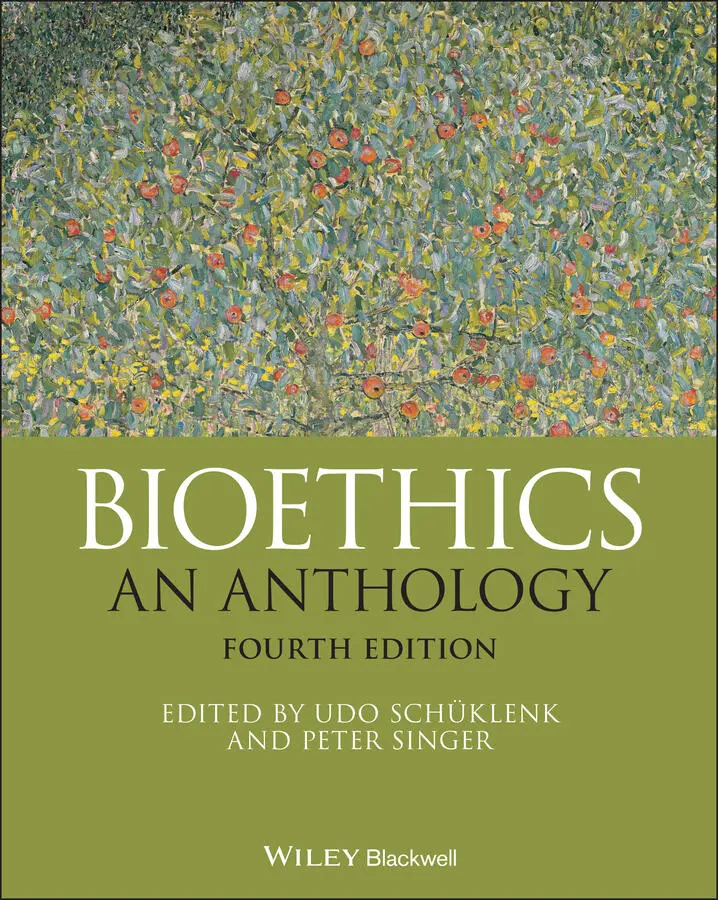
- Название:Bioethics
- Автор:
- Жанр:
- Год:неизвестен
- ISBN:нет данных
- Рейтинг книги:4 / 5. Голосов: 1
-
Избранное:Добавить в избранное
- Отзывы:
-
Ваша оценка:
Bioethics: краткое содержание, описание и аннотация
Предлагаем к чтению аннотацию, описание, краткое содержание или предисловие (зависит от того, что написал сам автор книги «Bioethics»). Если вы не нашли необходимую информацию о книге — напишите в комментариях, мы постараемся отыскать её.
For more than two decades,
has been widely regarded as the definitive single-volume compendium of seminal readings on both traditional and cutting-edge ethical issues in biology and medicine. Acclaimed for its scope and depth of coverage, this landmark work brings together compelling writings by internationally-renowned bioethicist to help readers develop a thorough understanding of the central ideas, critical issues, and current debate in the field.
Now fully revised and updated, the fourth edition contains a wealth of new content on ethical questions and controversies related to the COVID-19 pandemic, advances in CRISPR gene editing technology, physician-assisted death, public health and vaccinations, transgender children, medical aid in dying, the morality of ending the lives of newborns, and much more. Throughout the new edition, carefully selected essays explore a wide range of topics and offer diverse perspectives that underscore the interdisciplinary nature of bioethical study. Edited by two of the field’s most respected scholars, Covers an unparalleled range of thematically-organized topics in a single volume Discusses recent high-profile cases, debates, and ethical issues Features three brand-new sections: Conscientious Objection, Academic Freedom and Research, and Disability Contains new essays on topics such as brain death, life and death decisions for the critically ill, experiments on humans and animals, neuroethics, and the use of drugs to ease the pain of unrequited love Includes a detailed index that allows the reader to easily find terms and topics of interest
remains a must-have resource for all students, lecturers, and researchers studying the ethical implications of the health-related life sciences, and an invaluable reference for doctors, nurses, and other professionals working in health care and the biomedical sciences.
Bioethics — читать онлайн ознакомительный отрывок
Ниже представлен текст книги, разбитый по страницам. Система сохранения места последней прочитанной страницы, позволяет с удобством читать онлайн бесплатно книгу «Bioethics», без необходимости каждый раз заново искать на чём Вы остановились. Поставьте закладку, и сможете в любой момент перейти на страницу, на которой закончили чтение.
Интервал:
Закладка:
I do not share the general pessimism about the possibility of resolving the issue of abortion and infanticide because I believe it is possible to point to a very plausible moral principle dealing with the question of necessary conditions for something’s having a right to life, where the conditions in question will provide an answer to the question of the permissibility of abortion and infanticide.
There is a second cause of pessimism that should be noted before proceeding. It is tied up with the fact that the development of an organism is one of gradual and continuous change. Given this continuity, how is one to draw a line at one point and declare it permissible to destroy a member of Homo sapiens up to, but not beyond, that point? Won’t there be an arbitrariness about any point that is chosen? I will return to this worry shortly. It does not present a serious difficulty once the basic moral principles relevant to the ascription of a right to life to an individual are established.
Let us turn now to the first and most fundamental question: What properties must something have in order to be a person, i.e., to have a serious right to life? The claim I wish to defend is this: An organism possesses a serious right to life only if it possesses the concept of a self as a continuing subject of experiences and other mental states, and believes that it is itself such a continuing entity.
My basic argument in support of this claim, which I will call the self‐consciousness requirement, will be clearest, I think, if I first offer a simplified version of the argument, and then consider a modification that seems desirable. The simplified version of my argument is this. To ascribe a right to an individual is to assert something about the prima facie obligations of other individuals to act, or to refrain from acting, in certain ways. However, the obligations in question are conditional ones, being dependent upon the existence of certain desires of the individual to whom the right is ascribed. Thus if an individual asks one to destroy something to which he has a right, one does not violate his right to that thing if one proceeds to destroy it. This suggests the following analysis: “A has a right to X” is roughly synonymous with “If A desires X, then others are under a prima facie obligation to refrain from actions that would deprive him of it.” 16
Although this analysis is initially plausible, there are reasons for thinking it not entirely correct. I will consider these later. Even here, however, some expansion is necessary, since there are features of the concept of a right that are important in the present context, and that ought to be dealt with more explicitly. In particular, it seems to be a conceptual truth that things that lack consciousness, such as ordinary machines, cannot have rights. Does this conceptual truth follow from the above analysis of the concept of a right? The answer depends on how the term “desire” is interpreted. If one adopts a completely behavioristic interpretation of “desire,” so that a machine that searches for an electrical outlet in order to get its batteries recharged is described as having a desire to be recharged, then it will not follow from this analysis that objects that lack consciousness cannot have rights. On the other hand, if “desire” is interpreted in such a way that desires are states necessarily standing in some sort of relationship to states of consciousness, it will follow from the analysis that a machine that is not capable of being conscious, and consequently of having desires, cannot have any rights. I think those who defend analyses of the concept of a right along the lines of this one do have in mind an interpretation of the term “desire” that involves reference to something more than behavioral dispositions. However, rather than relying on this, it seems preferable to make such an interpretation explicit. The following analysis is a natural way of doing that: “A has a right to X” is roughly synonymous with “A is the sort of thing that is a subject of experiences and other mental states, A is capable of desiring X, and if A does desire X, then others are under a prima facie obligation to refrain from actions that would deprive him of it.”
The next step in the argument is basically a matter of applying this analysis to the concept of a right to life. Unfortunately the expression “right to life” is not entirely a happy one, since it suggests that the right in question concerns the continued existence of a biological organism. That this is incorrect can be brought out by considering possible ways of violating an individual’s right to life. Suppose, for example, that by some technology of the future the brain of an adult human were to be completely reprogrammed, so that the organism wound up with memories (or rather, apparent memories), beliefs, attitudes, and personality traits completely different from those associated with it before it was subjected to reprogramming. In such a case one would surely say that an individual had been destroyed, that an adult human’s right to life had been violated, even though no biological organism had been killed. This example shows that the expression “right to life” is misleading, since what one is really concerned about is not just the continued existence of a biological organism, but the right of a subject of experiences and other mental states to continue to exist.
Given this more precise description of the right with which we are here concerned, we are now in a position to apply the analysis of the concept of a right stated above. When we do so we find that the statement “A has a right to continue to exist as a subject of experiences and other mental states” is roughly synonymous with the statement “A is a subject of experiences and other mental states, A is capable of desiring to continue to exist as a subject of experiences and other mental states, and if A does desire to continue to exist as such an entity, then others are under a prima facie obligation not to prevent him from doing so.”
The final stage in the argument is simply a matter of asking what must be the case if something is to be capable of having a desire to continue existing as a subject of experiences and other mental states. The basic point here is that the desires a thing can have are limited by the concepts it possesses. For the fundamental way of describing a given desire is as a desire that a certain proposition be true. 17 Then, since one cannot desire that a certain proposition be true unless one understands it, and since one cannot understand it without possessing the concepts involved in it, it follows that the desires one can have are limited by the concepts one possesses. Applying this to the present case results in the conclusion that an entity cannot be the sort of thing that can desire that a subject of experiences and other mental states exist unless it possesses the concept of such a subject. Moreover, an entity cannot desire that it itself continue existing as a subject of experiences and other mental states unless it believes that it is now such a subject. This completes the justification of the claim that it is a necessary condition of something’s having a serious right to life that it possess the concept of a self as a continuing subject of experiences, and that it believe that it is itself such an entity.
Let us now consider a modification in the above argument that seems desirable. This modification concerns the crucial conceptual claim advanced about the relationship between ascription of rights and ascription of the corresponding desires. Certain situations suggest that there may be exceptions to the claim that if a person doesn’t desire something, one cannot violate his right to it. There are three types of situations that call this claim into question: (i) situations in which an individual’s desires reflect a state of emotional disturbance; (ii) situations in which a previously conscious individual is temporarily unconscious; (iii) situations in which an individual’s desires have been distorted by conditioning or by indoctrination.
Читать дальшеИнтервал:
Закладка:
Похожие книги на «Bioethics»
Представляем Вашему вниманию похожие книги на «Bioethics» списком для выбора. Мы отобрали схожую по названию и смыслу литературу в надежде предоставить читателям больше вариантов отыскать новые, интересные, ещё непрочитанные произведения.

Обсуждение, отзывы о книге «Bioethics» и просто собственные мнения читателей. Оставьте ваши комментарии, напишите, что Вы думаете о произведении, его смысле или главных героях. Укажите что конкретно понравилось, а что нет, и почему Вы так считаете.