Bioethics
Здесь есть возможность читать онлайн «Bioethics» — ознакомительный отрывок электронной книги совершенно бесплатно, а после прочтения отрывка купить полную версию. В некоторых случаях можно слушать аудио, скачать через торрент в формате fb2 и присутствует краткое содержание. Жанр: unrecognised, на английском языке. Описание произведения, (предисловие) а так же отзывы посетителей доступны на портале библиотеки ЛибКат.
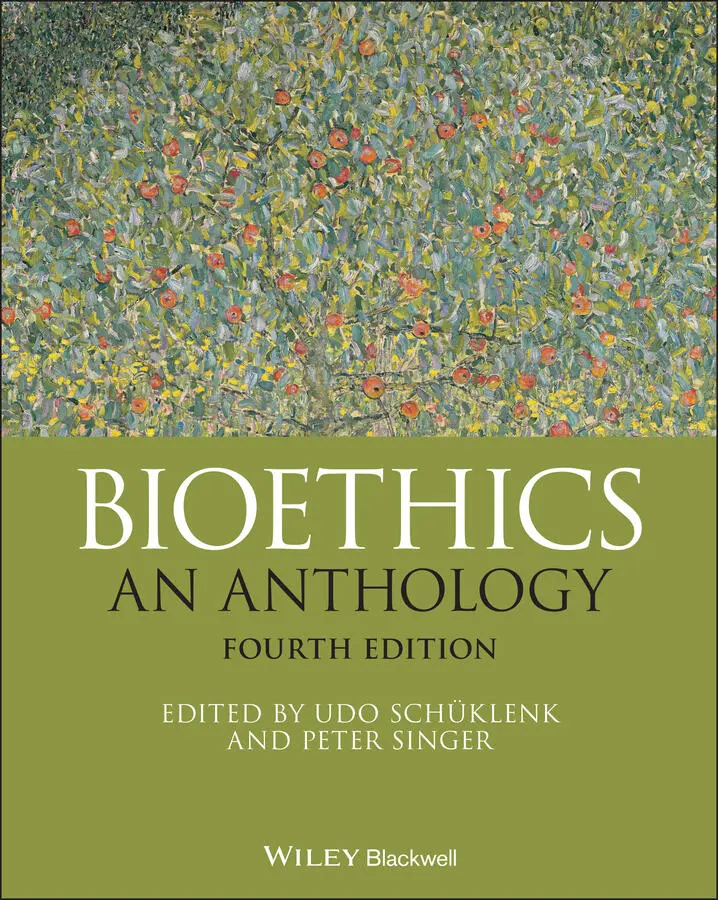
- Название:Bioethics
- Автор:
- Жанр:
- Год:неизвестен
- ISBN:нет данных
- Рейтинг книги:4 / 5. Голосов: 1
-
Избранное:Добавить в избранное
- Отзывы:
-
Ваша оценка:
Bioethics: краткое содержание, описание и аннотация
Предлагаем к чтению аннотацию, описание, краткое содержание или предисловие (зависит от того, что написал сам автор книги «Bioethics»). Если вы не нашли необходимую информацию о книге — напишите в комментариях, мы постараемся отыскать её.
For more than two decades,
has been widely regarded as the definitive single-volume compendium of seminal readings on both traditional and cutting-edge ethical issues in biology and medicine. Acclaimed for its scope and depth of coverage, this landmark work brings together compelling writings by internationally-renowned bioethicist to help readers develop a thorough understanding of the central ideas, critical issues, and current debate in the field.
Now fully revised and updated, the fourth edition contains a wealth of new content on ethical questions and controversies related to the COVID-19 pandemic, advances in CRISPR gene editing technology, physician-assisted death, public health and vaccinations, transgender children, medical aid in dying, the morality of ending the lives of newborns, and much more. Throughout the new edition, carefully selected essays explore a wide range of topics and offer diverse perspectives that underscore the interdisciplinary nature of bioethical study. Edited by two of the field’s most respected scholars, Covers an unparalleled range of thematically-organized topics in a single volume Discusses recent high-profile cases, debates, and ethical issues Features three brand-new sections: Conscientious Objection, Academic Freedom and Research, and Disability Contains new essays on topics such as brain death, life and death decisions for the critically ill, experiments on humans and animals, neuroethics, and the use of drugs to ease the pain of unrequited love Includes a detailed index that allows the reader to easily find terms and topics of interest
remains a must-have resource for all students, lecturers, and researchers studying the ethical implications of the health-related life sciences, and an invaluable reference for doctors, nurses, and other professionals working in health care and the biomedical sciences.
Bioethics — читать онлайн ознакомительный отрывок
Ниже представлен текст книги, разбитый по страницам. Система сохранения места последней прочитанной страницы, позволяет с удобством читать онлайн бесплатно книгу «Bioethics», без необходимости каждый раз заново искать на чём Вы остановились. Поставьте закладку, и сможете в любой момент перейти на страницу, на которой закончили чтение.
Интервал:
Закладка:
How is the term “person” to be interpreted? I shall treat the concept of a person as a purely moral concept, free of all descriptive content. Specifically, in my usage the sentence “X is a person” will be synonymous with the sentence “X has a (serious) moral right to life.”
This usage diverges slightly from what is perhaps the more common way of interpreting the term “person” when it is employed as a purely moral term, where to say that X is a person is to say that X has rights. If everything that had rights had a right to life, these interpretations would be extensionally equivalent. But I am inclined to think that it does not follow from acceptable moral principles that whatever has any rights at all has a right to life. My reason is this. Given the choice between being killed and being tortured for an hour, most adult humans would surely choose the latter. So it seems plausible to say it is worse to kill an adult human being than it is to torture him for an hour. In contrast, it seems to me that while it is not seriously wrong to kill a newborn kitten, it is seriously wrong to torture one for an hour. This suggests that newborn kittens may have a right not to be tortured without having a serious right to life. For it seems to be true that an individual has a right to something whenever it is the case that, if he wants that thing, it would be wrong for others to deprive him of it. Then if it is wrong to inflict a certain sensation upon a kitten if it doesn’t want to experience that sensation, it will follow that the kitten has a right not to have sensation inflicted upon it. 6 I shall return to this example later. My point here is merely that it provides some reason for holding that it does not follow from acceptable moral principles that if something has any rights at all, it has a serious right to life.
There has been a tendency in recent discussions of abortion to use expressions such as “person” and “human being” interchangeably. B. A. Brody, for example, refers to the difficulty of determining “whether destroying the foetus constitutes the taking of a human life,” and suggests it is very plausible that “the taking of a human life is an action that has bad consequences for him whose life is being taken.” 7 When Brody refers to something as a human life he apparently construes this as entailing that the thing is a person. For if every living organism belonging to the species Homo sapiens counted as a human life, there would be no difficulty in determining whether a fetus inside a human mother was a human life.
The same tendency is found in Judith Jarvis Thomson’s article, which opens with the statement: “Most opposition to abortion relies on the premise that the fetus is a human being, a person, from the moment of conception.” 8 The same is true of Roger Wertheimer, who explicitly says: “First off I should note that the expressions ‘a human life,’ ‘a human being,’ ‘a person’ are virtually interchangeable in this context.” 9
The tendency to use expressions like “person” and “human being” interchangeably is an unfortunate one. For one thing, it tends to lend covert support to antiabortionist positions. Given such usage, one who holds a liberal view of abortion is put in the position of maintaining that fetuses, at least up to a certain point, are not human beings. Even philosophers are led astray by this usage. Thus Wertheimer says that “except for monstrosities, every member of our species is indubitably a person, a human being, at the very latest at birth.” 10 Is it really indubitable that newborn babies are persons? Surely this is a wild contention. Wertheimer is falling prey to the confusion naturally engendered by the practice of using “person” and “human being” interchangeably. Another example of this is provided by Thomson: “I am inclined to think also that we shall probably have to agree that the fetus has already become a human person well before birth. Indeed, it comes as a surprise when one first learns how early in its life it begins to acquire human characteristics. By the tenth week, for example, it already has a face, arms and legs, fingers and toes; it has internal organs, and brain activity is detectable.” 11 But what do such physiological characteristics have to do with the question of whether the organism is a person? Thomson, partly, I think, because of the unfortunate use of terminology, does not even raise this question. As a result she virtually takes it for granted that there are some cases in which abortion is “positively indecent.” 12
There is a second reason why using “person” and “human being” interchangeably is unhappy philosophically. If one says that the dispute between pro‐ and anti‐abortionists centers on whether the fetus is a human, it is natural to conclude that it is essentially a disagreement about certain facts, a disagreement about what properties a fetus possesses. Thus Wertheimer says that “if one insists on using the raggy fact–value distinction, then one ought to say that the dispute is over a matter of fact in the sense in which it is a fact that the Negro slaves were human beings.” 13 I shall argue that the two cases are not parallel, and that in the case of abortion what is primarily at stake is what moral principles one should accept. If one says that the central issue between conservatives and liberals in the abortion question is whether the fetus is a person, it is clear that the dispute may be either about what properties a thing must have in order to be a person, in order to have a right to life – a moral question – or about whether a fetus at a given stage of development as a matter of fact possesses the properties in question. The temptation to suppose that the disagreement must be a factual one is removed.
It should now be clear why the common practice of using expressions such as “person” and “human being” interchangeably in discussions of abortion is unfortunate. It would perhaps be best to avoid the term “human” altogether, employing instead some expression that is more naturally interpreted as referring to a certain type of biological organism characterized in physiological terms, such as “member of the species Homo sapiens .” My own approach will be to use the term “human” only in contexts where it is not philosophically dangerous.
III The Basic Issue: When is a Member of the Species Homo sapiens a Person?
Settling the issue of the morality of abortion and infanticide will involve answering the following questions: What properties must something have to be a person, i.e., to have a serious right to life? At what point in the development of a member of the species Homo sapiens does the organism possess the properties that make it a person? The first question raises a moral issue. To answer it is to decide what basic 14 moral principles involving the ascription of a right to life one ought to accept. The second question raises a purely factual issue, since the properties in question are properties of a purely descriptive sort.
Some writers seem quite pessimistic about the possibility of resolving the question of the morality of abortion. Indeed, some have gone so far as to suggest that the question of whether the fetus is a person is in principle unanswerable: “we seem to be stuck with the indeterminateness of the fetus’ humanity.” 15 An understanding of some of the sources of this pessimism will, I think, help us to tackle the problem. Let us begin by considering the similarity a number of people have noted between the issue of abortion and the issue of Negro slavery. The question here is why it should be more difficult to decide whether abortion and infanticide are acceptable than it was to decide whether slavery was acceptable. The answer seems to be that in the case of slavery there are moral principles of a quite uncontroversial sort that settle the issue. Thus most people would agree to some such principle as the following: No organism that has experiences, that is capable of thought and of using language, and that has harmed no one, should be made a slave. In the case of abortion, on the other hand, conditions that are generally agreed to be sufficient grounds for ascribing a right to life to something do not suffice to settle the issue. It is easy to specify other, purportedly sufficient conditions that will settle the issue, but no one has been successful in putting forward considerations that will convince others to accept those additional moral principles.
Читать дальшеИнтервал:
Закладка:
Похожие книги на «Bioethics»
Представляем Вашему вниманию похожие книги на «Bioethics» списком для выбора. Мы отобрали схожую по названию и смыслу литературу в надежде предоставить читателям больше вариантов отыскать новые, интересные, ещё непрочитанные произведения.

Обсуждение, отзывы о книге «Bioethics» и просто собственные мнения читателей. Оставьте ваши комментарии, напишите, что Вы думаете о произведении, его смысле или главных героях. Укажите что конкретно понравилось, а что нет, и почему Вы так считаете.