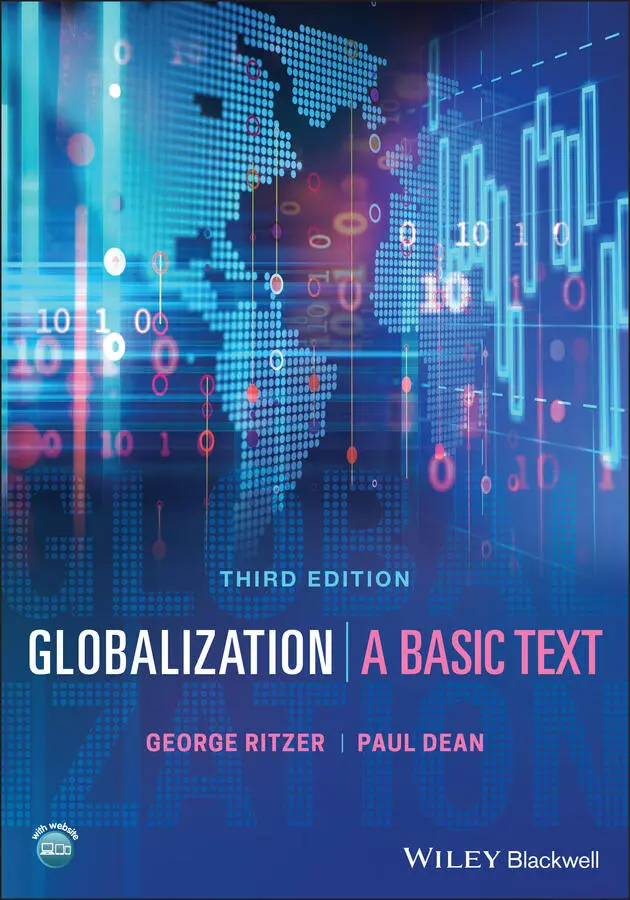
George Ritzer - Globalization
Здесь есть возможность читать онлайн «George Ritzer - Globalization» — ознакомительный отрывок электронной книги совершенно бесплатно, а после прочтения отрывка купить полную версию. В некоторых случаях можно слушать аудио, скачать через торрент в формате fb2 и присутствует краткое содержание. Жанр: unrecognised, на английском языке. Описание произведения, (предисловие) а так же отзывы посетителей доступны на портале библиотеки ЛибКат.
- Название:Globalization
- Автор:
- Жанр:
- Год:неизвестен
- ISBN:нет данных
- Рейтинг книги:3 / 5. Голосов: 1
-
Избранное:Добавить в избранное
- Отзывы:
-
Ваша оценка:
Globalization: краткое содержание, описание и аннотация
Предлагаем к чтению аннотацию, описание, краткое содержание или предисловие (зависит от того, что написал сам автор книги «Globalization»). Если вы не нашли необходимую информацию о книге — напишите в комментариях, мы постараемся отыскать её.
, distinguished researchers and authors George Ritzer and Paul Dean deliver an up-to-date introduction to major trends and topics related to the study of globalization. The book includes accessible and rigorous material on the key theories and major topics in globalization, as well as modern developments like the rise of populism and far-right political groups, Brexit, migration and backlash to it, trade negotiations, social media and the spread of misinformation, climate change, social justice issues, and COVID-19.
The new edition includes a greater focus on the structures of inequality that encourage or discourage global flows. Additionally, new examples and sources from Central and South America, Africa, and Asia are used to illustrate key concepts, and round out the international coverage of book. Throughout, the authors use clear and helpful metaphors including solids, liquids, gases, and flows to introduce and explain the complex nature of globalization in an engaging and understandable way.
Readers will also benefit from the inclusion of:
A thorough introduction to globalization and related processes, including imperialism, colonialism, development, and westernization An exploration of neoliberalism, including its roots, principles, criticisms, and Neo-Marxist alternatives A practical discussion of global political structures and processes, as well as global economic flows of production and consumption A concise treatment of negative global flows and processes, including dangerous imports, diseases, crime, terrorism, and war Analysis of the changing nature of globalization and de-globalization, and the social movements and technological developments driving these changes More images, charts, and graphs to help illustrate and highlight the concepts contained in the book Perfect for advanced undergraduates studying globalization across sociology, political science, geography, anthropology, and economics,
will also be essential reading for students taking courses in culture, economy and inequality, and migration taught from a global perspective.
Globalization — читать онлайн ознакомительный отрывок
Ниже представлен текст книги, разбитый по страницам. Система сохранения места последней прочитанной страницы, позволяет с удобством читать онлайн бесплатно книгу «Globalization», без необходимости каждый раз заново искать на чём Вы остановились. Поставьте закладку, и сможете в любой момент перейти на страницу, на которой закончили чтение.
Интервал:
Закладка:
THE ERA OF THE “POSTS”
We have already had occasion to mention postcolonization in the context of a discussion of colonization. However, it is also possible to argue that almost all of the processes discussed in this chapter can be described as being in the “era of the posts.” That is, they have passed into history, passed their prime, or are showing signs of moving into the past tense. Most, if not all, of them remain important, but what is also important are the signs of their passage into history. Thus, we could talk in terms (and many do) of post-imperialism, postcolonialism, post-development, post-Easternization, and post-Americanization.
One concrete example of this is post-Westernization, specifically the post-Westernization of the sport of cricket (Rumford 2007c: 97–106). Cricket was at its origin a Western, especially an English, sport. However, in recent years, former British colonies, especially in Asia, have become more equal combatants in global cricket matches and competitions (Fletcher 2011). Indeed, there is an ongoing struggle for control of cricket between the traditional and the nascent powers. This is especially true of India: “In many ways, India is the focal point for both the globalization of cricket – a new focus for generating cricket finance through massive TV audiences and administrative leadership – and for post-Westernization of the game” (Rumford 2007c: 95).
The more general issue, of course, is whether we have moved into a post-Western era in a broader sense. The idea of Easternization, especially in terms of the rise of China, and to a lesser extent India, as global powers, can be taken as an indication of post-Westernization. If the twentieth century marked the peak of Westernization, it may be that the twenty-first century will come to be seen as a post-Western era, as the era of Easternization.
Fareed Zakaria (2008, 2011) has argued that we are living in the post-American age. Contrary to some other authors (Preble 2018), he is quite clear from the opening sentence of his book that the key issue is not the decline of the US, but rather “the rise of everyone else” (2008: 1). Everyone else involves other nation-states (especially China – “the second-most-important country in the world” [2008: 93], but not likely to surpass the US in any domain for decades, at least), as well as various non-state actors (e.g. EU). The US has lost, or is losing, its top position in many realms, large and small, but it maintains and is likely to continue to retain, its politico-military position as the world’s dominant, if not only, superpower. However, in virtually every other important domain – “industrial, financial, educational, social, cultural” –the pendulum is swinging away from US dominance (2008: 4). In other words, “we are moving into a post-American world , one defined and directed from many places and by many people” (2008: 5). The US is most threatened by these changes, and has the most to lose, but it is likely to remain on top in at least some areas for some time and its effects will be felt long into the future. One of the reasons for the resiliency of the US is the vibrancy of its demographics, at least in contrast to many other parts of the world (especially the EU) where populations are shrinking and immigrants are less welcome. It is this dynamic population that helps to give the US its edge in innovativeness. Others point to America’s military, economic, and soft power as helping it remain dominant in coming decades (Nye, Jr., 2015).
While Zakaria focuses on the rest, he is not oblivious to problems in the US that have contributed to its relative decline. He is especially critical of what he considers a dysfunctional government that is able to accomplish little or nothing. Beyond that he recognizes that there are problems in the economy – the US dollar is weak, the savings rate is low, and the costs associated with rapidly growing entitlements (e.g. Medicare) are soaring.
In the end, what this means for Zakaria is that the US will no longer be in a position to dictate to the rest of the world. Instead, the US will need to engage in “consultation, cooperation, and even [shockingly!] compromise” (Zakaria 2008: 233). Nevertheless, the role of the US will remain very important both in terms of setting agendas for the rest of the world and in organizing coalitions in support of its preferred courses of action.
CHAPTER SUMMARY
This chapter examines several concepts related to globalization – imperialism, colonialism (and postcolonialism), development (and dependency), Westernization, Easternization, and Americanization. While some of these processes had an impact on globalization in the past, others continue to affect and might even be a part of globalization today.
Imperialism describes methods employed by one country to gain territorial control over another, in order to exercise political, economic, and territorial control over it. Such control might be exercised over multiple nation-states as well as less well-defined geographic areas. The idea of imperialism has come to be associated with rule over vast regions. This characteristic leads it to be associated with globalization. Major imperial powers have included Great Britain, the former Soviet Union, and in usually a less direct form, the United States. Today, while political imperialism (direct political control) has declined, other forms persist.
Lenin argued that economic factors are the essence of imperialism. According to this view, factors inherent in capitalism lead nations to undertake imperial ventures. Apart from the economic aspect, cultural imperialism is also an important form of control. This idea emerged primarily in the European context with the belief that “superior” culture should “civilize” the rest of the “less developed” world, through exploratory, missionary, and humanitarian missions. Education and publishing acted as key tools for the dissemination of European ideas. The US has been the most powerful global force from the perspective of cultural imperialism, through the proliferation of American movies, television, and books. Harvey makes the case for a new imperialism in the form of capitalist imperialism with the US as its prime representative. This form of imperialism consists of a complex and contradictory fusion of political and economic imperialism.
Colonialism involves more formal mechanisms of control over a territory entailing the creation of an administrative apparatus to run a colony’s internal affairs. There have been two major, more recent, phases of colonialism – the first began in the fifteenth century and was dominated by Spain and Portugal; the second lasted from the 1820s to the end of WW I and involved Great Britain, France, and Germany, as well as the US and Japan.
The end of WW II saw a strong drive toward decolonization. Colonization was replaced by a more insidious attempt at economic control and exploitation, through neo-colonialism . Postcolonialism relates to developments in former colonies after the departure of the colonizing power.
Development as a project focused on the economic development of specific nations. It was an inherently elitist project based on the assumption that the North was an “ideal” model of economic growth. In its attempt to move the South as close to this “ideal” as possible, the project extended beyond economics. Efforts were undertaken to replace the “inferior” socio-cultural factors of the South with those in the North, which were presumed to be more conducive to economic growth. This project was motivated by Western apprehensions that weak nations would follow the communist path.
A major critique of the development project emerged in the form of dependency theory . Adherents of this theory argued that instead of promoting development, in reality the development project led to the South’s greater dependency on the North. Underdevelopment is not traceable to internal sources in a particular nation. Rather, it is a product of the relationship between developed and underdeveloped countries in the capitalist system. Globalization is often criticized as a less offensive version of the development project.
Читать дальшеИнтервал:
Закладка:
Похожие книги на «Globalization»
Представляем Вашему вниманию похожие книги на «Globalization» списком для выбора. Мы отобрали схожую по названию и смыслу литературу в надежде предоставить читателям больше вариантов отыскать новые, интересные, ещё непрочитанные произведения.









Обсуждение, отзывы о книге «Globalization» и просто собственные мнения читателей. Оставьте ваши комментарии, напишите, что Вы думаете о произведении, его смысле или главных героях. Укажите что конкретно понравилось, а что нет, и почему Вы так считаете.