George Ritzer - Globalization
Здесь есть возможность читать онлайн «George Ritzer - Globalization» — ознакомительный отрывок электронной книги совершенно бесплатно, а после прочтения отрывка купить полную версию. В некоторых случаях можно слушать аудио, скачать через торрент в формате fb2 и присутствует краткое содержание. Жанр: unrecognised, на английском языке. Описание произведения, (предисловие) а так же отзывы посетителей доступны на портале библиотеки ЛибКат.
- Название:Globalization
- Автор:
- Жанр:
- Год:неизвестен
- ISBN:нет данных
- Рейтинг книги:3 / 5. Голосов: 1
-
Избранное:Добавить в избранное
- Отзывы:
-
Ваша оценка:
Globalization: краткое содержание, описание и аннотация
Предлагаем к чтению аннотацию, описание, краткое содержание или предисловие (зависит от того, что написал сам автор книги «Globalization»). Если вы не нашли необходимую информацию о книге — напишите в комментариях, мы постараемся отыскать её.
, distinguished researchers and authors George Ritzer and Paul Dean deliver an up-to-date introduction to major trends and topics related to the study of globalization. The book includes accessible and rigorous material on the key theories and major topics in globalization, as well as modern developments like the rise of populism and far-right political groups, Brexit, migration and backlash to it, trade negotiations, social media and the spread of misinformation, climate change, social justice issues, and COVID-19.
The new edition includes a greater focus on the structures of inequality that encourage or discourage global flows. Additionally, new examples and sources from Central and South America, Africa, and Asia are used to illustrate key concepts, and round out the international coverage of book. Throughout, the authors use clear and helpful metaphors including solids, liquids, gases, and flows to introduce and explain the complex nature of globalization in an engaging and understandable way.
Readers will also benefit from the inclusion of:
A thorough introduction to globalization and related processes, including imperialism, colonialism, development, and westernization An exploration of neoliberalism, including its roots, principles, criticisms, and Neo-Marxist alternatives A practical discussion of global political structures and processes, as well as global economic flows of production and consumption A concise treatment of negative global flows and processes, including dangerous imports, diseases, crime, terrorism, and war Analysis of the changing nature of globalization and de-globalization, and the social movements and technological developments driving these changes More images, charts, and graphs to help illustrate and highlight the concepts contained in the book Perfect for advanced undergraduates studying globalization across sociology, political science, geography, anthropology, and economics,
will also be essential reading for students taking courses in culture, economy and inequality, and migration taught from a global perspective.
Globalization — читать онлайн ознакомительный отрывок
Ниже представлен текст книги, разбитый по страницам. Система сохранения места последней прочитанной страницы, позволяет с удобством читать онлайн бесплатно книгу «Globalization», без необходимости каждый раз заново искать на чём Вы остановились. Поставьте закладку, и сможете в любой момент перейти на страницу, на которой закончили чтение.
Интервал:
Закладка:
Then there is the view that a focus on either the US or the receiving nation is wrongheaded and that the focus should be on the relationship among and between them. Receiving nations are not passive and may play an active role in shaping Americanization. For its part, what is exported by the US may be shaped by what it (or more accurately elements in it such as big business) thinks other nations will accept and various nations may be receptive to different American exports. Americanization, then, exists in this reciprocal relationship and not in either America or the receiving nations alone.
There is also much diversity in the US and we must specify what aspects of it we are discussing when analyzing Americanization. Thus, for example, we can talk about something like “African Americanization” (White 2004: 164) – for example, in the global dissemination of jazz, hip hop, or rap music – and recognize that some nations are being affected more by it than others. Furthermore, if there is such a thing as African Americanization, there is certainly Native American, Latin–American, and Jewish–American Americanization (e.g. as discussed above in the case of the Holocaust), and so on. Furthermore, there is growing diversity in the US increasing the number of possibilities. An example is the growing number of Latin Americans and their exports to various countries, especially to Central and South America (e.g. of money in the form of remittances; see Chapter 10).
With the rise of former President Donald Trump in the US, and his “America first” policy, Americanization is further complicated. For starters, research has shown that the public image of the US around the world declined under Trump (Pew Research Center 2017). People around the world viewed Trump as arrogant, intolerant, and dangerous, with widespread disagreement with his policy proposals. If Americanization is largely dependent on the receptivity of a country or their inter-relationship with the US, which is likely to suffer under an “America first” policy, then demand for Americanization can naturally decrease. On the other hand, the same research shows continued high praise for American people, culture, and civil liberties. And while favorability for the US decreased around the world under Trump (although it actually increased in Russia) at least some global support is likely to return under President Biden. For a more detailed breakdown of support for the US under former Presidents Obama and Trump, refer to Figure 3.3.
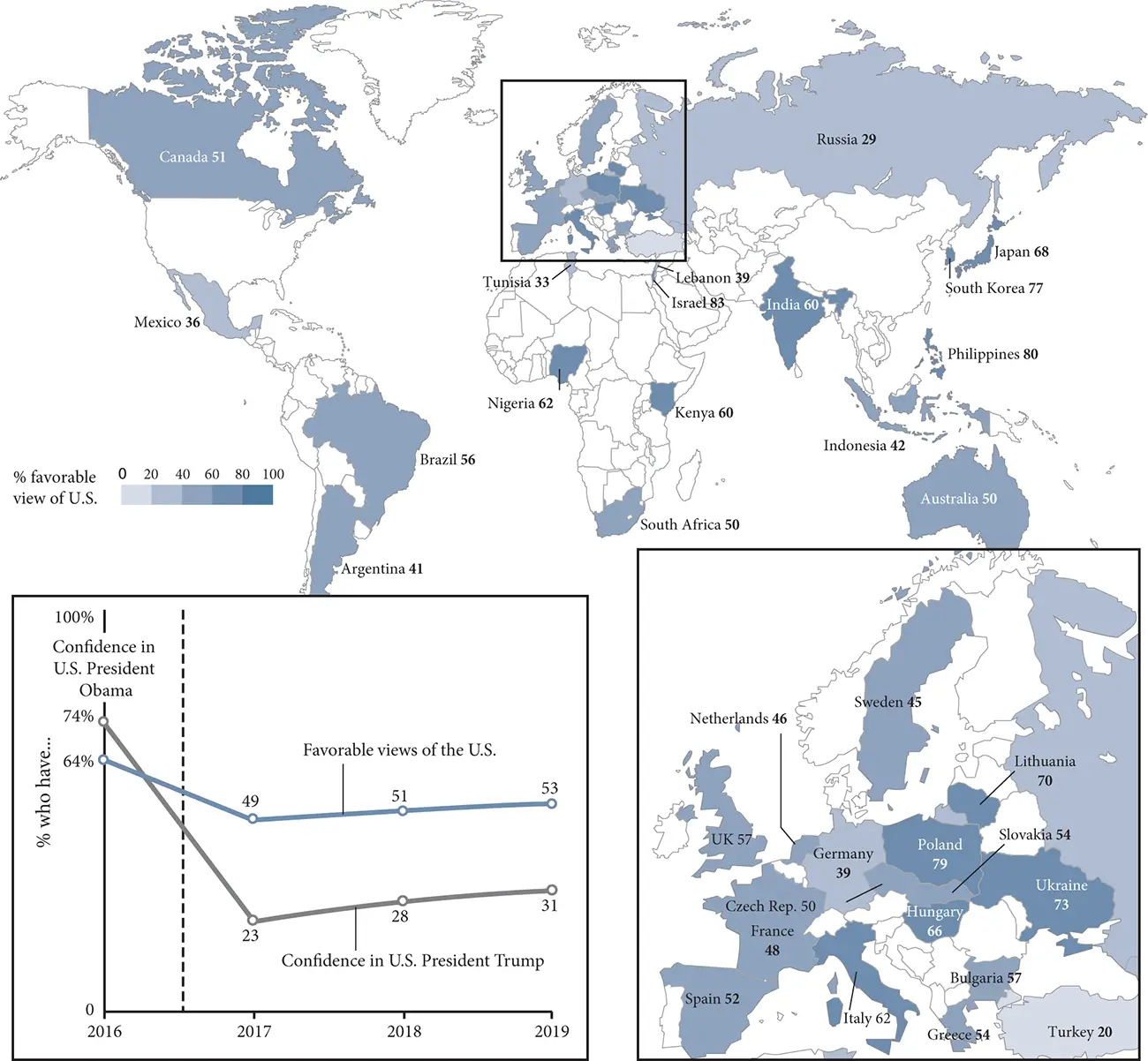
Figure 3.3 Trump Ratings Were Low Around Globe, While Views of US Stayed Mostly Favorable. In comparison to President Obama, global views of President Trump were much lower. However, views of the US remained mostly favourable, with some exceptions. The US was viewed most positively in Israel, the Philippines, Poland, and South Korea, and most negatively in Russia, Turkey, Tunisia, and Mexico. Source: Redrawn from How people around the world see the U.S. and Donald Trump in 10 charts. Retrieved from: https://www.pewresearch.org/fact-tank/2020/01/08/how-people-around-the-world-see-the-u-s-and-donald-trump-in-10-charts/
More recently, many people around the world have been shocked at how the US handled the COVID-19 pandemic in its early days. While most countries implemented strict measures for social distancing, mask requirements, and quarantines, the US resisted many of these efforts. The virus hit China and Italy especially hard, which gave other countries – such as the US – more time to respond (Associated Press 2020). But despite the additional time to prepare, the medical knowledge about its threat, and the economic resources to handle it aggressively, the US and the Trump administration downplayed the threat, often referring to it as a hoax. As a result, it led the world in COVID-19 cases and deaths, with one of the highest per capita infection rates. At the same time, the US made efforts to acquire as much of the early vaccines produced elsewhere as possible elsewhere and outbid other purchasers to obtain medical supplies headed to other countries. Responses like this were common:
To a watching world, the absence of a fair, affordable US healthcare system, the cut-throat contest between American states for scarce medical supplies, the disproportionate death toll among ethnic minorities, chaotic social distancing rules, and a lack of centralised coordination are reminiscent of a poor, developing country, not the most powerful, influential nation on earth. That’s a title the US appears on course to lose – a fall from grace that may prove irreversible. (Tisdall 2020)
Compared to the US, citizens in other countries were far more agreeable to measures needed to curtail the virus, and interpreted them as necessary for the common good. Many commentators have wondered if the global reputation of the US will ever recover. (Associated Press 2020)
Certainly, readers can debate whether or not Americanization is declining, but it is clear that it certainly was a powerful force in the past and much of globalization, at least until very recently, has been American-led. At the minimum, that (recent) history needs to be recognized for what it was – heavily dominated by Americanization. Furthermore, no matter how far Americanization may have already declined in importance, it will be a long time before most of the nations and areas affected by it in the past will be free of its highly diverse and often powerful effects. The effects of Americanization will continue to be felt in many nations for years to come even if we think of it as slowing or even halting completely (a clearly erroneous view, at least at the present time).
The continued effects of Americanization are demonstrated by the modern fast-food restaurant, which was an American invention (specifically Ray Kroc and the creation of the McDonald’s chain beginning in the mid-1950s) that was, and is still being, actively and aggressively exported to the rest of the world. However, many nations have now created their own McDonaldized restaurants (and other forms) that in some cases (e.g. Pollo Campero from Guatemala) are being actively exported back into the US. While this may now be part of the “Latin Americanization” of the US, it has its roots in Americanization (in this case of Latin America) via the export of the fast-food restaurant. While it may be selling food more indigenous to Latin America, even a superficial look at a Pollo Campero restaurant makes it clear that it is a product of Americanization.
A more clear example of Latin-Americanization was the politics of Trump himself (Lovato 2018). For decades, many Latin American countries have been led by a “caudillo,” or strong man using fiery rhetoric. A Washington Post reporter went so far as to declare Trump “the US’s first Latin American president” (Tharoor 2017). He was a clear departure from American political norms, and rather draws upon extreme self-inflation, tough talk, authoritarianism, machismo, and public humiliation to attack his enemies. By mimicking Latin American (from both left and right) strong men in style, he brought forth a different kind of Americanization.
A BROADER AND DEEPER VIEW OF THE AMERICANIZATION OF CONSUMER CULTURE
Consumerism and consumer culture are at the heart of Americanization. Victoria de Grazia’s Irresistible Empire: America’s Advance through 20th-Century Europe (de Grazia 2005: 3) examines the deeper forces in the Americanization of consumer culture, but with a somewhat different focus on:
The rise of the great imperium [the United States] with the outlook of a great emporium. This was the United States during the reign of what I call the Market Empire. An empire without frontiers, it arose during the twentieth century, reached its apogee during its second half, and showed symptoms of disintegration toward its close. Its most distant perimeters would be marked by the insatiable ambitions of its leading corporations for global markets, the ever vaster sales territories charted by state agencies and private enterprise, the far-flung influence of its business networks, the coin of recognition of its ubiquitous brands, and the intimate familiarity with the American way of life that all these engendered in peoples around the world. Its impetus and instruments derived from the same revolution in mass consumption that was ever more visibly reshaping the lives of its own citizens.
Читать дальшеИнтервал:
Закладка:
Похожие книги на «Globalization»
Представляем Вашему вниманию похожие книги на «Globalization» списком для выбора. Мы отобрали схожую по названию и смыслу литературу в надежде предоставить читателям больше вариантов отыскать новые, интересные, ещё непрочитанные произведения.











Обсуждение, отзывы о книге «Globalization» и просто собственные мнения читателей. Оставьте ваши комментарии, напишите, что Вы думаете о произведении, его смысле или главных героях. Укажите что конкретно понравилось, а что нет, и почему Вы так считаете.