George Ritzer - Globalization
Здесь есть возможность читать онлайн «George Ritzer - Globalization» — ознакомительный отрывок электронной книги совершенно бесплатно, а после прочтения отрывка купить полную версию. В некоторых случаях можно слушать аудио, скачать через торрент в формате fb2 и присутствует краткое содержание. Жанр: unrecognised, на английском языке. Описание произведения, (предисловие) а так же отзывы посетителей доступны на портале библиотеки ЛибКат.
- Название:Globalization
- Автор:
- Жанр:
- Год:неизвестен
- ISBN:нет данных
- Рейтинг книги:3 / 5. Голосов: 1
-
Избранное:Добавить в избранное
- Отзывы:
-
Ваша оценка:
Globalization: краткое содержание, описание и аннотация
Предлагаем к чтению аннотацию, описание, краткое содержание или предисловие (зависит от того, что написал сам автор книги «Globalization»). Если вы не нашли необходимую информацию о книге — напишите в комментариях, мы постараемся отыскать её.
, distinguished researchers and authors George Ritzer and Paul Dean deliver an up-to-date introduction to major trends and topics related to the study of globalization. The book includes accessible and rigorous material on the key theories and major topics in globalization, as well as modern developments like the rise of populism and far-right political groups, Brexit, migration and backlash to it, trade negotiations, social media and the spread of misinformation, climate change, social justice issues, and COVID-19.
The new edition includes a greater focus on the structures of inequality that encourage or discourage global flows. Additionally, new examples and sources from Central and South America, Africa, and Asia are used to illustrate key concepts, and round out the international coverage of book. Throughout, the authors use clear and helpful metaphors including solids, liquids, gases, and flows to introduce and explain the complex nature of globalization in an engaging and understandable way.
Readers will also benefit from the inclusion of:
A thorough introduction to globalization and related processes, including imperialism, colonialism, development, and westernization An exploration of neoliberalism, including its roots, principles, criticisms, and Neo-Marxist alternatives A practical discussion of global political structures and processes, as well as global economic flows of production and consumption A concise treatment of negative global flows and processes, including dangerous imports, diseases, crime, terrorism, and war Analysis of the changing nature of globalization and de-globalization, and the social movements and technological developments driving these changes More images, charts, and graphs to help illustrate and highlight the concepts contained in the book Perfect for advanced undergraduates studying globalization across sociology, political science, geography, anthropology, and economics,
will also be essential reading for students taking courses in culture, economy and inequality, and migration taught from a global perspective.
Globalization — читать онлайн ознакомительный отрывок
Ниже представлен текст книги, разбитый по страницам. Система сохранения места последней прочитанной страницы, позволяет с удобством читать онлайн бесплатно книгу «Globalization», без необходимости каждый раз заново искать на чём Вы остановились. Поставьте закладку, и сможете в любой момент перейти на страницу, на которой закончили чтение.
Интервал:
Закладка:
2014 – the Intergovernmental Panel on Climate Change (IPCC) issued its fourth assessment report noting the overwhelming scientific consensus on global warming, its human causes, and calls for necessary global responses. According to Ulrich Beck (2016), climate change “has already altered our way of being in the world the way we live in the world, think about the world and seek to act upon the world through our actions and politics.”
2018 –the majority of the world became connected to the Internet. Since the Internet became publicly accessible for the first time in 1991, it took only 28 years to connect half of the globe to this paradigmatic global technology (see Figure 2.1 for Internet usage rates around the world).
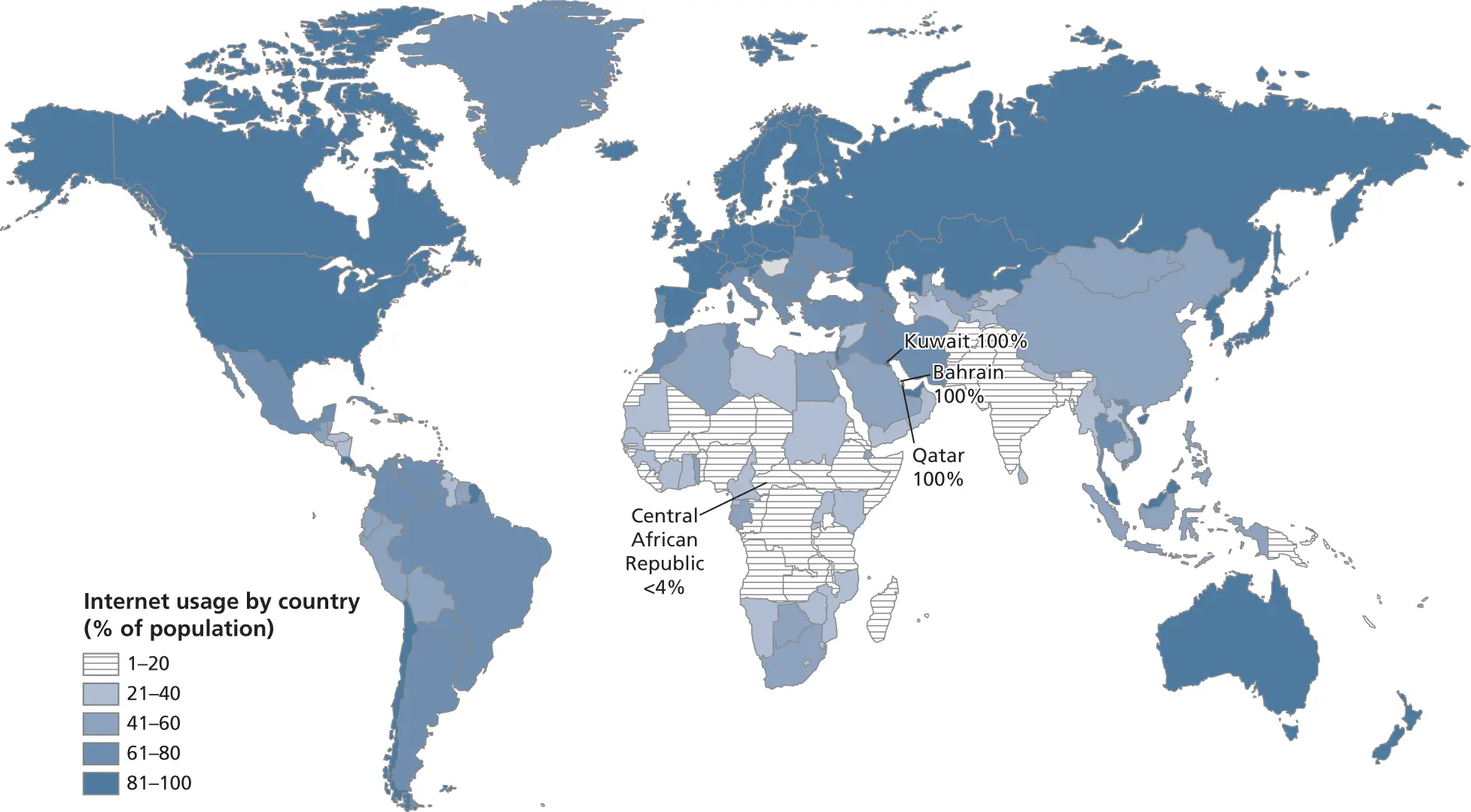
Figure 2.1 Internet Usage by Country (% of population). As of 2019, 49% of the world is connected to the Internet. But it varies significantly based on level of income with 16% of people connected in low income countries, 45% in middle income countries, and 87% in high income countries. The countries with the highest and lowest Internet usage are indicated on the map. Source: Data from Individuals using the Internet % of population. Retrieved from: https://data.worldbank.org/indicator/IT.NET.USER.ZS.
This focus on specific historical events is less general than the approach taken in this book that focuses on the current global age.
BROADER, MORE RECENT CHANGES
The fifth view focuses on broader, but still recent, changes. There is a sense in this view that a sea change occurred in the last half of the twentieth century. Three of these momentous changes have been identified by scholars as the point of origin of globalization as it exists today:
1 The emergence of the United States as the global power in the years following WW II.
The US not only projected its military power throughout the world (Korea in the early 1950s; disastrously in Vietnam in the 1960s and early 1970s), it extended its reach in the economic realm as it became the dominant industrial power when the war decimated most of its competitors militarily (Germany, Japan) and/or economically (the Axis powers as well as Allies such as France and Great Britain). Many other aspects of America’s global reach either accompanied these changes or soon followed. Among them was the diplomatic clout of the US government, the reach of the US media, the power of Hollywood, and so on. Such a view closely aligns globalization with the idea of Americanization (see Chapter 3).
2.The emergence of multinational corporations (MNCs).
While the world’s great corporations can be traced back to the eighteenth and early nineteenth centuries in, for example, Germany, Great Britain, and the United States, they were initially largely associated with their nations of origin and did the vast majority of their business within those countries (Bonanno and Antonio 2012). However, over time, those corporations did more and more business internationally. In so doing, they were following Marx’s dictum that because of stagnant or declining profits capitalism had to expand into international markets or die. As Marx and Engels (1848/2000: 248–9) put it:
The need of a constantly expanding market for its products chases the bourgeoisie over the entire surface of the globe. It must nestle everywhere, settle everywhere, establish connections everywhere. The bourgeoisie has, through its exploitation of the world market, given a cosmopolitan character to production and consumption in every country… . All old-established national industries have been destroyed or are daily being destroyed. They are dislodged by new industries … that no longer work up indigenous raw material, but raw materials drawn from the remotest zones; industries whose products are consumed, not only at home, but in every quarter of the globe. In place of the old wants, satisfied by the production of the country, we find new wants, requiring for their satisfaction the products of distant lands and climes. In place of the old local and national seclusion and self-sufficiency, we have intercourse in every direction, universal interdependence of nations.
For example, the once-great American automobile companies – Ford and General Motors – not only originated in the US, but focused, at least initially, on selling into the American market and most, if not all, of the component parts were produced by them or sub-contractors in the US. Of course, they did import raw materials of various kinds (and they did sell their automobiles overseas, especially in Europe), but in the main, the bulk of their business was done in the US. Furthermore, the vast majority of top executives, employees, and investors were American. However, that began to change over the course of the twentieth century as these corporations exported more of their automobiles to other parts of the world, opened factories in other countries to sell cars under their brand names (or others), targeted their products to the distinctive needs (e.g. for smaller, more fuel-efficient cars) of those countries, and more recently began to move more and more of their automobile production aimed at the US market to other countries, either in factories of their own or in the factories of sub-contractors in those countries.
In these and other ways, Ford and General Motors have become multinational corporations and MNCs are, because of their very nature, inherently part of globalization. Indeed, MNCs are not only involved in globalization but this process is internalized into the organization as all sorts of global flows (parts, people, money) occur within the corporation.
The case of the other of the one-time “Big Three” American automobile companies – Chrysler – is even more striking in this regard. Initially, Chrysler followed the same course as Ford and GM and became increasingly multinational. However, Chrysler has long been the most marginal of the Big Three and, famously, had to be bailed out in 1979 by a controversial loan from the US government. However, that was only of short-term help and in 1998 Chrysler was taken over by the German manufacturer of Mercedes Benz automobiles which changed its name to Daimler-Chrysler AG. This clearly represented the formation of a MNC, although Daimler-Benz itself (as well as Chrysler) was a multinational corporation before that since, among other things, it actively sold its automobiles in the US as well as in many other parts of the world. However, this marriage was short-lived and Daimler sold off its interest in Chrysler in 2007. After filing for bankruptcy in 2009, Chrysler was again bailed out (as was GM) by the US government during the Great Recession, which cost US taxpayers $1.3 billion. Today, Chrysler is owned by Fiat, a MNC headquartered in Italy.
3.The demise of the Soviet Union and the end of the Cold War.
It could be argued that globalization is even more recent and did not truly begin until the fall of the “Iron Curtain” and the Soviet Union in 1991. With those events, the division of the world into mainly “capitalist” and “communist” spheres rapidly eroded as did all sorts of barriers that existed between them. Major parts of the world were opened for the first time since the early twentieth century to all sorts of global flows – immigration, tourism, media, diplomacy, and especially the capitalistic economic transactions of MNCs and other businesses. The global processes that had spread throughout most of the “free” world before 1991 flooded into the now independent states of the old Soviet Union, especially Russia, and most of its allies.
Vestiges of communism exist as of this writing, especially in Cuba, North Korea and, at least nominally, in China (Ray 2012). Cuba remains, in the main, outside of global capitalism, largely because of the US embargo against trading with Cuba, in force since 1962 and expanded and codified several times since then. However, the embargo itself is a manifestation of globalization – the US setting up barriers in order to limit or halt the flow of trade with Cuba and to inhibit or prevent other nations from around the world from trading with Cuba. China, of course, is becoming a, if not soon, the major force in global capitalism even though the government remains communist, at least in name (Gruin 2016; Panitch et al. 2013). In any case, China is actively involved in globalization not only economically, but in many other realms as well (e.g. the Chinese Ministry of Culture participated actively in the prestigious Venice Biennale art exhibition [Platt 2013]).
Читать дальшеИнтервал:
Закладка:
Похожие книги на «Globalization»
Представляем Вашему вниманию похожие книги на «Globalization» списком для выбора. Мы отобрали схожую по названию и смыслу литературу в надежде предоставить читателям больше вариантов отыскать новые, интересные, ещё непрочитанные произведения.











Обсуждение, отзывы о книге «Globalization» и просто собственные мнения читателей. Оставьте ваши комментарии, напишите, что Вы думаете о произведении, его смысле или главных героях. Укажите что конкретно понравилось, а что нет, и почему Вы так считаете.