George Ritzer - Globalization
Здесь есть возможность читать онлайн «George Ritzer - Globalization» — ознакомительный отрывок электронной книги совершенно бесплатно, а после прочтения отрывка купить полную версию. В некоторых случаях можно слушать аудио, скачать через торрент в формате fb2 и присутствует краткое содержание. Жанр: unrecognised, на английском языке. Описание произведения, (предисловие) а так же отзывы посетителей доступны на портале библиотеки ЛибКат.
- Название:Globalization
- Автор:
- Жанр:
- Год:неизвестен
- ISBN:нет данных
- Рейтинг книги:3 / 5. Голосов: 1
-
Избранное:Добавить в избранное
- Отзывы:
-
Ваша оценка:
Globalization: краткое содержание, описание и аннотация
Предлагаем к чтению аннотацию, описание, краткое содержание или предисловие (зависит от того, что написал сам автор книги «Globalization»). Если вы не нашли необходимую информацию о книге — напишите в комментариях, мы постараемся отыскать её.
, distinguished researchers and authors George Ritzer and Paul Dean deliver an up-to-date introduction to major trends and topics related to the study of globalization. The book includes accessible and rigorous material on the key theories and major topics in globalization, as well as modern developments like the rise of populism and far-right political groups, Brexit, migration and backlash to it, trade negotiations, social media and the spread of misinformation, climate change, social justice issues, and COVID-19.
The new edition includes a greater focus on the structures of inequality that encourage or discourage global flows. Additionally, new examples and sources from Central and South America, Africa, and Asia are used to illustrate key concepts, and round out the international coverage of book. Throughout, the authors use clear and helpful metaphors including solids, liquids, gases, and flows to introduce and explain the complex nature of globalization in an engaging and understandable way.
Readers will also benefit from the inclusion of:
A thorough introduction to globalization and related processes, including imperialism, colonialism, development, and westernization An exploration of neoliberalism, including its roots, principles, criticisms, and Neo-Marxist alternatives A practical discussion of global political structures and processes, as well as global economic flows of production and consumption A concise treatment of negative global flows and processes, including dangerous imports, diseases, crime, terrorism, and war Analysis of the changing nature of globalization and de-globalization, and the social movements and technological developments driving these changes More images, charts, and graphs to help illustrate and highlight the concepts contained in the book Perfect for advanced undergraduates studying globalization across sociology, political science, geography, anthropology, and economics,
will also be essential reading for students taking courses in culture, economy and inequality, and migration taught from a global perspective.
Globalization — читать онлайн ознакомительный отрывок
Ниже представлен текст книги, разбитый по страницам. Система сохранения места последней прочитанной страницы, позволяет с удобством читать онлайн бесплатно книгу «Globalization», без необходимости каждый раз заново искать на чём Вы остановились. Поставьте закладку, и сможете в любой момент перейти на страницу, на которой закончили чтение.
Интервал:
Закладка:
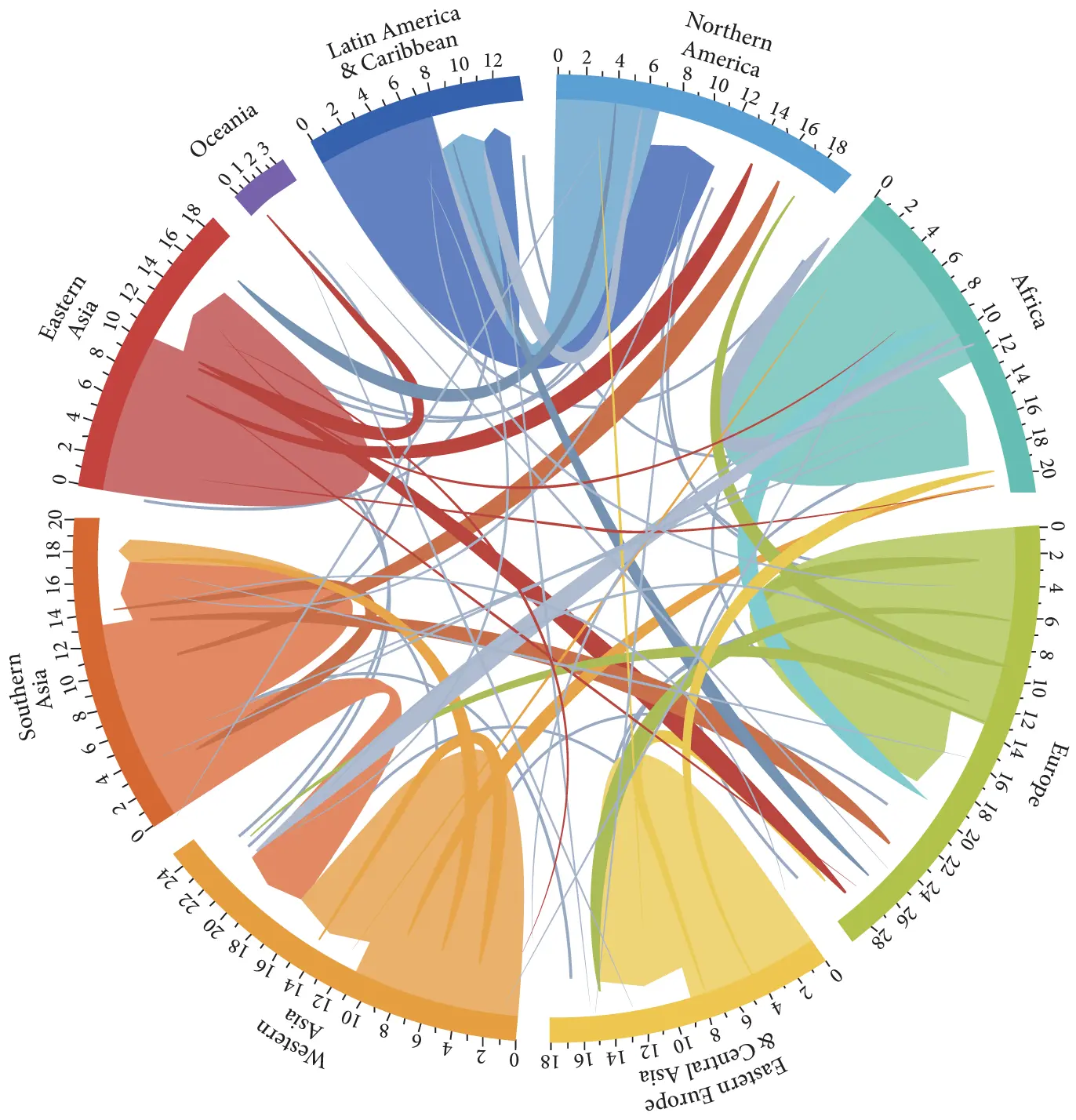
Figure 1.2 Global migration flows by region, 2010–2015. Arrows estimate international migration between countries within and between all regions of the world. Source: Azose, Jonathan, and Adrian Raftery 2019. Estimation of Emigration, Return Migration and Transit Migration Between All Pairs of Countries. PNAS 116 (10: 116–122.), doi : https://doi.org/10.1073/pnas.1722334116. National Academy of Sciences.
It is also the case that an increasing number of people, perhaps nearly everyone, is involved in, and affected by, global relations and flows and personally participate in global networks (Axford 2012; Singh Grewal 2008) of one kind or another (networks of communication and information technology, interpersonal networks involving individuals and groups, having to alter their lives as result of flows of COVID-19). While global networks span the globe (e.g. cables under the oceans that permit transoceanic communication [Yuan 2006: A1]), or at least much of it, there are other types of networks including transnational (those that pass through the boundaries of nation-states [Portes 2001]), international (those that involve two or more nation-states), national (those that are bounded by the nation-state), and local (those that exist at the sub-national level) (Mann 2007). Networks can expedite the flow of innumerable things, but they are perhaps best-suited to the flow of information (Connell and Crawford 2005). People involved in networks can communicate all sorts of information to one another in various ways – phone calls, snail-mail, email, blogs, social networking sites, and so on. These networks have revolutionized and greatly expanded the global flow of information. As with all other structures, such networks can be blocked or monitored in various ways (e.g. the “Great Firewall” or NSF surveillance).
All sorts of networks have been made possible by the Internet. The Internet can be seen as being of enormous importance in allowing information of various sorts to flow in innumerable directions. One important example involves the formation of the networks that became and constitute the movements for global justice and democratization (Vanden et al. 2017; see Chapter 15). It (as well as its various political actions, most notably the anti-WTO [World Trade Organization] protests in Seattle in 1999), like much else in the world today (e.g. the popular uprisings in Turkey and Egypt in 2013), was made possible by the Internet:
By significantly enhancing the speed, flexibility, and global reach of information flows , allowing for communication at a distance in real time, digital networks provide the technological infrastructure for the emergence of contemporary network-based social forms … allowing communities to sustain interactions across vast distances… . Using the Internet as technological architecture, such movements operate at local, regional, and global levels… .(Juris 2008: 353–4)
Finally, it is not only individuals who are increasingly involved in networks. An increasing number of social structures (e.g. states, cities, law) and social institutions (the family, religion, sport) are interconnected on a global basis and these, too, enable and enhance global flows. For example, the international banking system has an infrastructure that facilitates the global movement of funds among a network of banks. Included in that infrastructure are IBANs (International Bank Account Numbers), rules, norms, and procedures on how such money transfers are to occur, and a highly sophisticated technical language that allows those in the business to communicate with one another wherever they are in the world. Another example involves global (Sassen 1991, 2013) and world cities (Derudder et al. 2012) (see Chapter 13) that are increasingly interconnected with one another directly rather than through the nation-states in which they happen to exist. The financial markets of the world cities of New York, London, and Tokyo are tightly linked with the result that all sorts of financial products flow among them and at lightning speed. More generally, in this context, we can talk in terms of the “global economy’s connectedness” (Altman 2007). To take another example, the World Health Organization (WHO) includes nearly 200 member states and has coordinated the global response to COVID-19 (see Chapter 15). When the virus was discovered at the end of 2019, the WHO immediately went into action by tracking cases and the spread of the disease, disseminating the most recent medical knowledge, helping to distribute personal protective equipment (PPE) throughout networked countries, recommending health-related policies, and developing the COVID-19 Solidarity Response Fund for fundraising for the pandemic. Once again, however, barriers are erected to limit such interconnections (e.g. the unwillingness of at least some countries to acknowledge the urgent threat of the disease, and the US’s attempt to withdraw funding to the WHO).
HEAVY STRUCTURES AS BARRIERS TO FLOWS
While there is no question that the world is increasingly characterized by greater liquidity, increased flows, as well as various structures that expedite those flows, we also need to recognize that there are limits and barriers to those flows. The world is not just in process, there are also many material structures (trade agreements, regulatory agencies, borders, customs barriers, standards, and so on) in existence. As Inda and Rosaldo (2008: 31) argue: “Material infrastructures do not only promote mobility… . They also hinder and block it.” Any thoroughgoing account of globalization needs to look at both flows and structures and, in terms of the latter, the ways in which they both produce and enhance flows as well as alter and even block them. In other words, there is interplay between flows and structures, especially between flows and the structures that are created in an attempt to inhibit or to stop them. As Shamir (2005: 197) puts it, globalization is an epoch of increased openness and “simultaneously an era of growing restrictions on movement.” Borders, of course, are major points at which movement is blocked. There are many examples of this including the toughening of border controls in the UK (and elsewhere in Europe), Australia, and the US because of growing hostility to refugees and undocumented immigratns (Hogan and Haltinner 2015).
There are challenges to the idea that all there is to globalization is flows and fluidity (Tsing 2000). In examining global flows (some of which have been anticipated above), we also need to consider those agents who “carve” the channels through which things flow, those who alter those channels over time, national and regional units that create and battle over flows, and coalitions of claimants for control over channels.
A focus on the above kinds of agents and structures, rather than flows, promises a more critical orientation to globalization in terms of the structures themselves, as well as in terms of who creates the structures through which things flow as well as who does and does not control and profit from them (more on this in the next section).
Another important idea is the “frictions,” or the “awkward, unequal, unstable … interconnection across difference” (Lowenhaupt Tsing 2005: 4). The main idea is that the global flows that create interconnections do not move about smoothly; they do not move about without creating friction. Friction gets in the way of the smooth operation of global flows. 3However, friction not only slows flows down, it can also serve to keep them moving and even speed them up. Highways can have this double-edged quality by both limiting where people and vehicles can go while at the same time making movement “easier and more efficient” (Lowenhaupt Tsing 2005: 6). More generally, “global connections [are] made, and muddied, in friction” (Lowenhaupt Tsing 2005: 272). The key point in this context is that flows themselves produce friction that can slow or even stop global flows: “without even trying friction gets in the way of the smooth operation of global power. Difference can disrupt, causing everyday malfunctions as well as unexpected cataclysms. Friction refuses the lie that global power operates as a well-oiled machine. Furthermore, difference sometimes inspires insurrection. Friction can be the fly in the elephant’s nose” (Lowenhaupt Tsing 2005: 6). A prime example of this today is the many frictions being produced in many parts of the world by large numbers of documented and undocumented immigrants, and the backlash against them. For example, refugees from Syria have fled to Europe and other places, and have sometimes been killed by border guards when entering a country without authorization (Yeginsu and Shoumali 2016). Such frictions led Greece to complete a 6.5 mile fence along its border with Turkey, which was considered the most porous entry point for undocumented immigrants entering Europe (Besant 2012). As has already been mentioned, the most important and most obvious barriers to global flows are those constructed by nation-states. There are borders, gates, guards, passport controls, customs agents, health inspectors, and so on, in most countries in the world. (The great exception is the countries that are part of the European Union [EU] where barriers to movement among and between member countries have been greatly reduced, if not eliminated. The EU is a kind of structure that allows people and products to move much more freely and much more quickly. At the same time, it serves to reduce the need to use hidden channels since there is far less need to conceal what is moving among and between EU countries.) Although many people (undocumented immigrants) and things (contraband goods) do get through those barriers, some of them are successfully blocked or impeded by the barriers. However, it is far more difficult to erect barriers against many newer phenomena, especially the non-material phenomena associated with cell phones and the Internet.
Читать дальшеИнтервал:
Закладка:
Похожие книги на «Globalization»
Представляем Вашему вниманию похожие книги на «Globalization» списком для выбора. Мы отобрали схожую по названию и смыслу литературу в надежде предоставить читателям больше вариантов отыскать новые, интересные, ещё непрочитанные произведения.










Обсуждение, отзывы о книге «Globalization» и просто собственные мнения читателей. Оставьте ваши комментарии, напишите, что Вы думаете о произведении, его смысле или главных героях. Укажите что конкретно понравилось, а что нет, и почему Вы так считаете.