George Ritzer - Globalization
Здесь есть возможность читать онлайн «George Ritzer - Globalization» — ознакомительный отрывок электронной книги совершенно бесплатно, а после прочтения отрывка купить полную версию. В некоторых случаях можно слушать аудио, скачать через торрент в формате fb2 и присутствует краткое содержание. Жанр: unrecognised, на английском языке. Описание произведения, (предисловие) а так же отзывы посетителей доступны на портале библиотеки ЛибКат.
- Название:Globalization
- Автор:
- Жанр:
- Год:неизвестен
- ISBN:нет данных
- Рейтинг книги:3 / 5. Голосов: 1
-
Избранное:Добавить в избранное
- Отзывы:
-
Ваша оценка:
Globalization: краткое содержание, описание и аннотация
Предлагаем к чтению аннотацию, описание, краткое содержание или предисловие (зависит от того, что написал сам автор книги «Globalization»). Если вы не нашли необходимую информацию о книге — напишите в комментариях, мы постараемся отыскать её.
, distinguished researchers and authors George Ritzer and Paul Dean deliver an up-to-date introduction to major trends and topics related to the study of globalization. The book includes accessible and rigorous material on the key theories and major topics in globalization, as well as modern developments like the rise of populism and far-right political groups, Brexit, migration and backlash to it, trade negotiations, social media and the spread of misinformation, climate change, social justice issues, and COVID-19.
The new edition includes a greater focus on the structures of inequality that encourage or discourage global flows. Additionally, new examples and sources from Central and South America, Africa, and Asia are used to illustrate key concepts, and round out the international coverage of book. Throughout, the authors use clear and helpful metaphors including solids, liquids, gases, and flows to introduce and explain the complex nature of globalization in an engaging and understandable way.
Readers will also benefit from the inclusion of:
A thorough introduction to globalization and related processes, including imperialism, colonialism, development, and westernization An exploration of neoliberalism, including its roots, principles, criticisms, and Neo-Marxist alternatives A practical discussion of global political structures and processes, as well as global economic flows of production and consumption A concise treatment of negative global flows and processes, including dangerous imports, diseases, crime, terrorism, and war Analysis of the changing nature of globalization and de-globalization, and the social movements and technological developments driving these changes More images, charts, and graphs to help illustrate and highlight the concepts contained in the book Perfect for advanced undergraduates studying globalization across sociology, political science, geography, anthropology, and economics,
will also be essential reading for students taking courses in culture, economy and inequality, and migration taught from a global perspective.
Globalization — читать онлайн ознакомительный отрывок
Ниже представлен текст книги, разбитый по страницам. Система сохранения места последней прочитанной страницы, позволяет с удобством читать онлайн бесплатно книгу «Globalization», без необходимости каждый раз заново искать на чём Вы остановились. Поставьте закладку, и сможете в любой момент перейти на страницу, на которой закончили чтение.
Интервал:
Закладка:
The ideas of increasing liquidity and weightlessness being employed here do not require that the world be “flat” or be considered as such (see Chapter 4) (Friedman 2007, 2012). Fluids can seep through all sorts of tall and wide structures and, in the case of a flood, those structures can even be washed away (as was the Berlin Wall, for example, and more metaphorically, the Iron Curtain), at least temporarily. Further, that which is weightless can waft over and between the tallest and widest structures. Thus, the world today is increasingly characterized by liquidity and weightlessness, but it is not necessarily any flatter than it ever was. Those tall, wide structures continue to be important, especially in impeding (or attempting to), the movement of that which is solid and heavy. It is less clear how successful these structures will be in impeding that which is liquid, light, or weightless.
The most obvious of such structures are the borders (Jones and Johnson 2016; Wastl-Walter 2012) between nation-states and the fact that in recent years we have witnessed the strengthening (heightening, lengthening, etc.) of many of those borders. Similarly, several governments (e.g. China, Russia) have sought to restrict the access of its citizens to at least some aspects of the Internet that those governments feel are dangerous to their continued rule. In the case of China, the electronic barrier that the government has constructed is known as the “Great Firewall.” (A firewall is a barrier on the Internet; the idea of the “Great Firewall” plays off China’s Great Wall.)
The huge “digital divide” in the world today (Cruz-Jesus et al. 2018; Drori 2012), especially between developed and developing countries (or the North and South), is another example of a barrier. Developing countries have fewer computers and the supporting infrastructure (cellular and broadband connections) needed for a computerized world, which creates an enormous barrier relative to wealthier countries. In terms of computerization, the world may be increasingly flat (although certainly not totally flat) among and between developed countries in the North, but it has many hills in the developing countries and huge and seemingly insurmountable mountain ranges continue to separate the North from the South.
The history of the social world and social thought and research leads us to the conclusion that people, as well as their representatives in the areas in which they live, have always sought to erect structural barriers to protect and advance themselves, and to adversely affect others, and it seems highly likely that they will continue to do so. Thus, we may live in a more liquefied, more weightless, world, but we do not live in a flat world and are not likely to live in one any time soon, if ever. Even a successful capitalist, George Soros, acknowledges this, using yet another metaphor, in his analysis of economic globalizationwhen he argues: “The global capitalist system has produced a very uneven playing field” (Soros 2000: xix, italics added).
HEAVY STRUCTURES THAT EXPEDITE FLOWS
The liquefaction of the social world, as well as its increasing weightlessness, is only part of the story of globalization. As pointed out already, another major part is the fact that many heavy, material, objective structures continue to exist and to be created in the globalized world. Some are holdovers from the pre-global world, but others are actually produced, intentionally or unintentionally, by global forces. In studying globalization we must look at both all of that which flows (or “wafts”) with increasing ease, as well as all of the structures 7that impede or block those flows (see below for more on these), as well as that serve to expedite and channel those flows. To put it another way, we must look at both that which is light and weightless as well as that which is solid and heavy and that greatly affects their flow in both a positive and a negative sense. This is in line with the view of Inda and Rosaldo (2008: 29):
we will examine the materiality of the global. This refers to the material practices – infrastructure, institutions, regulatory mechanisms, governmental strategies, and so forth – that both produce and preclude movement. The objective here is to suggest that global flows are patently structured and regulated, such that while certain objects and subjects are permitted to travel, others are not. Immobility and exclusion are thus as much a part of globalization as movement.
For example, there are various “routes” or “paths” that can be seen as structures that serve to both expedite flows along their length, as well as to limit flows that occur outside their confines.
Intercontinental airlines generally fly a limited number of well-defined routes (say between New Delhi and London) rather than flying whatever route the pilots wish and thereby greatly increasing the possibility of mid-air collisions (see Figure 1.1 for some of the major global airline routes).
Undocumented immigrants from Mexico have, at least until recently, generally followed a relatively small number of well-worn paths into the US. Indeed, they often need to pay smugglers large sums of money and the smugglers generally follow the routes that have worked for them (and others) in the past.
Goods of all sorts are generally involved in rather well-defined “global value chains” (see Chapter 7for a discussion of this concept) as they are exported from some countries and imported into others.
Illegal products – e.g. counterfeit drugs – follow oft-trod paths en route from their point of manufacture (often China), through loosely controlled free-trade zones (e.g. in Dubai), through several intermediate countries, to their ultimate destination, often the US, where they are frequently obtained over the Internet (Maddox et al. 2016).
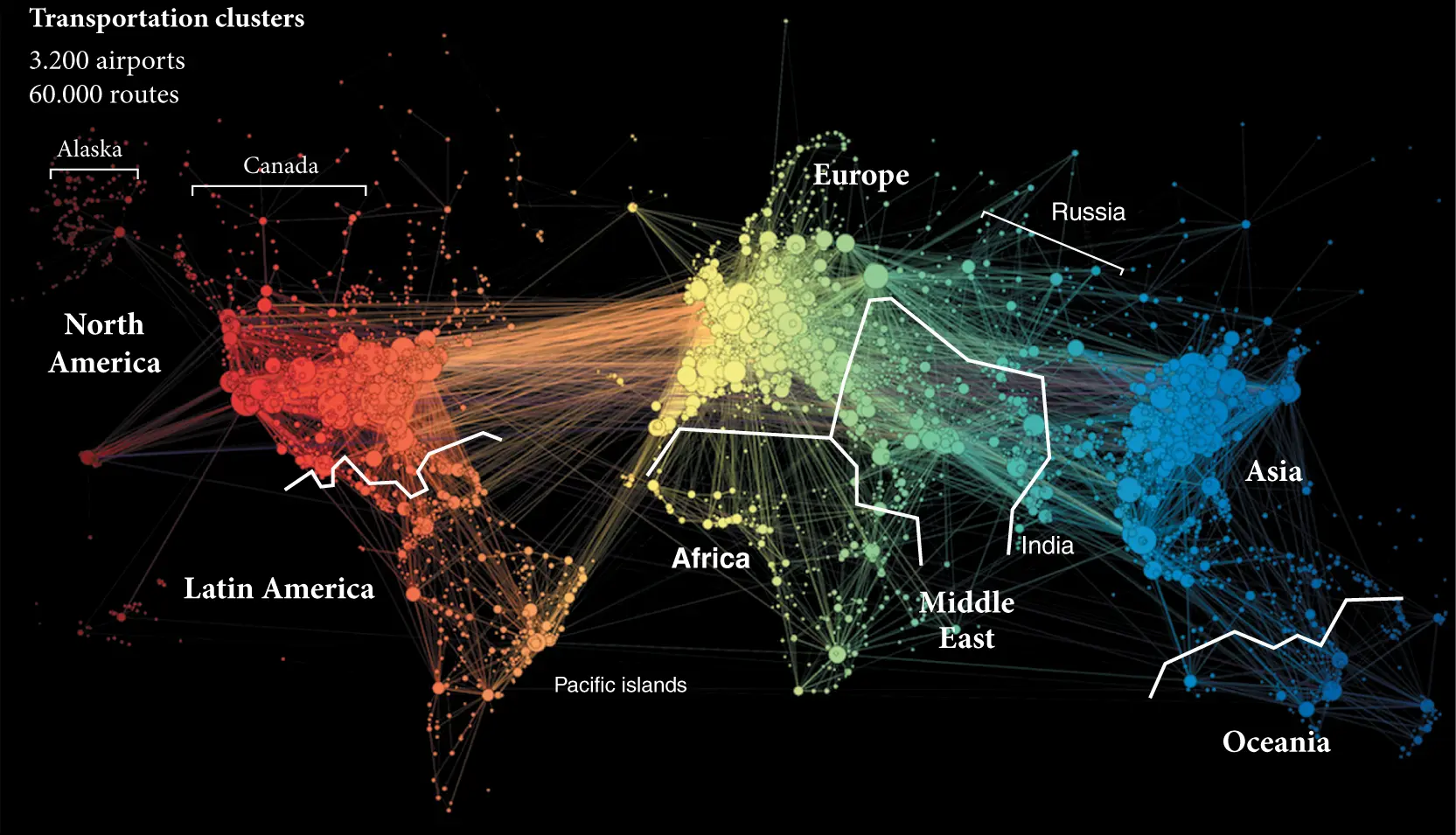
Figure 1.1 Airline passenger volume. Air travel, the dominant mode of international passenger transportation, was once limited to the wealthy and those traveling for business. With increased competition, lower fares, and a growing global economy, air travel has boomed over the last 40 years. Air traffic is concentrated in the Northern Hemisphere between Europe and North America, with increasing volume to East Asia. Martingrandjean.ch. Licensed under CC BY-SA 3.0
Then there are an increasing number of formal and informal “bridges” (Anner and Evans 2004) which have been created throughout the globe that expedite the flow of all sorts of things. This idea applies perhaps best to the passage of documented people across borders through the process of migration (Sassen 2007). It is clear that in the not-too-distant past there were many structural barriers to the flow of people. There are even a few places in the world today where this remains true – e.g. between the US and Cuba, or into and out of North Korea. However, with the end of the Cold War, there are now many bridges for people (and products) to cross openly not only between the countries of the old East and West, but also among and between virtually every country and region of the world (see Figure 1.2 for a representation of the international flows of migrants within and between various regions). However, undocumented migrants are likely to need to be more covert in their movements. All sorts of illegal products are also less likely to move openly across such “bridges” where they would be highly visible to the authorities. Thus, there are also more hidden structures that permit movement of undocumented people and illegal products.
Читать дальшеИнтервал:
Закладка:
Похожие книги на «Globalization»
Представляем Вашему вниманию похожие книги на «Globalization» списком для выбора. Мы отобрали схожую по названию и смыслу литературу в надежде предоставить читателям больше вариантов отыскать новые, интересные, ещё непрочитанные произведения.










Обсуждение, отзывы о книге «Globalization» и просто собственные мнения читателей. Оставьте ваши комментарии, напишите, что Вы думаете о произведении, его смысле или главных героях. Укажите что конкретно понравилось, а что нет, и почему Вы так считаете.