Rosi Braidotti - Posthuman Feminism
Здесь есть возможность читать онлайн «Rosi Braidotti - Posthuman Feminism» — ознакомительный отрывок электронной книги совершенно бесплатно, а после прочтения отрывка купить полную версию. В некоторых случаях можно слушать аудио, скачать через торрент в формате fb2 и присутствует краткое содержание. Жанр: unrecognised, на английском языке. Описание произведения, (предисловие) а так же отзывы посетителей доступны на портале библиотеки ЛибКат.
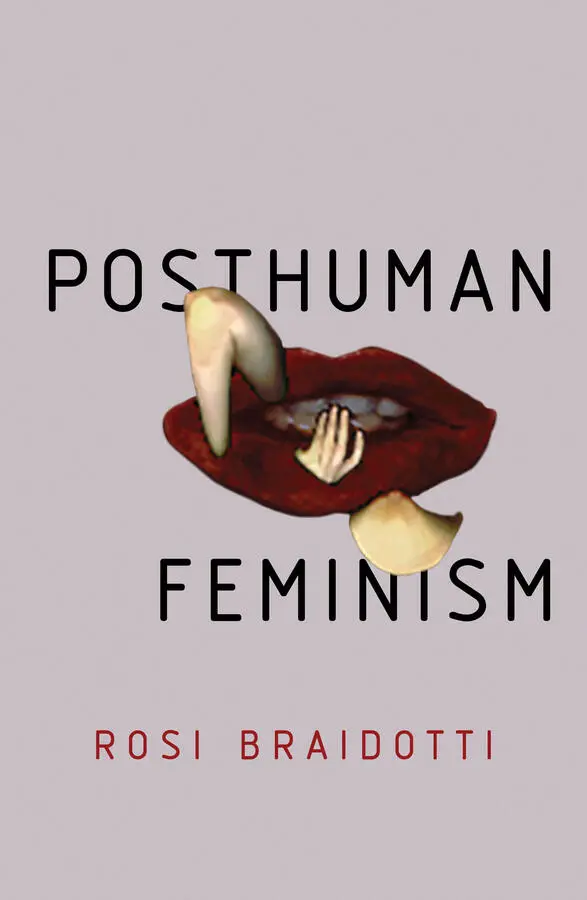
- Название:Posthuman Feminism
- Автор:
- Жанр:
- Год:неизвестен
- ISBN:нет данных
- Рейтинг книги:3 / 5. Голосов: 1
-
Избранное:Добавить в избранное
- Отзывы:
-
Ваша оценка:
Posthuman Feminism: краткое содержание, описание и аннотация
Предлагаем к чтению аннотацию, описание, краткое содержание или предисловие (зависит от того, что написал сам автор книги «Posthuman Feminism»). Если вы не нашли необходимую информацию о книге — напишите в комментариях, мы постараемся отыскать её.
Posthuman Feminism — читать онлайн ознакомительный отрывок
Ниже представлен текст книги, разбитый по страницам. Система сохранения места последней прочитанной страницы, позволяет с удобством читать онлайн бесплатно книгу «Posthuman Feminism», без необходимости каждый раз заново искать на чём Вы остановились. Поставьте закладку, и сможете в любой момент перейти на страницу, на которой закончили чтение.
Интервал:
Закладка:
Drawing inspiration from a variety of non-European sources, such as African Ubuntu (Mandela, 1994), Black, decolonial and Indigenous feminists rescue the humanist project by inscribing it into transformative politics with a strong spiritual undertone (hooks, 1990; Hill Collins, 1991). Buddhist, Marxist and other schools of ecofeminism and environmental activism produce their own brand of humanist defence of the human, combining the critique of the epistemic and physical violence of modernity with that of European colonialism (Shiva, 1997). These non-Western forms of radical humanism allow us to look at the ‘human’ from a more inclusive and diverse angle. They suggest new recompositions of humanity after Eurocentrism. This leads to a critical form of humanism referring to non-Western sources and looking at the human from a more inclusive and diverse angle (Narayan, 1989).
Black, decolonial and Indigenous feminists adopted a cautious approach to the generative potential of other traditions of humanism. Or, as the Combahee River Collective argued decades ago (1979), for those who have been systematically excluded from humanity, to be recognized as human, levelly human, is enough. They take humanism as an unfulfilled project, betrayed by Eurocentric violence and aim to develop its anti-racist and inclusive potential. They are committed to explore new understandings of humanity after colonialism and to draw from non-Western sources the inspiration to fully realize the potential of the humanist project.
This is the line defended by Sylvia Wynter, in a strong claim to a specific Black ontology (2015) that draws from a radical anticolonial tradition to argue that ‘the human’ is always, somewhere, ‘a colonial figure’. For decolonial scholarship, especially when inflected by queer theory, race is the primary mover in ontological formations of the human and not just a problematic side-effect of it (Jackson, 2018; Winnubst, 2018). The production of the figure of ‘the human’ is located within the violent colonial history of racialization, as a central tool of European power. Wynter analyses the human accordingly as a colonial figure that is always becoming something else and whose presence implies a principle of deselection of Black people. Wynter makes an exclusive ontological claim for the primacy of race as a constitutive element of the human, alongside the politics of gender and processes of genderization. Maria Lugones (2007, 2010) analyses the colonial gender system and argues that any discussion of the human implies a racialized ontology implemented by colonialism. She argues that in the framework of empire, race functions as the defining factor in the construction of all other intersectional differences, notably class, sexuality and gender. Lugones joins forces with feminist race theory (Davis, 1981; Crenshaw, 1991) to draw attention to the specific and systematic violence visited upon women of colour. She criticizes the bias of feminist theory, which tends to reflect the bio-politics of white, middle-class women, ignoring women of Black and working-class backgrounds (Repo, 2016).
By extension, the racialized ontology of ‘Man’ in Western philosophy is assessed by Black feminists as non-representative of humanity. Wynter urges to correct this through a revision of humanism in relation to concepts of Blackness. She makes a useful distinction between the humanist ‘Man of Reason’ – whom she defines as ‘Man 1’ – and the nineteenth-century version – ‘Man 2’ – of post-Darwinian science. She argues that neither version of ‘Man’ does justice to the dehumanized others; only a full recognition of the racialized character of all ontologies can provide an adequate analysis of the human. For Wynter, ‘the human has not yet come’. She calls for the need for a third event (after Man 1 and Man 2), in which the deselected people join forces to recognize what they actually are. This involves contesting the workings of capital and developing a new kind of politics emerging from those who have been ‘de-selected’ (2003).
I describe this position of Black neo-humanism as ‘strategic anthropocentrism’, 12echoing the 1980s definition of ‘strategic essentialism’ by Gayatri Spivak (1985). The strategy consists in setting up a provisional morality – the belief in the absolute priority of certain categories (gender, race, class), which entails taking the calculated risk of making them more robust and stable than they may be in reality. This strategic statement expresses epistemic faith in the real-life experiences of the racialized (and sexualized and naturalized) subjects – the marginalized ‘others’. The politics of locations and their perspectivist method mean that, though there are significant points of encounter between a posthuman feminist position that targets Eurocentrism and racism from within and a decolonial perspective, there are divergences as well between the respective positions. Both deal with how to take ethical and political accountability for structural exclusions. Practising embodied and embedded perspectives allows for immanent points of encounter without appropriation.
Looking back at the mixed legacy of European humanism, notably its historical connection to empire, colonialism and enslavement, Audre Lorde put it with characteristic visionary force: ‘Our survival means learning to use difference for something other than destruction. So does yours’ (Lorde in Rodriguez, 2020).
Queer and Trans Inhumanism: Equality and Diversity
LGBTQ+ theories and practices are positioned in the aftermath of humanism in that they pursue the political project of emancipation with claims to equality and struggles for recognition and justice. These claims rest on a sense of radical alienation from the heteronormative idea of the human built into European humanism. Many queer and trans feminists express a deeper bond to other species, notably animals, or rather ‘transanimals’ (Hayward and Weinstein, 2015). They feel not only excluded from, but also deviant, abnormal and monstrous in relation to the dominant definition of the human. Socially coded as ‘unnatural’ in their rejection of compulsory heterosexuality and reproductive normativity, queer and trans theorists deploy an extreme form of dis-identification from the Vitruvian humanist image of ‘Man’. Queer and trans theorists join forces with disability studies scholars in critiquing the discriminatory aspects of that idealized depiction of human normality.
Queer and trans feminisms work on the intersectional resonances between sexuality, gender, race, colonialism and the full range of the non-humans. They prefer the category of ‘ in humanism’ to indicate their liminal and marginal position in relation to the hegemonic figure of ‘Man’. But ‘inhuman’ also refers to the violence and the various forms of de-humanization inflicted upon LGBTQ+ people, in social, environmental and symbolic terms (Muñoz, 2015). Strongly allied to the dehumanized and non-human others, LGBTQ+ theories stress the parallels between the treatment of sexualized and racialized others, their increased vulnerability and mortality.
What also binds them is the shared desire to escape from the power of heteronormativity scaled on an abstract notion of ‘Man’ and a binary gender system either by equalizing rights and entitlements and thus fight back against the exclusions, or by devising altogether new visions of what humans could become. That points to the posthuman moment, which includes the production of alternative ways of knowing, new epistemologies and new ways of relating to and understanding the contemporary world. Susan Stryker sums it up clearly: ‘(In)human thus cuts both ways, toward remaking what human has meant and might yet come to be, as well as toward what should be turned away from, abandoned in the name of a better ethics’ (2015: 228).
Читать дальшеИнтервал:
Закладка:
Похожие книги на «Posthuman Feminism»
Представляем Вашему вниманию похожие книги на «Posthuman Feminism» списком для выбора. Мы отобрали схожую по названию и смыслу литературу в надежде предоставить читателям больше вариантов отыскать новые, интересные, ещё непрочитанные произведения.








Обсуждение, отзывы о книге «Posthuman Feminism» и просто собственные мнения читателей. Оставьте ваши комментарии, напишите, что Вы думаете о произведении, его смысле или главных героях. Укажите что конкретно понравилось, а что нет, и почему Вы так считаете.