Rosi Braidotti - Posthuman Feminism
Здесь есть возможность читать онлайн «Rosi Braidotti - Posthuman Feminism» — ознакомительный отрывок электронной книги совершенно бесплатно, а после прочтения отрывка купить полную версию. В некоторых случаях можно слушать аудио, скачать через торрент в формате fb2 и присутствует краткое содержание. Жанр: unrecognised, на английском языке. Описание произведения, (предисловие) а так же отзывы посетителей доступны на портале библиотеки ЛибКат.
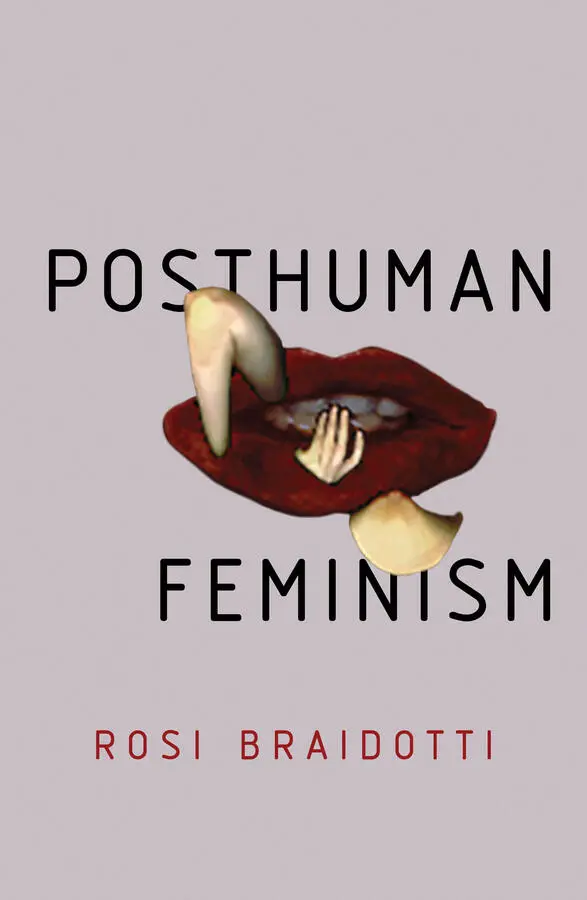
- Название:Posthuman Feminism
- Автор:
- Жанр:
- Год:неизвестен
- ISBN:нет данных
- Рейтинг книги:3 / 5. Голосов: 1
-
Избранное:Добавить в избранное
- Отзывы:
-
Ваша оценка:
Posthuman Feminism: краткое содержание, описание и аннотация
Предлагаем к чтению аннотацию, описание, краткое содержание или предисловие (зависит от того, что написал сам автор книги «Posthuman Feminism»). Если вы не нашли необходимую информацию о книге — напишите в комментариях, мы постараемся отыскать её.
Posthuman Feminism — читать онлайн ознакомительный отрывок
Ниже представлен текст книги, разбитый по страницам. Система сохранения места последней прочитанной страницы, позволяет с удобством читать онлайн бесплатно книгу «Posthuman Feminism», без необходимости каждый раз заново искать на чём Вы остановились. Поставьте закладку, и сможете в любой момент перейти на страницу, на которой закончили чтение.
Интервал:
Закладка:
Socialist feminists today are also the most consistent critics of capitalism and its liberal apologists. For socialists, mainstream feminism has become a useful ‘handmaiden of capitalism’ (Fraser, 2009) and complicit with its liberal economics (Eisenstein, 2005). All-too-familiar patterns of social and economic inequality, social exclusion and symbolic disqualification on the grounds of class, race, ethnicity, religion, age and body abilities persist unchanged and are even becoming exacerbated. Fraser argues that liberal feminism, despite its claims, actively enforces capitalist injustices by forcing women into part-time work and flexible practices of low-waged services. This has resulted in increased precarization and racialization of the workforce and, in the long term, more poverty and inequalities.
Moreover, liberal feminism has become hyper-individualistic and prone to the commodification of everyday life through the ideology of well-being, health and fitness. Liberals sabotage state intervention and welfare support and replace them with a more entrepreneurial approach, which legitimizes the expansion of a market economy. Fraser calls for a return to feminist solidarity and a redistributive sense of justice. She also campaigns for economic equality, not only in terms of waged work, but also of unpaid care work.
Critical questions were raised, however, about Fraser’s selective account of feminism (Funk, 2013). Moreover, socialist-minded feminists do not fall neatly into party lines. Many contemporary socialist movements are led by citizen activists and journalists (Baker and Blaagaard, 2016), as, for instance, is the case with the French ‘gilets jaunes’ (yellow vests) movement. It was started by Priscillia Ludosky in protest at rising fuel prices and the impact on people living and working outside the public transport networks of urban areas. Yet, the movement transformed into a broader social organization in defence of workers’ rights, tax reform in favour of the working class, and general political resistance to the government.
Socialist feminist energies run high in the second decade of the new millennium and are not confined within any specific political formations. Other important contemporary movements that are socially minded and quite radical are the successful #MeToo movement that was started in 2006 by Tarana Burke, a Black feminist educator and activist. The ‘Black Lives Matter’ movement was founded by three activists with a strong feminist profile: Alicia Garza and Patrisse Cullors have a background in gender and queer studies, and Opal Tometi in immigration and anti-racism studies.
Patriarchal power is a prominent notion for socialist feminism, the focus being on the systemic economic and social injustices and the unfair distribution of income and power between men and women across the class system. A basic optimism supports the revolutionary politics of the socialist feminist movement: egalitarian changes will come, and equality will eventually be achieved, if women and men work together to bring about a socialist system first.
For socialist feminists, authentic humanity has been perverted by capitalist greed and ‘Man’ cannot fully come into his own in the oppressive and unjust capitalist patriarchal system. The point of socialism is precisely to liberate and deploy the human potential that was previously harnessed to the profit economy, and thus repressed. The inferior social conditions of women and other minorities will be automatically adjusted once the new socialist system is in place. Feminists are socialist co-workers and travelling companions in the struggle to precipitate the end of the capitalist system, which is taken as the main source of their oppression. In this view, feminism is a revolutionary movement to the extent that it works alongside a larger socialist revolution, in a form of double militancy and a fight against double oppression.
Feminist Black Humanism: Race Equality
Gender, class and race are never too far apart from each other in the intersectional mode pioneered by feminist race theory (Harding, 1993; Crenshaw et al., 1995; Brah, 1996). Black feminist critical theories have a distinguished tradition of rethinking the human, building on African anticolonial activism and theory. Some of the most vocal criticism of European humanism has been produced by Black, Indigenous and decolonial feminist theorists. They have historically advanced pertinent contestations of the dominant powers of ‘Man’ as the marker for Eurocentric, white, masculinist supremacy.
The Black feminists hold European humanism accountable for its false claim to universalism, assessing it against the real-life history of colonialism and slavery. Black feminism takes critical distance from that humanist ideal by exposing the racialized ontology that privileges whiteness as the human ideal emanating from the transcendental mind of European philosophers (Silva, 2007). The Eurocentric humanist model is criticized because it entails the imposition of hegemonic whiteness and hence implements the racialization of the categories of the excluded (hooks, 1981, 1990, 1992; Ware, 1992; Tuana, 1992; Alcoff, 2006, 2015). They argue consequently that we need to rescue humanism from the contradictory and violent mess into which Western culture plunged it, as evidenced by the legacies of colonialism, slavery and imperialism. As Gayatri Spivak writes, ‘There is an affinity between the imperialist subject and the subject of humanism’ (1987: 202). And this imperialist and exclusive form of humanism needs to be historicized and held to account.
Race theorists also point out the proximity between European humanism, as the foundation for the Enlightenment rule of scientific reason and democratic rule, and practices of violent domination, enslavement and instrumental use of terror. Reason and horror need not be, and historically have not been, mutually exclusive within the European colonial mindset and patriarchal system of values. This is what Sylvia Wynter defines as the paradox of the complementarity of European modernity and colonialism. This produces ‘the Janus-faced effects of large-scale human emancipation yoked to the no less large-scale human degradation and immiseration’ (Wynter, 2003: 270). Acknowledging that reason and barbarism are not self-contradictory, nor are humanism and genocide, may horrify the ‘clarity fetishists’ (Spivak, 1989: 206) of Western rationalism, but remains true. By extension, the claim to universality by Western scientific rationality is challenged (Spivak, 1999) as an expression of aggressive Western culture and of white supremacy (hooks, 1990).
Post- and decolonial feminist thinkers developed trenchant analyses of the physical and epistemic violence involved in reducing the sexualized, racialized and naturalized ‘others’ to inferior ontological status (Spivak, 1985, 1999). In her classic ‘Under Western Eyes’, Chandra Talpade Mohanty (1991) extended postcolonial feminist criticism to bear on Western feminist scholarship, exposing the binary constructions of first world and third world women within that community. The European colour-blindness and disregard of diversity has been revealed as everyday racism (Essed, 1991). Decolonial feminism developed from South and Native American feminists, such as Gloria Anzaldúa’s Chicana feminism (1987). They foregrounded the decolonial figuration of mestiza consciousness as an empowering alternative to dominant subject positions (Lugones, 2010).
In spite of these powerful critiques of humanism, postcolonial and race theory have not given up entirely on humanism, as Franz Fanon (1963 [1961]) and Aimé Césaire (2000 [1955]) teach us. For instance, Paul Gilroy (2000, 2016) thinks it is crucial to rescue humanism from its treacherous European perpetuators, looking to other cultural sources of hope and inspiration. He argues: ‘We might consider how to cultivate the capacity to act morally and justly not just in the face of otherness – imploring or hostile – but in response to the xenophobia and violence that threatens to engulf, purify, or erase it’ (Gilroy, 2004: 75). A vernacular form of multiculturalist and planetary cosmopolitanism is Gilroy’s response to exclusionary ethnocentric humanism.
Читать дальшеИнтервал:
Закладка:
Похожие книги на «Posthuman Feminism»
Представляем Вашему вниманию похожие книги на «Posthuman Feminism» списком для выбора. Мы отобрали схожую по названию и смыслу литературу в надежде предоставить читателям больше вариантов отыскать новые, интересные, ещё непрочитанные произведения.








Обсуждение, отзывы о книге «Posthuman Feminism» и просто собственные мнения читателей. Оставьте ваши комментарии, напишите, что Вы думаете о произведении, его смысле или главных героях. Укажите что конкретно понравилось, а что нет, и почему Вы так считаете.