Community, Seriality, and the State of the Nation - British and Irish Television Series in the 21st Century
Здесь есть возможность читать онлайн «Community, Seriality, and the State of the Nation - British and Irish Television Series in the 21st Century» — ознакомительный отрывок электронной книги совершенно бесплатно, а после прочтения отрывка купить полную версию. В некоторых случаях можно слушать аудио, скачать через торрент в формате fb2 и присутствует краткое содержание. Жанр: unrecognised, на английском языке. Описание произведения, (предисловие) а так же отзывы посетителей доступны на портале библиотеки ЛибКат.

- Название:Community, Seriality, and the State of the Nation: British and Irish Television Series in the 21st Century
- Автор:
- Жанр:
- Год:неизвестен
- ISBN:нет данных
- Рейтинг книги:5 / 5. Голосов: 1
-
Избранное:Добавить в избранное
- Отзывы:
-
Ваша оценка:
Community, Seriality, and the State of the Nation: British and Irish Television Series in the 21st Century: краткое содержание, описание и аннотация
Предлагаем к чтению аннотацию, описание, краткое содержание или предисловие (зависит от того, что написал сам автор книги «Community, Seriality, and the State of the Nation: British and Irish Television Series in the 21st Century»). Если вы не нашли необходимую информацию о книге — напишите в комментариях, мы постараемся отыскать её.
Community, Seriality, and the State of the Nation: British and Irish Television Series in the 21st Century — читать онлайн ознакомительный отрывок
Ниже представлен текст книги, разбитый по страницам. Система сохранения места последней прочитанной страницы, позволяет с удобством читать онлайн бесплатно книгу «Community, Seriality, and the State of the Nation: British and Irish Television Series in the 21st Century», без необходимости каждый раз заново искать на чём Вы остановились. Поставьте закладку, и сможете в любой момент перейти на страницу, на которой закончили чтение.
Интервал:
Закладка:
Quite the opposite, and in contrast to all other groups in Peaky Blinders which invoke an ideal of community, that is, Royalists, the IRA, and Communists, the Shelbys are conceived through non-identity. Thereby, the family exemplifies a re-conception of community commenced by the French Collège de Sociologie in the 1930s. The Collège was founded in 1937, at a time when fascism had perverted the ‘cure’ of community in Italy, Germany, and Spain. Advocating a ‘sacred sociology’ (Moebius 13), their work, in particular that of Georges Bataille, focuses not on what determines and confines communities, but, inspired by Emile Durkheim’s sociology of religion (see Gertenbach et al. 155), on ritual-sacral processes of communitarisation. The aim of this ‘sacred sociology’, according to Stephan Moebius, was to “study and revive the vital elements of communal ties such as collective experiences and effervescences – initiated by rituals, festivities, or games – in modern society” (13, my translation). While such communitarisation is conceived as an antidote to modern atomisation (see ibid. 14), Bataille deems any attempt to restore a ‘lost’ community hazardous (see Gertenbach et al. 157-8). As Moebius puts it, “[a]gainst a reanimation of traditional, communitarian values and a consolidation of the social order, the Collège opts for the creation of new values qua elective communities, which transcend the social order” (151, my translation). This moment of transgression is captured in Bataille’s emphasis on the ‘ecstatic’ of communities, which thus transcend themselves as closed formations, invalidating a conception of community based on identity and homogeneity (see Gertenbach et al. 157).3
In a deconstructionist vein, Jean Luc Nancy picked up on Bataille’s thoughts to reformulate community as an, in Heidegger’s terms, ontological ‘Mit-Sein’, a ‘being-in-common’ that precedes any articulation of community (see Gertenbach et al. 160-2). Such articulation cannot escape normativity; it produces a conception of community that is afflicted with expectations and presuppositions (see ibid. 164). As Nancy asserts in The Inoperative Community ,
the thinking of community as essence […] assigns to community a common being , whereas community is a matter of something quite different, namely, of existence inasmuch as it is in common, but without letting itself be absorbed into a common substance. Being in common has nothing to do with communion, with fusion into a body, into a unique and ultimate identity that would no longer be exposed. (xxxviii)
While there is the risk that Nancy’s theory of community deconstructs the concept up to the point of non-applicability, it exposes and revokes the normativity of community in a manner analogous to Peaky Blinders ’ assessment of community. As ‘Gypsies’, the Shelbys revise “the lack of representation of such figures in the media” (Long 173), normally obliterated as society’s other. Their “liminal status” (ibid.), though, is maintained, emblematic of the community they form.
Tommy’s ‘Gypsy’ heritage is stylised as a pastoral, enchanted alternative to the ills of modernity, rendering Tommy a ‘wanderer’ between seemingly apart worlds. In particular, a natural connection with horses is repeatedly spotlighted by the show as representative of a harmonically pre-modern,4 organic way of life as practiced by the Shelbys’ ‘Gypsy’ kinship and set in sharp contrast to Peaky Blinders ’ urban setting. As if to illustrate this – stereotypically flawed – opposition, Curly, a character of presumably ‘Gypsy’ origins who works in the scrap yard of Thomas’ uncle Charlie, bemoans that there is “[n]o heart in motor cars. I can’t talk to them” (S1/E3, 00:38). When Thomas’ family and business are under attack towards the end of series two, Esme prompts him to “[i]magine riding away […]. Living the real life, you know? Your Gypsy half is the stronger. You just want to ride away. France is the new place for us, they say” (E5, 00:17).
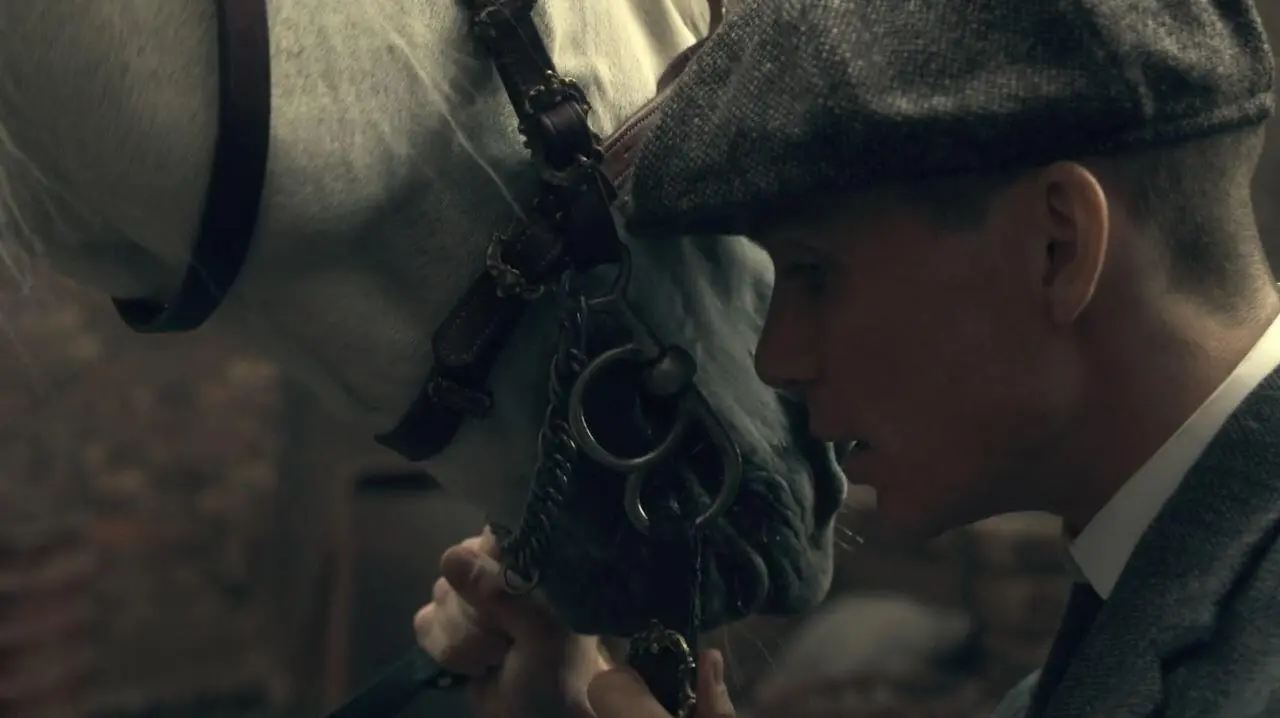
Fig. 3: Thomas ‘talks’ to his horse (S1/E2, 00:21).
Thomas’ “Gypsy half” comes forth in a number of scenes: a close-up shows him soothing a shying horse by pulling near his face and whispering into his nostrils in episode two of the first series (see fig. 3); in series two, he asks Curly for “black powder” to cure his wounds (E2, 00:06), and in series three, he consults Madame Boswell after the death of his wife (E3, 00:28). Yet, returned from the war, he is irreversibly embedded in and subject to the fundamentally modern way of life of the city. “I’ve been to France”, he answers Esme (S2/E5, 00:17), referring to the battlefields of the Great War. Rather than offering an escape into pre-modern tradition, this ‘Gypsy’ heritage allows an experience of the ‘sacred’ in the here and now of Thomas’ existence as a creation of modernity. He is acutely aware of his disbelief in curses and nonetheless comforted by Madame Boswell’s (coerced) confirmation that a cursed sapphire caused the death of his wife. His chosen method of solving conflicts, the toss of a coin, is a “sacred” (S4/E3, 00:27) act not because it is based on tradition, but because it creates a ‘sacred’ experience in the sense of the Collège de Sociologie, one which “transcends to social order”.
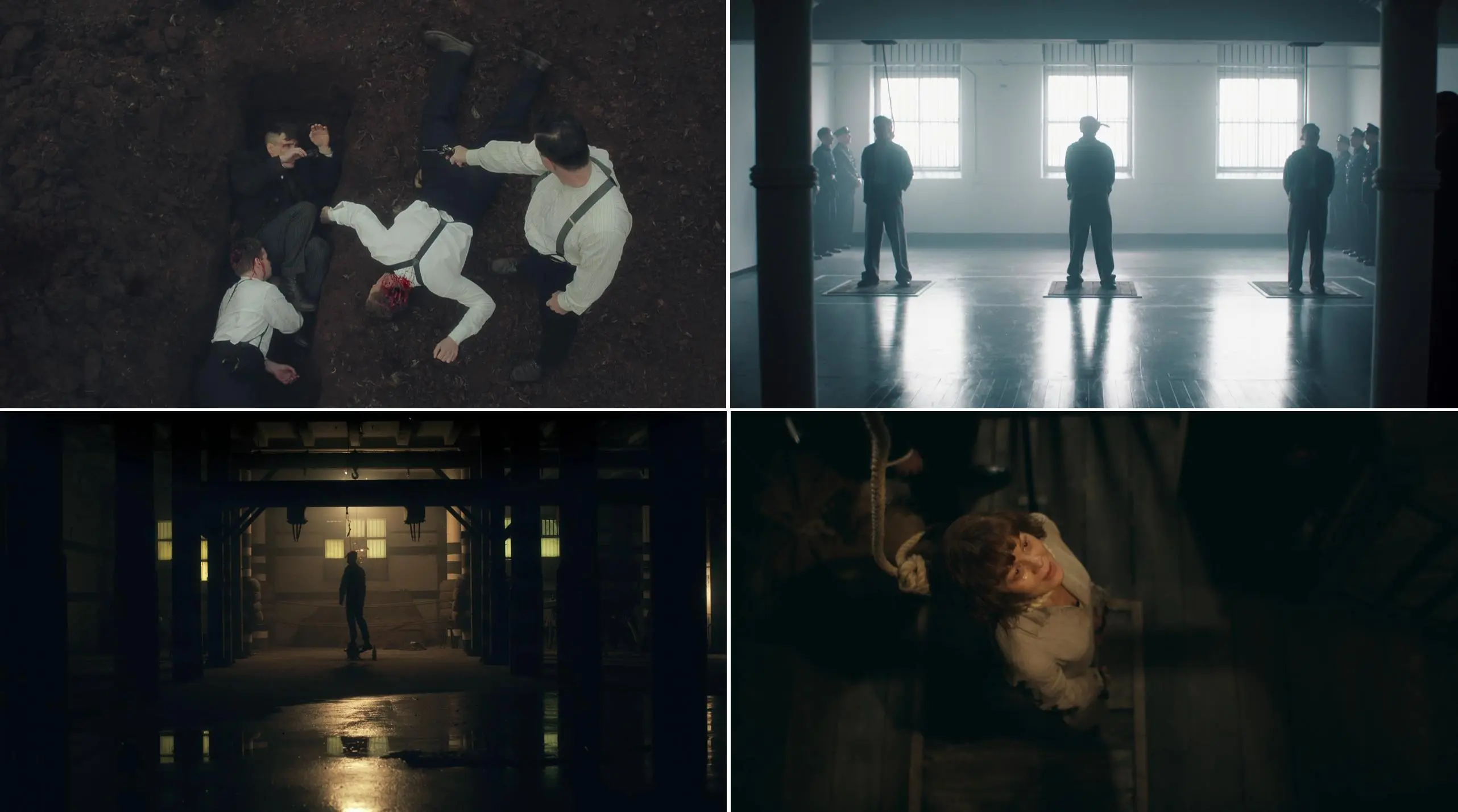
Fig. 4a (top left): Thomas prompted to “[g]et out of the grave [dug for him], tinker!” (S2/E6, 00:54).
Fig. 4b (bottom left): Arthur attempting to commit suicide (S1/E5, 00:50).Fig. 4c (top right): John, Arthur and Michael at their execution (S4/E1, 00:04).Fig. 4d (bottom right): Polly at her execution (S4/E1, 00:04).
The Romani Lee family in Peaky Blinders still travels the country, professing a (symbolic) sense of non-belonging. Apart from horse wagons, the ‘Gypsy’ means of travel is on the liminal space of the water of rivers and canals, on boat. What is more, the Shelby family, in particular Thomas, are methodically situated between life and death. “It’s in our Gypsy blood. We live somewhere between life and death”, reasons Polly in series four (E6, 00:46). Thomas is declared dead countless times. He narrowly escapes his own grave in the finale of series two (see fig. 4a), and he is resurrected after beaten half to death twice. In episode two of series two, his recovery is effected by a journey back to life on a boat steered by Curly, in turn linking this passage to ‘Gypsy’ ways of life, and in the fifth episode of series three, Thomas’ hospital recovery from a fractured skull is accompanied by David Bowie’s “Lazarus”. Arthur’s suicide attempt in series one fails (see fig. 4b), and his death is faked in series four (E6). He, John, Polly, and Michael have already been escorted to the noose in the first episode of series four when the news reaches them that they have been exonerated (see fig. 4c and fig. 4d).
The list could be continued. What it highlights is the family members’ socially unacknowledged status and, by extension, their non-normativity. As that which the establishment represses, the Shelbys prove that established norms are untenable under the conditions of modernity. The endeavour of grasping the Shelbys by means of an essential conception of identity remains futile; the family embodies the paradox of a community that can only exist if not too insistently articulated (see Bauman 11-2). This is what ‘new television’ has to offer: flawed, open, dysfunctional families. This is all there is in the midst of “normative emptiness” (Shuster 7), and yet, this is something. For the family, Shuster states, maintains the possibility of possibility, that of new life. Hence ‘ new television’: “in addition to being novel aesthetic objects these shows are conceptually linked by a genre or mode that explores the ‘newness’ that emerges from human natality, indeed, every human birth” (6). Family, then,
Читать дальшеИнтервал:
Закладка:
Похожие книги на «Community, Seriality, and the State of the Nation: British and Irish Television Series in the 21st Century»
Представляем Вашему вниманию похожие книги на «Community, Seriality, and the State of the Nation: British and Irish Television Series in the 21st Century» списком для выбора. Мы отобрали схожую по названию и смыслу литературу в надежде предоставить читателям больше вариантов отыскать новые, интересные, ещё непрочитанные произведения.







Обсуждение, отзывы о книге «Community, Seriality, and the State of the Nation: British and Irish Television Series in the 21st Century» и просто собственные мнения читателей. Оставьте ваши комментарии, напишите, что Вы думаете о произведении, его смысле или главных героях. Укажите что конкретно понравилось, а что нет, и почему Вы так считаете.