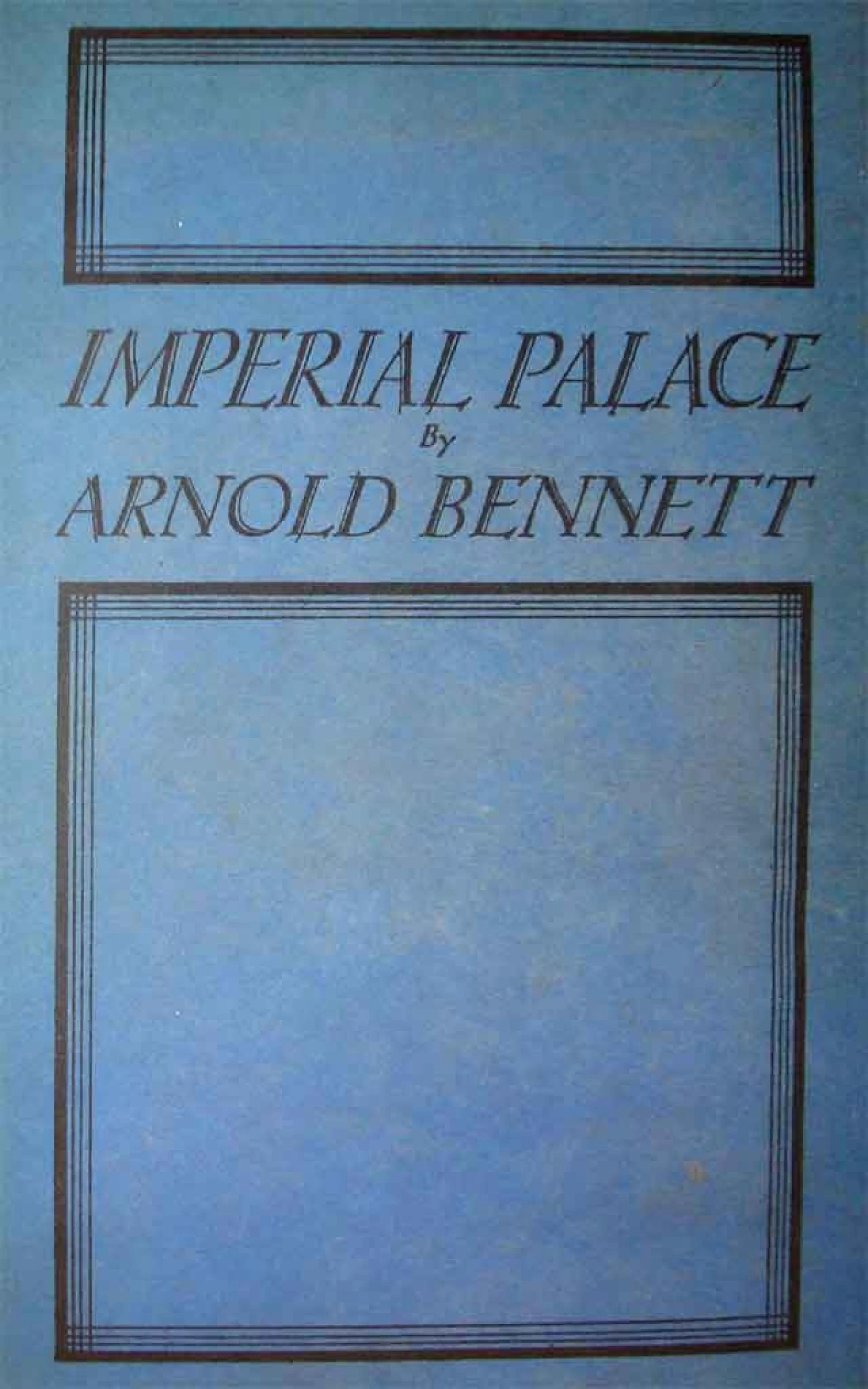
Arnold Bennett - Imperial Palace
Здесь есть возможность читать онлайн «Arnold Bennett - Imperial Palace» — ознакомительный отрывок электронной книги совершенно бесплатно, а после прочтения отрывка купить полную версию. В некоторых случаях можно слушать аудио, скачать через торрент в формате fb2 и присутствует краткое содержание. Жанр: unrecognised, на английском языке. Описание произведения, (предисловие) а так же отзывы посетителей доступны на портале библиотеки ЛибКат.
- Название:Imperial Palace
- Автор:
- Жанр:
- Год:неизвестен
- ISBN:нет данных
- Рейтинг книги:4 / 5. Голосов: 1
-
Избранное:Добавить в избранное
- Отзывы:
-
Ваша оценка:
Imperial Palace: краткое содержание, описание и аннотация
Предлагаем к чтению аннотацию, описание, краткое содержание или предисловие (зависит от того, что написал сам автор книги «Imperial Palace»). Если вы не нашли необходимую информацию о книге — напишите в комментариях, мы постараемся отыскать её.
Imperial Palace — читать онлайн ознакомительный отрывок
Ниже представлен текст книги, разбитый по страницам. Система сохранения места последней прочитанной страницы, позволяет с удобством читать онлайн бесплатно книгу «Imperial Palace», без необходимости каждый раз заново искать на чём Вы остановились. Поставьте закладку, и сможете в любой момент перейти на страницу, на которой закончили чтение.
Интервал:
Закладка:
A white-jacketed, black-trousered youth ceremoniously approached.
“Maddix,” Evelyn murmured to him before Sir Henry could speak.
The youth hurried away.
There were four solemn revellers at the bar, and a priest and an acolyte behind it. The ascetic priest was a thin, short, middle-aged man with a semi-bald cranium, a few close-cropped grey hairs, and an enormous dome of a forehead above grey eyes. Leaving the bar and his customers to the care of the acolyte, the priest came tripping with dignity across the room and halted in silence at Evelyn’s elbow.
“Well, Maddix, what’s your latest? Apollo?” Evelyn asked, hardly smiling.
“The Apollo is quite new, sir. But my latest I’ve christened Green Parrot. I only really finished it last night.”
“Not on the market yet?”
“Not as you might say, sir.”
“Well, Sir Henry, will you try a Green Parrot?”
“Good evening, Sir Henry,” said Maddix, his tone a mixture of deference and self-respect.
“Why of course it’s Maddix!” Sir Henry exclaimed, holding out his hand. “How are you, Maddix? Haven’t seen you since God knows when—at the Plaza in New York. You were a very famous figure there.”
Maddix took the offered hand with reserve.
“Yes, sir,” he agreed placidly. “I suppose I was. I suppose I was the best-known barman in New York for twenty years. Prohibition and Mr. Orcham brought me back home.”
“And how are the boys?” Sir Henry enquired.
“Which boys, Sir Henry? The general bar population?”
“No. Your two sons of course.” A swift change transformed the impassive countenance of the legendary world-figure, the formidable man whose demeanour divided the general bar population of the two greatest capitals in history into two groups, the group which ventured to address him as ‘Maddix,’ with or without familiar additions, and the group which did not venture. The countenance relaxed and showed human emotion.
“Thank you for remembering them, Sir Henry. The eldest is still over there. Fur trade. Seems to be dollars in it. The other one’s with me and his mother, here.”
“And what’s he doing?”
“Well, Sir Henry, you may think it queer. But I’ve got a tennis-court back of my little house at Fulham, and the boy’s gone mad on tennis. He means to be a professional player. His mother isn’t very pleased. But I say, ‘What can you do—if he’s made up his mind?’ Between parents and children things aren’t what they used to be, are they, Sir Henry?”
“They are not,” the millionaire concurred, thinking of Gracie.
“A Green Parrot then, Sir Henry?”
“I’ll risk it.”
“And you, sir?”
Evelyn said:
“Soft.”
“Excuse me, gentlemen,” said Maddix. “I should prefer to mix that Green Parrot myself.” He went away.
“A character!” observed Sir Henry. “How did you manage to get him away from New York?”
“I saw him once or twice when I was over there,” Evelyn answered placidly. “He said he’d like to come home. I believed him. Considering Prohibition! A man who can live for twenty years behind a New York bar and never pick up an American accent—and never use a word of American slang—well, there must be something incurably English about him. I told him I had the finest American bar in the world, and I wanted the finest barman in the world to take charge of it. He came. Of course he gets the salary of an Under-Secretary of State. So he ought to.”
“Not quite the cocktail hour here, is it?” said Sir Henry, again glancing around at the large, half-empty room.
“No. It’s too late and too early. But it’ll soon be the liqueur hour. Extraordinary how many men prefer to come in here for a drink at the end of a meal. They feel more at home near a bar, even if they don’t stand at it.”
II
Two fat men in lounge-suits wandered in. The first word that Evelyn caught in their self-conscious conversation was the word ‘Acceptances.’ He knew and cared absolutely nothing about racing; but he had the wit to gather that Acceptances were one of the few human phenomena capable of making all men kin. The talk among the leaners against the bar suddenly rose to loudness. “And I say that gin is the——” he heard, from an affected and disputatious voice. (He would have liked to hear a profound remark concerning women from some other quarter of the room; but he was disappointed.) He thought: “There was a quality about that wigwam in the Westminster Bridge Road that this place hasn’t got. The free-and-easy! This place is too stiff.” And he began to wonder how the Prince of Wales’s Feathers’ quality could be added to the qualities of the Imperial Palace American bar. “No!” he decided. “Couldn’t be done. Wouldn’t do, either.” But he regretted its absence from the too correct and august atmosphere of the place.
Then a procession moved from the bar in the direction of Evelyn and Sir Henry: an acolyte solemnly bearing a tray upon which were two small glasses, one green, one yellow, followed by the priestly Maddix. Evelyn took the yellow glass, Sir Henry the green. The acolyte bowed and retired. Maddix stood, awaiting in silence the verdict of Sir Henry. Evelyn absurdly wished that Maddix, with rolled-up shirt-sleeves exposing hairy forearms, might have exclaimed freely: “Well, what abaht it, guv’nor?”
Observing that Sir Henry’s eyes were on Evelyn’s glass, not on his own, Maddix allowed himself to remark:
“Mr. Orcham is not much for cocktails.”
“I’m much more for cocktails than you are, Maddix,” Evelyn said. And to Sir Henry: “Maddix is a strict teetotaller.”
“Then how do you manage to invent these things?” asked Sir Henry, gazing now at the green glass.
“I taste. I never swallow.”
Sir Henry both tasted and swallowed, and, putting on the air of a connoisseur, amiably delivered judgment: “Very original. Very good.”
Maddix bowed his gratitude—a bow hardly perceptible; he had divined that to the millionaire all cocktails were more or less the same cocktail. The experience of decades, the inventive imagination of a genuine creator, and some good luck, had gone into the conceiving of the Green Parrot cocktail, and the millionaire recked not, sympathised not, understood not! He had been friendly enough about the human offspring of the cocktail genius, but to the miracles of cocktail art God had decreed that he should be insensible. As a fact Maddix did not know more than ten men in London who truly comprehended the great classical principles of the cocktail. Evelyn was one of the ten.
Sir Henry began to talk to Evelyn. Maddix sedately walked away, the artist sardonic because unappreciated by a barbaric public.
Presently Evelyn glanced at his watch.
“Perhaps we ought to go back to the foyer.”
“Lots of time,” said Sir Henry soothingly.
At that moment the whole room, from the bar to the furthest corner, became agitated with a unique agitation, and every masculine face seemed to be saying: “Strange things have happened, but this is the strangest.” Oblivious of the printed notice prominently displayed at the entrance, a woman was intruding. And not merely a woman, but a young woman, a beautiful woman, proud of bearing, clad in a magnificent frock of mauve and pink, and glinting with jewels. And neither apology nor challenge in her mien. Maddix started instinctively into protest at this desecration; then stopped, thinking: “A greater than me is here. Let him deal with the unparalleled outrage.” And yet the outrage was delicious to every beholding male, even to Maddix himself. The woman went straight to Evelyn and Sir Henry, who both rose quickly. Sir Henry at any rate felt that she must be removed at once. Evelyn did not care whether she was removed or not: in the Palace he was above all laws; the one law was his own approval.
Читать дальшеИнтервал:
Закладка:
Похожие книги на «Imperial Palace»
Представляем Вашему вниманию похожие книги на «Imperial Palace» списком для выбора. Мы отобрали схожую по названию и смыслу литературу в надежде предоставить читателям больше вариантов отыскать новые, интересные, ещё непрочитанные произведения.








Обсуждение, отзывы о книге «Imperial Palace» и просто собственные мнения читателей. Оставьте ваши комментарии, напишите, что Вы думаете о произведении, его смысле или главных героях. Укажите что конкретно понравилось, а что нет, и почему Вы так считаете.