Arnold Bennett - Imperial Palace
Здесь есть возможность читать онлайн «Arnold Bennett - Imperial Palace» — ознакомительный отрывок электронной книги совершенно бесплатно, а после прочтения отрывка купить полную версию. В некоторых случаях можно слушать аудио, скачать через торрент в формате fb2 и присутствует краткое содержание. Жанр: unrecognised, на английском языке. Описание произведения, (предисловие) а так же отзывы посетителей доступны на портале библиотеки ЛибКат.
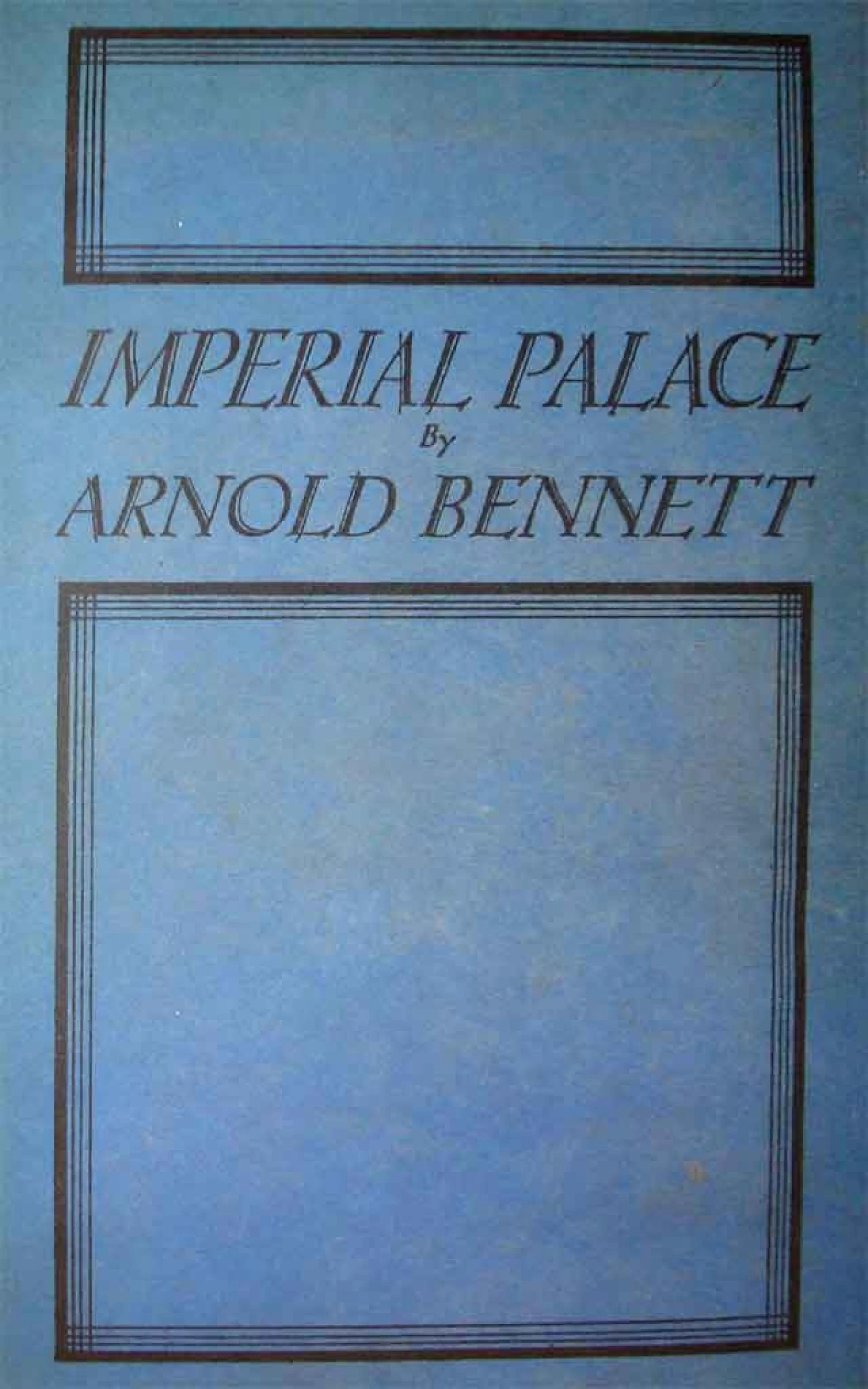
- Название:Imperial Palace
- Автор:
- Жанр:
- Год:неизвестен
- ISBN:нет данных
- Рейтинг книги:4 / 5. Голосов: 1
-
Избранное:Добавить в избранное
- Отзывы:
-
Ваша оценка:
Imperial Palace: краткое содержание, описание и аннотация
Предлагаем к чтению аннотацию, описание, краткое содержание или предисловие (зависит от того, что написал сам автор книги «Imperial Palace»). Если вы не нашли необходимую информацию о книге — напишите в комментариях, мы постараемся отыскать её.
Imperial Palace — читать онлайн ознакомительный отрывок
Ниже представлен текст книги, разбитый по страницам. Система сохранения места последней прочитанной страницы, позволяет с удобством читать онлайн бесплатно книгу «Imperial Palace», без необходимости каждый раз заново искать на чём Вы остановились. Поставьте закладку, и сможете в любой момент перейти на страницу, на которой закончили чтение.
Интервал:
Закладка:
“That ought to be all right,” she murmured.
II
She stood at the heavy, narrow double doors, expectant that he should open them for her. He pushed hard against one of them. As soon as Gracie had squeezed through the door banged back on Evelyn. Then he had to push it a second time. He too squeezed through, and the door gave a short series of quick bangs, diminuendo.
A small room. A counter in front of them. Shelves full of bottles behind the counter. No barman at the counter. To the left a glazed mahogany partition, very elaborate. A panelled mahogany wall opposite the partition, and another opposite the counter, and advertisements of alcohol across the panels. A very heavily sculptured ceiling. A sanded floor. Along the two panelled walls ran two mahogany benches, with a small round barrel, its top stained in circles, at the angle. A powerful odour of ale. Sound of rough voices, strident or muttering, over the curved summit of the partition.
“Oh! What a horrible lovely place!” said Gracie, sitting down on a bench near the barrel. “But it’s exactly what I thought it would be.”
A barman appeared at the counter.
“This is mine,” said Gracie to Evelyn, and to the barman: “Two light sherries, please.” And to Evelyn: “That right?”
“Right you are, miss,” said the barman with cheerful heartiness, and reached down a bottle from one of the shelves.
Evelyn had been afraid that she might order beer; but she had ordered the only correct, the only possible, thing; sherry had at least an air of decorum; also it was the only wholesome apéritif. The girl knew her way about; he supposed that all these girls did; he supposed it was proper that they should, and although he did not quite like it he strove to broaden his views concerning girls in order to like it. “A bit too much of the oriental attitude about me about young women!” he thought.
“Here you are, sir,” said the barman, addressing Evelyn this time. And Evelyn had to fetch the too full glasses from the counter.
“One and four, sir.”
Evelyn paid.
The counter was wet with sherry. The barman rubbed it hard with a towel that had once been clean. The hearty, hail-fellow-well-met barman in his shirt-sleeves, to say nothing of the dirty towel, made a rude contrast with the manners which obtained at the celebrated Imperial Palace American bar, where the celebrated head-barman was a strict teetotaller with a head like that of a Presbyterian minister and a dispensing knowledge in the head of a hundred and thirteen different cocktails. At the Palace drinks were ceremoniously brought to seated customers by young men in immaculate white jackets—and Evelyn knew the exact sum per dozen debited by the Laundry to the hotel for the washing and getting-up of the white jackets. And no waiter there would venture to name the price of a drink until asked.
“You give me that twopence,” said Gracie, fumbling in her bag, as Evelyn sat down with his change in his hand. “And I’ll give you eighteenpence.”
He accepted the suggestion without argument. Why should not girls pay if they chose? As for the particular case of Gracie, she probably spent on herself the equivalent of Evelyn’s entire income, which nevertheless yielded a considerable super-tax to the State. Evidently her big baggage had arrived at the Palace, for she was wearing another frock and still another hat. Beneath and above the stern chic of the leather coat was visible the frivolous chic of the frock and the hat.
“Yours!” said Gracie, raising her glass. “You aren’t cross, are you?”
“No. Why should I be?”
“I don’t know,” said Gracie. “But you look so severe I’m frightened.”
“Take more than that to frighten you,” Evelyn retorted, forcing a grim smile.
“Not a bad sherry this,” he added, enquiring with his brain into the precise sensations of his palate. He was proud that he and no other selected the wines for the Palace. He recalled some good phrases from his formal lectures to the wine-waiters upon their own subject.
“But it is rather a jolly place, isn’t it?” said Gracie. “Do come down off the roof to the ground-floor.”
He smiled less grimly. Why not be honest? It was indeed rather a jolly place: strange, exotic, romantic. And he did like the freedoms of the barman, after the retired, artificial, costive politenesses of the Palace service. He saw charm even in the dirty towel. (And she had discovered the place, and had had the enterprise to enter it.) He was seeing London, indigenous London. The Palace was no part of London. Why not for a change yield to the attraction of the moment? Of course if he were caught sitting with a smart young woman in a corner of the Prince of Wales’s Feathers in Westminster Bridge Road, his friends or his customers or his heads of departments might lift an eye-brow. But he could not be caught. Moreover the Feathers would be the height of respectability to ninety-nine decent Londoners out of a hundred. And even if it were not respectable—well, Gracie was above respectability. Violet Powler would not be. But Gracie was. She had robust ideas about things. He was bound to admire her robust taste, and her adventurous enterprise. Violet Powler would shrink from the invitation of the Feathers. He himself had shrunk from it. He suffered from masculine timidity and conventionality. Gracie and her sort had something to teach him.
“You know the telephone-message you sent to daddy this morning.” Gracie began her business. “Well, daddy was fast asleep, and it came to me.” She told him quite frankly what she had done. “That’s why I wanted to see you.” Here she lit a cigarette, and Evelyn, determined to surpass her, lit a cigar. She explained to him her father’s Napoleonic sensitiveness. “I’d like you to do something. I couldn’t bear any trouble between you and daddy,” she finished, with eagerness. Her rich, changing voice fell enchantingly on his ear.
What did that mean: couldn’t bear any trouble between him and Sir Henry? Did it mean that any such trouble might compromise the relations between her and himself, and that that was what she couldn’t bear? Odd, flattering, insidious, specious implication! He leaned closer to her:
“What would you like me to do?”
Intimacy was suddenly increased. How was it that they had become so intimate in a dozen hours of spasmodic intercourse? He knew. It was because they had gone off together on a romantic excursion in what was for her the middle of the night. One visit to strange Smithfield before dawn would create more familiarity, demolish more barriers between soul and soul, than ten exquisite dinners exquisitely served within the trammels of a polite code. . . . Never again could they be mere acquaintances.
“Couldn’t you ask daddy to dinner to-night—and me? He’d appreciate it frightfully.”
Evelyn was astounded afresh. What on earth would the incredible girl say next? He could not phrase a reply.
Fortunately at this juncture four men entered the bar. They were clad somewhat in the style of Mr. Cyril Purkin, but more flashily. They had glittering watch-chains, jewelled rings, rakish hats and neckties and tie-pins, and assurance. If not prosperous, they looked prosperous. They glanced casually at Evelyn and Gracie, and glanced away. Men of the world, whom vast experience of the world had carried far beyond the narrow curiosity of hard-working persons—persons who had to look twice at sixpence. Evelyn was decidedly more interested in them than they were interested in him and Gracie. They leaned against the counter, called ‘Jock,’ ‘Jock,’ and when Jock came they ordered four double whiskies. They were discussing the day’s racing. Then they talked about the secret significance of ‘acceptances.’ They sipped the whiskies.
Читать дальшеИнтервал:
Закладка:
Похожие книги на «Imperial Palace»
Представляем Вашему вниманию похожие книги на «Imperial Palace» списком для выбора. Мы отобрали схожую по названию и смыслу литературу в надежде предоставить читателям больше вариантов отыскать новые, интересные, ещё непрочитанные произведения.







Обсуждение, отзывы о книге «Imperial Palace» и просто собственные мнения читателей. Оставьте ваши комментарии, напишите, что Вы думаете о произведении, его смысле или главных героях. Укажите что конкретно понравилось, а что нет, и почему Вы так считаете.