Alan Gunn - Parasitology
Здесь есть возможность читать онлайн «Alan Gunn - Parasitology» — ознакомительный отрывок электронной книги совершенно бесплатно, а после прочтения отрывка купить полную версию. В некоторых случаях можно слушать аудио, скачать через торрент в формате fb2 и присутствует краткое содержание. Жанр: unrecognised, на английском языке. Описание произведения, (предисловие) а так же отзывы посетителей доступны на портале библиотеки ЛибКат.
- Название:Parasitology
- Автор:
- Жанр:
- Год:неизвестен
- ISBN:нет данных
- Рейтинг книги:3 / 5. Голосов: 1
-
Избранное:Добавить в избранное
- Отзывы:
-
Ваша оценка:
Parasitology: краткое содержание, описание и аннотация
Предлагаем к чтению аннотацию, описание, краткое содержание или предисловие (зависит от того, что написал сам автор книги «Parasitology»). Если вы не нашли необходимую информацию о книге — напишите в комментариях, мы постараемся отыскать её.
Highly detailed textbook on parasites and parasite relationships Parasitology: An Integrated Approach
Parasitology: An Integrated Approach, 2nd edition
Parasitology — читать онлайн ознакомительный отрывок
Ниже представлен текст книги, разбитый по страницам. Система сохранения места последней прочитанной страницы, позволяет с удобством читать онлайн бесплатно книгу «Parasitology», без необходимости каждый раз заново искать на чём Вы остановились. Поставьте закладку, и сможете в любой момент перейти на страницу, на которой закончили чтение.
Интервал:
Закладка:
3.3.2.5 Tritrichomonas foetus
This is a sexually transmitted parasite of cattle, and although it is also found as a sexually transmitted infection in other animals (e.g., horses), it is not usually pathogenic in them. The trophozoite of T. foetus is a pear‐shaped organism 10–25 μm long and 3–15 μm wide with four anterior flagella, three of which are free and one flagellum curves backwards to form an undulating membrane that extends the length of the body and then projects freely from the posterior apex ( Figure 3.8). There is no cyst stage although they form pseudocysts in response to iron depletion. It is uncertain whether the pseudocyst stage plays an important role in parasite transmission.
In bulls, the parasites are usually found in the preputial cavity and cause little harm although there is sometimes inflammation that causes painful urination and unwillingness to copulate. In cows, the parasite causes more serious pathology. The infection begins with vaginitis and then spreads to the uterus where they can cause early abortion and permanent sterility. The parasite remains in the lumen and does not penetrate the underlying tissues.
There are increasing reports of T. foetus causing large bowel diarrhoea in domestic cats in the UK, USA, and parts of Europe. The parasites isolated from cats are morphologically identical to those from cattle, and there are only very minor differences in their DNA sequences (Yao and Köster 2015). Therefore, the current consensus is that they represent two isolates of a single species. However, in cats, transmission of the parasite occurs through faecal–oral contamination.
3.3.2.6 Pentatrichomonas hominis
This parasite usually lives as a harmless commensal in our large intestine and caecum. It has a worldwide distribution and in addition to humans, it colonizes the large intestine of many wild and domestic mammals, including sheep, dogs, pigs, and monkeys. However, the extent to which zoonotic transfer occurs is uncertain.
The trophozoite is pear‐shaped, 5–15 μm long, and 7–10 μm wide with four free flagellae at the anterior end ( Figure 3.7). A fifth flagellum curves back to form an undulating membrane that extends the length of the body and then projects freely from the posterior apex.
Prevalences tend to be higher in children than in adults. Sometimes it is associated with diarrhoea but whether it causes the condition is not known. Similarly, although there is a higher prevalence of P. hominis in patients suffering from gastrointestinal cancer than in healthy patients, whether there is a causative association is uncertain (Zhang et al. 2019).
3.4 Phylum Apicomplexa
The Apicomplexa is one of the largest phyla amongst the protozoa and includes many important parasites of humans and domestic animals ( Table 3.1).
As with many other protozoa, the taxonomic arrangements within the Apicomplexa are in a state of flux. All members of the phylum are obligate intracellular parasites of invertebrates and vertebrates. A common feature shared by all apicomplexans is the presence within their invasive stage of a unique intracellular structure called the apical complex that is composed of a group of secretory organelles called the micronemes and rhoptries ( Figure 3.9). The apical complex lies at the anterior apex of the cell where it is associated with a region called the oral structure. The secretions of the micronemes and the rhoptries play an important role in the invasion of red blood cells by the malaria parasites (Suarez et al. 2019).
Table 3.1 Representative examples of parasitic protozoa belonging to the phylum Apicomplexa to illustrate the wide variety of hosts and transmission strategies.
| Genus | Example | Host | Transmission | Disease |
|---|---|---|---|---|
| Plasmodium | Plasmodium falciparum | Humans | Vector: Anopheline mosquitoes | Malaria |
| Toxoplasma | Toxoplasma gondii | All warm‐blooded animals | Contamination, congenital, ingestion of infected flesh | Toxoplasmosis |
| Neospora | Neospora caninum | Dogs, cattle | Contamination, congenital | Neosporosis |
| Cyclospora | Cyclospora cyetanensis | Humans | Contamination | Cyclosporosis |
| Eimeria | Eimeria tenella | Poultry | Contamination | Coccidiosis |
| Theileria | Theileria parva | Cattle | Vector: Rhipicephalus ticks | East Coast Fever |
| Babesia | Babesia bigemina | Cattle | Vector: Rhipicephalus ticks | Texas Fever |
| Isospora | Isospora belli | Humans | None | Isosporosis |
| Cryptosporidium | Cryptosporidium hominis | Humans | Contamination | Cryptosporidiosis |
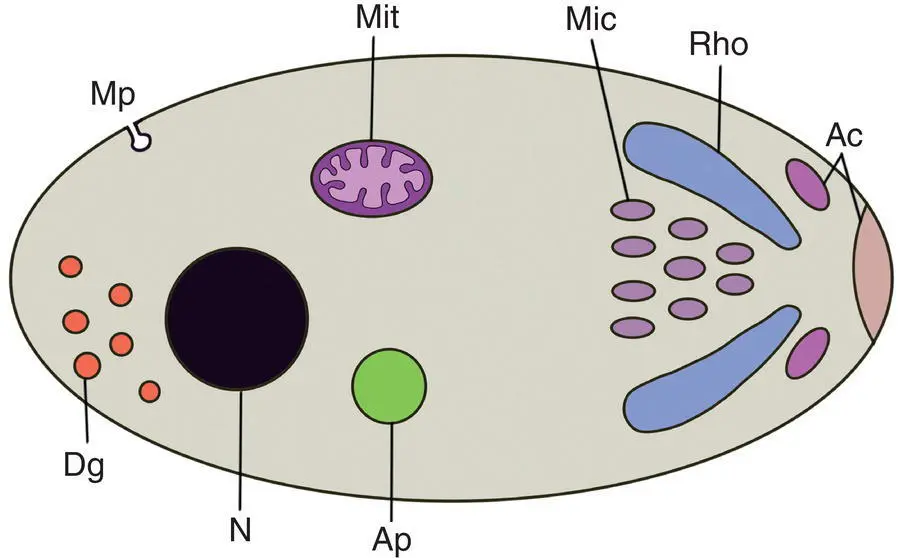
Figure 3.9 Generalized diagram of the invasive stage of an apicomplexan parasite. Abbreviations: Ac: apical complex (conoid + polar ring); Ap: apicoplast; Dg: dense granules; Mic: micronemes; Mit: mitochondrion; Mp: micropore; N: nucleus; Rho: rhoptries.
Plastids in Parasites
Apicomplexans contain a unique organelle called the apicoplast that probably evolved from a chloroplast (plastid) although it does not contain any pigments. Molecular studies indicate that the protozoa currently comprising the Apicomplexa arose from at least three independent transitions of free‐living photosynthetic algae to intracellular parasites (Mathur et al. 2019). The apicoplast has four membranes and contains DNA although most of the genes that code for proteins within it have transferred to the nucleus. Interestingly, a protist, Chromera velia , that is phylogenetically related to the Apicomplexans contains a functioning plastid that is morphologically similar to that found in the Apicomplexans (Moore et al. 2008). Chromera velia is usually free‐living, but it can form endosymbiotic relationships with the larvae of certain corals. It is related to the dinoflagellate algae – a group that includes species that combine photosynthesis with other forms of nutrition, including predation. The apicoplast is of interest because it has no equivalent in the parasite’s animal hosts and therefore is a potential target for specifically designed chemotherapeutics. The apicoplast produces essential metabolites and the parasites die if exposed to drugs that interfere with its functions (Lim et al. 2016).
Molecular phylogeny suggests that some of the Kinetoplastida may also have contained plastids at an early stage in their evolution, but these have since been lost. Many euglenid protozoa contain chloroplasts (e.g., Euglena gracilis ), and these are closely related to the Kinetoplastida. However, ultrastructural studies suggest that the euglenids acquired their plastids after the point at which they diverged from the Trypomastigota (Leander 2004).
3.4.1 Genus Plasmodium
The genus Plasmodium probably evolved hundreds of millions of years ago and long before the arrival of the vertebrates (Escalante and Ayala 1995). There are over 200 species, most of which are parasites of birds. In addition, many species infect reptiles, rodents, and primates. Blood‐feeding insects, especially mosquitoes, act as their vectors. Four principal species infect humans: Plasmodium falciparum, Plasmodium vivax, Plasmodium ovale, and Plasmodium malariae . A fifth species, Plasmodium knowlesi normally parasitizes monkeys but sometimes causes fatal human infections. In addition, there are rare case reports of people becoming infected by species of Plasmodium that normally parasitize other animals. In most vertebrate hosts, Plasmodium parasites are not particularly pathogenic but in humans, they cause the disease malaria. Historical literature usually refers to it as the ague or marsh fever. The word ague derives from the Latin for sharp ( acutus ) because it manifests as a sharp fever ( febris acuta ) whilst living in a marshy district has long been associated with ill health – although this was attributed to the bad air (hence mal aria ) rather than the anopheline mosquitoes flying in it.
Читать дальшеИнтервал:
Закладка:
Похожие книги на «Parasitology»
Представляем Вашему вниманию похожие книги на «Parasitology» списком для выбора. Мы отобрали схожую по названию и смыслу литературу в надежде предоставить читателям больше вариантов отыскать новые, интересные, ещё непрочитанные произведения.










Обсуждение, отзывы о книге «Parasitology» и просто собственные мнения читателей. Оставьте ваши комментарии, напишите, что Вы думаете о произведении, его смысле или главных героях. Укажите что конкретно понравилось, а что нет, и почему Вы так считаете.