Alan Gunn - Parasitology
Здесь есть возможность читать онлайн «Alan Gunn - Parasitology» — ознакомительный отрывок электронной книги совершенно бесплатно, а после прочтения отрывка купить полную версию. В некоторых случаях можно слушать аудио, скачать через торрент в формате fb2 и присутствует краткое содержание. Жанр: unrecognised, на английском языке. Описание произведения, (предисловие) а так же отзывы посетителей доступны на портале библиотеки ЛибКат.
- Название:Parasitology
- Автор:
- Жанр:
- Год:неизвестен
- ISBN:нет данных
- Рейтинг книги:3 / 5. Голосов: 1
-
Избранное:Добавить в избранное
- Отзывы:
-
Ваша оценка:
Parasitology: краткое содержание, описание и аннотация
Предлагаем к чтению аннотацию, описание, краткое содержание или предисловие (зависит от того, что написал сам автор книги «Parasitology»). Если вы не нашли необходимую информацию о книге — напишите в комментариях, мы постараемся отыскать её.
Highly detailed textbook on parasites and parasite relationships Parasitology: An Integrated Approach
Parasitology: An Integrated Approach, 2nd edition
Parasitology — читать онлайн ознакомительный отрывок
Ниже представлен текст книги, разбитый по страницам. Система сохранения места последней прочитанной страницы, позволяет с удобством читать онлайн бесплатно книгу «Parasitology», без необходимости каждый раз заново искать на чём Вы остановились. Поставьте закладку, и сможете в любой момент перейти на страницу, на которой закончили чтение.
Интервал:
Закладка:
3.3.2.2 Trichomonas vaginalis
Millions of people are infected with Trichomonas vaginalis and some estimates suggest that it is the most common non‐viral sexually transmitted infection in the world (Kissinger 2015). However, prevalences vary considerably between countries, and it is not especially common in the United Kingdom with around 6,000 cases per year (Field et al. 2018). By contrast, a study of trichomoniasis in four African cities found prevalences ranging from 6.5 to 40% (Buvé et al. 2001). Despite its name, T. vaginalis , frequently infects men, but it causes them little harm and they usually clear the infection rapidly. Infected men can transmit the infection to women during sexual intercourse and rectal T. vaginalis infections can occur in men‐who‐have‐sex‐with‐men (Hoffman et al. 2018).
The parasite is ‘tear‐drop’ shaped with five flagellae emerging at the anterior end: four of these flagella are free whilst the fifth curves back to form a short undulating membrane that extends just over half the length of the cell ( Figure 3.7). Trichomonas vaginalis expresses only one body shape, but its size varies considerably: the length can be 7–32 μm, whilst the width is 5–12 μm. In common with other diplomonads, there are no mitochondria, but they possess a row of hydrogenosomes alongside the axostyle. This arrangement distinguishes T. vaginalis from other trichomonad species. Hydrogenosomes probably derive from mitochondria but unlike the more degenerate mitosomes, they make ATP, as well as the hydrogen that gives them their name. Interestingly, although T. vaginalis only infects us, molecular evidence indicates that it originated in pigeons and subsequently switched hosts (Peters et al. 2020).
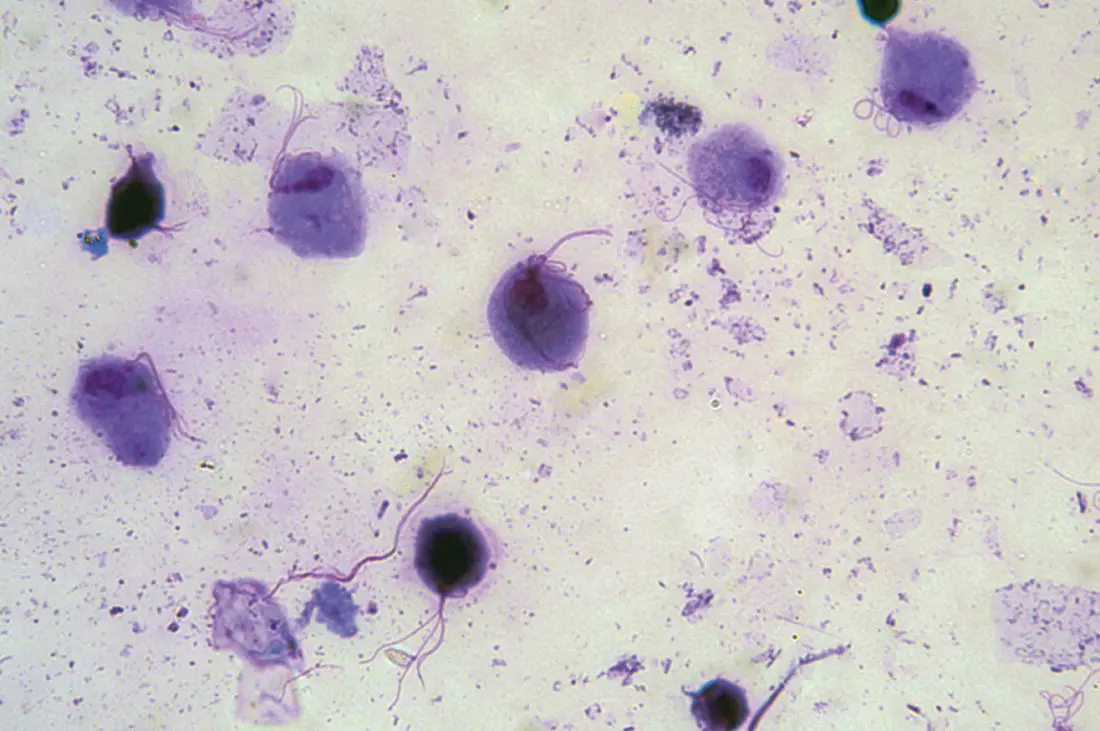
Figure 3.7 Trichomonas vaginalis . This protozoan parasite expresses only one body shape, but its size varies considerably: the length can be 7–32 μm, whilst the width is 5–12 μm. Five flagellae emerge at the anterior end: four of these flagella are free whilst the fifth curves back to form a short undulating membrane that extends just over half the length of the cell.
Although T. vaginalis infects millions of women every year, most of them remain asymptomatic. The protozoa feed on bacteria and sloughed off epithelial cells present in the reproductive tract. However, in some women the parasites induce a severe inflammatory response that manifests as a copious frothy white or greenish vaginal discharge. Infection during pregnancy is often associated with poor outcomes such as premature delivery and below‐average birth weight for the baby, although whether the parasite induces these effects is uncertain.
3.3.2.3 Trichomonas tenax
This is a common human parasite and occurs throughout the world. It is rather like T. vaginalis in appearance although it is slightly smaller (5–16 μm long, 2–15 μm wide), has a somewhat shorter undulating membrane, and the hydrogenosomes are arranged differently. Molecular studies indicate a close similarity between the two species and T. tenax may be a variant of T. vaginalis (Kucknoor et al. 2009). Trichomonas tenax is usually restricted to the oral cavity where it feeds on bacteria and tissue debris.
Trichomonas tenax does not form cysts and cannot survive passage through the digestive tract. Consequently, transmission probably involves contamination via kissing and the sharing of food and eating/drinking utensils. It is less host fastidious than T. vaginalis, and in addition to humans, it infects various domestic animals, including cats and dogs (Kellerová and Tachezy 2017). There is therefore the potential for zoonotic transmission between those besotted owners who inexplicably kiss their pets and those who do not follow basic hygiene during food preparation and consumption.
Although T. tenax is associated with periodontal diseases (Marty et al. 2017), it is also common in people with good dental hygiene. This is probably because strains of T. tenax differ in their pathogenicity (Benabdelkader et al. 2019). There are occasional reports of bronchopulmonary infections, but these are usually associated with pre‐existing pulmonary conditions, such as cancer.
3.3.2.4 Trichomonas gallinae
Trichomonas gallinae has a worldwide distribution and is a common parasite of poultry, pigeons, and many other birds. In doves and pigeons, it causes a condition called ‘canker’ whilst in birds of prey the condition is known as ‘frounce’. It lives predominantly in the upper digestive tract and particularly the crop. In contrast, the related species Tetratrichomonas gallinarum tends to live in the lower digestive tract, caeca, and sometimes the liver.
The trophozoites of T. gallinae are usually ovoid in shape, 7–11 μm in length, and have four free flagella with a fifth recurving to form an undulating membrane ( Figure 3.8). There is no cyst stage. Strains differ in their pathogenicity and pigeons, doves, and other members of the colubriformes are more badly affected than most other birds. In addition, raptors such as peregrine falcons ( Falco peregrinus ) and sparrowhawks ( Accipiter nisus ) that consume pigeons often suffer badly from T. tenax infections, and this can have consequences for their conservation (Dudek et al. 2018).
Avian trichomoniasis (trichomonosis) is an emerging disease in finches and other passerine birds in the UK, Europe, and Canada (Chi et al. 2013; Forzán et al. 2010). The first report of the problem was from the United Kingdom in 2005. Since then, it has become an ongoing epidemic as migrating birds spread the parasite across the country and throughout Europe. In the United Kingdom, this has resulted in a catastrophic decline in the number of greenfinches ( Chloris chloris ). In Europe, the epidemic is associated with a single clonal strain of T. tenax that is distinct from the strain causing extensive bird mortalities in America (Alrefaei et al. 2019).

Figure 3.8 Trichomonad parasites of animals. (a): Tritrichomonas foetus ; (b): Trichomonas gallinae .
Source : Reproduced from Chandler and Read, (1961), © Wiley‐Blackwell.
The pathogenic strains of T. tenax induce lesions in the wall of the intestine and the parasites, then spread around the bird’s body and cause liver pathology similar to that of Histomonas meleagridis . Young birds are the worst affected, and whilst adults are often infected, they do not show evidence of disease – although they act as carriers of infection. In badly affected birds, necrotic lesions to the intestine and mouth can extend to the bones.
Pigeons often clash bills during social interactions and until they are 10 days old; young squabs feed by pushing their beaks into their parent’s mouth to feed on ‘milk’ held within the parent’s crop. This provides many opportunities for parasite transmission to occur. Trichomonas tenax probably spread from pigeons to finches through infected pigeons contaminating garden birdbaths. In addition, in the United Kingdom, there has been a marked rise in the population of wood pigeons, and this has probably increased the levels of contamination. The parasites can survive for up to 1 hour in water, so a single infected bird can potentially infect many others after using a popular birdbath. They can also survive on moist but not dry bird seed, so it is possible that in some circumstances bird feeders may act as an additional source of infection (McBurney et al. 2017).
Читать дальшеИнтервал:
Закладка:
Похожие книги на «Parasitology»
Представляем Вашему вниманию похожие книги на «Parasitology» списком для выбора. Мы отобрали схожую по названию и смыслу литературу в надежде предоставить читателям больше вариантов отыскать новые, интересные, ещё непрочитанные произведения.










Обсуждение, отзывы о книге «Parasitology» и просто собственные мнения читателей. Оставьте ваши комментарии, напишите, что Вы думаете о произведении, его смысле или главных героях. Укажите что конкретно понравилось, а что нет, и почему Вы так считаете.