Alan Gunn - Parasitology
Здесь есть возможность читать онлайн «Alan Gunn - Parasitology» — ознакомительный отрывок электронной книги совершенно бесплатно, а после прочтения отрывка купить полную версию. В некоторых случаях можно слушать аудио, скачать через торрент в формате fb2 и присутствует краткое содержание. Жанр: unrecognised, на английском языке. Описание произведения, (предисловие) а так же отзывы посетителей доступны на портале библиотеки ЛибКат.
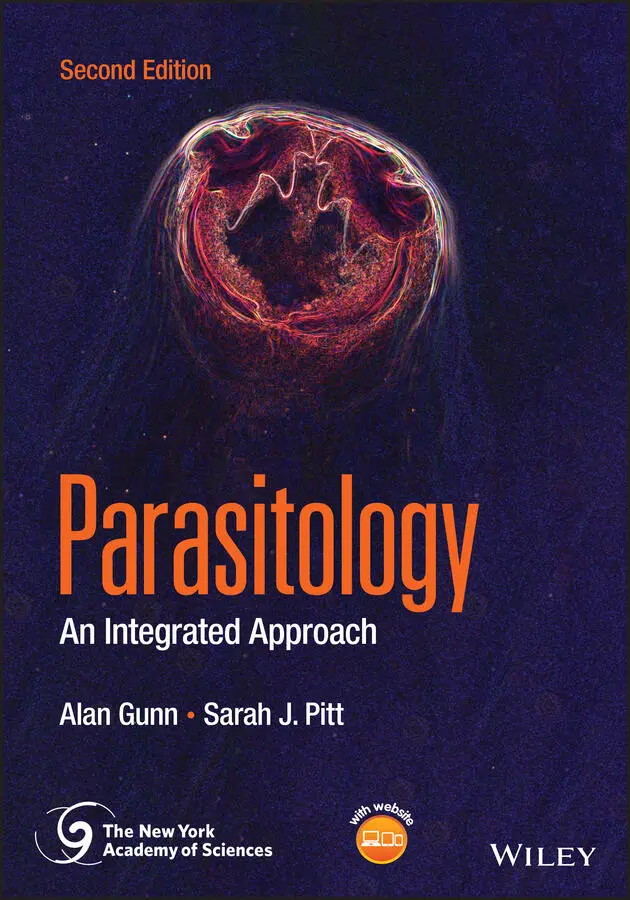
- Название:Parasitology
- Автор:
- Жанр:
- Год:неизвестен
- ISBN:нет данных
- Рейтинг книги:3 / 5. Голосов: 1
-
Избранное:Добавить в избранное
- Отзывы:
-
Ваша оценка:
Parasitology: краткое содержание, описание и аннотация
Предлагаем к чтению аннотацию, описание, краткое содержание или предисловие (зависит от того, что написал сам автор книги «Parasitology»). Если вы не нашли необходимую информацию о книге — напишите в комментариях, мы постараемся отыскать её.
Highly detailed textbook on parasites and parasite relationships Parasitology: An Integrated Approach
Parasitology: An Integrated Approach, 2nd edition
Parasitology — читать онлайн ознакомительный отрывок
Ниже представлен текст книги, разбитый по страницам. Система сохранения места последней прочитанной страницы, позволяет с удобством читать онлайн бесплатно книгу «Parasitology», без необходимости каждый раз заново искать на чём Вы остановились. Поставьте закладку, и сможете в любой момент перейти на страницу, на которой закончили чтение.
Интервал:
Закладка:
1.5 The Co‐evolution of Parasites and Their Hosts
Evolution can be defined as a change in gene frequency between generations, but for this to occur three criteria need to be met. First, there must be genetic variation within the population. If the population is genetically homogeneous, then variation can only occur sporadically through random mutation. The second criterion is that the variation must be heritable: if the variation cannot be passed on to offspring, then it will be lost regardless of the benefits it imparts. The third and final criterion is that the variation must influence the probability of leaving reproductively viable offspring. If the variation is beneficial, then the organism possessing it will leave more offspring; however, unless these are reproductively viable, the variation would be quickly lost from the gene pool. Parasites live in close association with their hosts and the two organisms will co‐evolve. The nature of the host: parasite relationship may therefore change with time. For example, provided the three criteria are met, the host will evolve resistance/susceptibility factors depending upon the pressure exerted by the parasite. Although ever greater resistance to infection may appear to be ‘ideal’, this is unlikely to arise if the energetic cost impacts on the ability to leave viable offspring. At the same time, the parasite will evolve virulence/avirulence factors that promote its own survival.
It is often stated that long‐standing parasite: host relationships are less pathogenic than those that have established more recently. This is based on the reasoning that if the parasite kills its host, then it will effectively ‘commit suicide’ because it will have destroyed its food supply. Consequently, over time, it is to be expected that the parasite will become less harmful to its host – that is, it becomes less virulent. However, this assumption is questionable because a pathogen’s virulence often reflects its reproductive success. For example, let us consider two hypothetical strains, A and B, of the same nematode species that lives in the gut of sheep. Strain A is highly virulent and causes the death of the sheep whilst strain B is relatively benign and seldom causes any mortality. At first glance, one might expect that strain B would leave more offspring because its host lives for longer. However, if virulence was linked to the nematode’s reproductive output and the eggs were released at a time when they were likely to infect new hosts, then strain A would bequeath more of its genes to subsequent generations. Consequently, the proportion of strain A in the nematode population would increase with time and there would be constant selection for increasing virulence. The sheep and the parasites may eventually be driven to extinction by these changes, but individual animals (and humans) are almost always driven by their own immediate self‐interest rather than hypothetical future prospects.
1.5.1 The Red Queen’s Race Hypothesis
The scenario described above naturally begs the question of, if this is true, why does life still exist today. This is because, on this basis, parasites and other pathogens should have killed everything off many millions of years ago. The answer is that the scenario is too simplistic and all host: parasite/pathogen relationships involve a complex array of competing factors. Consequently, the evolutionary endpoint of any relationship is case‐dependent. Sometimes the parasite becomes more virulent, and sometimes its virulence attenuates to an intermediate level, but one cannot assume that the natural endpoint is a mutually beneficial form of mutualism. Indeed, the relationship between a parasite and its host is often likened to a ‘co‐evolutionary arms race’ in which the parasites attempt to acquire more resources from the host to produce their offspring whilst the host evolves mechanisms for reducing its losses and eliminating the parasite. This has given rise to the ecological theory known as the Red Queen’s Race. The name derives the Red Queen in Lewis Carroll’s Alice Through the Looking Glass who says, “Now, here, you see, it takes all the running you can do, to keep in the same place” (Ladle 1992). One should also bear in mind that a parasite and its host are not co‐evolving in isolation. Hosts usually harbour various parasites and other pathogens, and these may influence its response to an infection. Similarly, the parasite may be competing with other infectious agents for the host’s resources. For example, experiments using bacteria infected with phage viruses suggest that the presence of numerous pathogens can speed up host evolution (Betts et al. 2018).
Parasites and other pathogens are generally smaller than their hosts are and reproduce faster. Consequently, one might expect them to win any arms race because, potentially, they could evolve adaptations to overcome their host’s defences faster than the host could generate new ones. However, hosts that are comparatively long‐lived usually have sophisticated immune systems that identify and kill or neutralize new parasite variants. The host is therefore not a constant environment for the parasite. Parasite virulence is also affected by the mode of transmission. Horizontally transmitted parasites, especially those with a wide host range, can ‘afford’ to be highly virulent because there are lots of potential hosts and if one or more of them dies it has no direct consequences. However, when the parasite is vertically transmitted (e.g., via the eggs of its host or across the placenta) there is a direct link between the effect of the parasite on its host and its own reproductive success. For example, a virulent parasite’s genes will not be transmitted; if the parasite is so pathogenic, it kills the host before it can reproduce. Similarly, if it kills the host’s eggs while they are in utero or reduces the number of host eggs that are produced or survive to become adults and reproduce themselves, then the parasite is compromising its own reproduction. It is therefore to be expected that, as a rule (there will always be exceptions), vertically transmitted parasites should be less pathogenic than those that are transmitted horizontally. There is some support for this hypothesis. For example, two ectoparasites of swifts – a louse and fly – that are vertically transmitted have no effect on nestling growth or fledgling success even when the numbers of these parasites are artificially increased or the birds are stressed (Tompkins et al. 1996). Similarly, in feral pigeons, a vertically transmitted louse has little impact on the birds’ health but horizontally transmitted ectoparasitic mites cause so much distress that the birds’ reproductive success drops to zero (Clayton and Tompkins 1995).
1.5.2 Parasites in the Fossil Record
Most parasites are soft‐bodied organisms, and they lack the hard structural features that facilitate preservation in the fossil record. It is therefore impossible to ascertain whether parasitism has always been a common ‘lifestyle’ – although this is highly likely. Conway Morris (1981) suggested surveying the commensals, symbionts and parasites of those organisms that have remained apparently unchanged for millions of years (the so‐called living fossils) might reveal unusual organisms and provide insights into animal associations. For example, horseshoe crabs (Phylum Chelicerata, Subclass Merostomata) have existed almost unchanged for hundreds of millions of years. There is little published information on their parasites although flatworms of the family Bdellouridae only form associations with them (Riesgo et al. 2017). Despite the paucity of the fossil record, studies to date suggest that many parasite–host relationships persist for millions of years, and that parasite life cycles and morphology remain remarkably constant (Leung 2017)
Читать дальшеИнтервал:
Закладка:
Похожие книги на «Parasitology»
Представляем Вашему вниманию похожие книги на «Parasitology» списком для выбора. Мы отобрали схожую по названию и смыслу литературу в надежде предоставить читателям больше вариантов отыскать новые, интересные, ещё непрочитанные произведения.









Обсуждение, отзывы о книге «Parasitology» и просто собственные мнения читателей. Оставьте ваши комментарии, напишите, что Вы думаете о произведении, его смысле или главных героях. Укажите что конкретно понравилось, а что нет, и почему Вы так считаете.