Alan Gunn - Parasitology
Здесь есть возможность читать онлайн «Alan Gunn - Parasitology» — ознакомительный отрывок электронной книги совершенно бесплатно, а после прочтения отрывка купить полную версию. В некоторых случаях можно слушать аудио, скачать через торрент в формате fb2 и присутствует краткое содержание. Жанр: unrecognised, на английском языке. Описание произведения, (предисловие) а так же отзывы посетителей доступны на портале библиотеки ЛибКат.
- Название:Parasitology
- Автор:
- Жанр:
- Год:неизвестен
- ISBN:нет данных
- Рейтинг книги:3 / 5. Голосов: 1
-
Избранное:Добавить в избранное
- Отзывы:
-
Ваша оценка:
Parasitology: краткое содержание, описание и аннотация
Предлагаем к чтению аннотацию, описание, краткое содержание или предисловие (зависит от того, что написал сам автор книги «Parasitology»). Если вы не нашли необходимую информацию о книге — напишите в комментариях, мы постараемся отыскать её.
Highly detailed textbook on parasites and parasite relationships Parasitology: An Integrated Approach
Parasitology: An Integrated Approach, 2nd edition
Parasitology — читать онлайн ознакомительный отрывок
Ниже представлен текст книги, разбитый по страницам. Система сохранения места последней прочитанной страницы, позволяет с удобством читать онлайн бесплатно книгу «Parasitology», без необходимости каждый раз заново искать на чём Вы остановились. Поставьте закладку, и сможете в любой момент перейти на страницу, на которой закончили чтение.
Интервал:
Закладка:
Parasites devote more of their energies to reproduction than free‐living animals because they do not have to worry about food, shelter, and fluctuations in environmental conditions. This is important because the chances of any offspring locating and establishing themselves within a suitable host are very low. The completion of a parasite’s life cycle sometimes depends upon the death of the intermediate host and the subsequent consumption of the larval form by the definitive host. In this situation, the parasite is often very pathogenic in its intermediate host but has relatively minor effects on the definitive host. The intermediate host is not always killed or consumed by the definitive host. For example, after undergoing asexual reproduction in the snail intermediate host, the cercariae of the liver fluke Fasciola hepatica physically and chemically bore their way out and swim off to transform into metacercariae attached to aquatic vegetation. The snail survives the damage to its tissues, and the lifecycle is completed when the metacercaria are consumed by the sheep definitive host (see Section 5.2.1.1.1for more details).
Parasites of Parasites
Viruses infect several parasitic protozoa such as Leishmania spp. (Rossi and Fasel 2018) and Giardia lamblia (Janssen et al. 2015) but, at the time of writing, there was surprisingly little evidence of their presence in helminths – though this is probably because few scientists have looked for them. Some workers suggest that viruses could be used to combat parasite infections (Hyman et al. 2013), but there is increasing evidence that many of the viruses found in parasitic protozoa contribute to their pathogenicity (Gómez‐Arreaza et al. 2017).
Parasites are also infected by prokaryotic (e.g., bacteria) and eukaryotic (e.g., fungi and protozoa) parasites. Those parasites that infect other parasites are known as hyperparasites. For example, the microsporidian Nosema helminthorum is parasitic on the tapeworm Moniezia expansa that lives within the small intestine of sheep and goats (Canning and Gunn 1984). Sheep become infected by the tapeworm when they accidentally ingest oribatid mites containing the cysticercoids of M. expansa . Subsequently, the sheep must consume the infective cysts of N. helminthorum and these must then penetrate the tegument (tapeworms lack a gut of their own) of the tapeworm. Within the tapeworm, N. helminthorum reproduces and causes numerous raised opaque bleb‐like patches but is not especially pathogenic. Related microsporidia affect various other platyhelminth parasites (Canning 1975; Sokolova and Overstreet 2020), but there are remarkably few reports of them infecting parasitic nematodes (e.g., Kudo and Hetherington 1922). The discovery of microsporidia infecting the free‐living nematode Caenorhabditis elegans has opened the potential of developing a laboratory model for studying both nematode immunity and the biology of microsporidia (Zhang et al. 2016). This is because C. elegans is a commonly used model organism whose full genome is known. Several species of microsporidia cause pathogenic infections in humans and domestic animals and a simple laboratory model would prove extremely useful in the development of drug treatments etc.
A paratenic host, also sometimes referred to as a transport host, is one that a parasite enters but within which it cannot undergo further development. Paratenic hosts are not usually essential for a parasite to complete its life cycle although they may provide a useful bridge between the infective stage/intermediate host and definitive host. For example, the definitive hosts of the nematode Capillaria hepatica are primarily rodents although it infects several other species of mammals including dogs, cats, and pigs. Human infections are rare but potentially serious. The adult worms reside in the definitive host’s liver and their unembryonated eggs remain there until the host dies/ is killed and a scavenger/ predator consumes them ( Figure 1.2). The unembryonated eggs pass through the gut of the scavenger/predator and then out with the faeces. This helps disperse the eggs in the environment. Development of the eggs to the infective stage occurs within the soil and takes several weeks or even months. If the definitive host’s body is not consumed, the eggs embryonate to the infective stage, but there will be little dispersal. Earthworms ingest infective embryonated eggs of C. hepatica whilst feeding on soil and detritus. Because many rodents consume earthworms, these probably facilitate the transfer of the nematode to its definitive host.
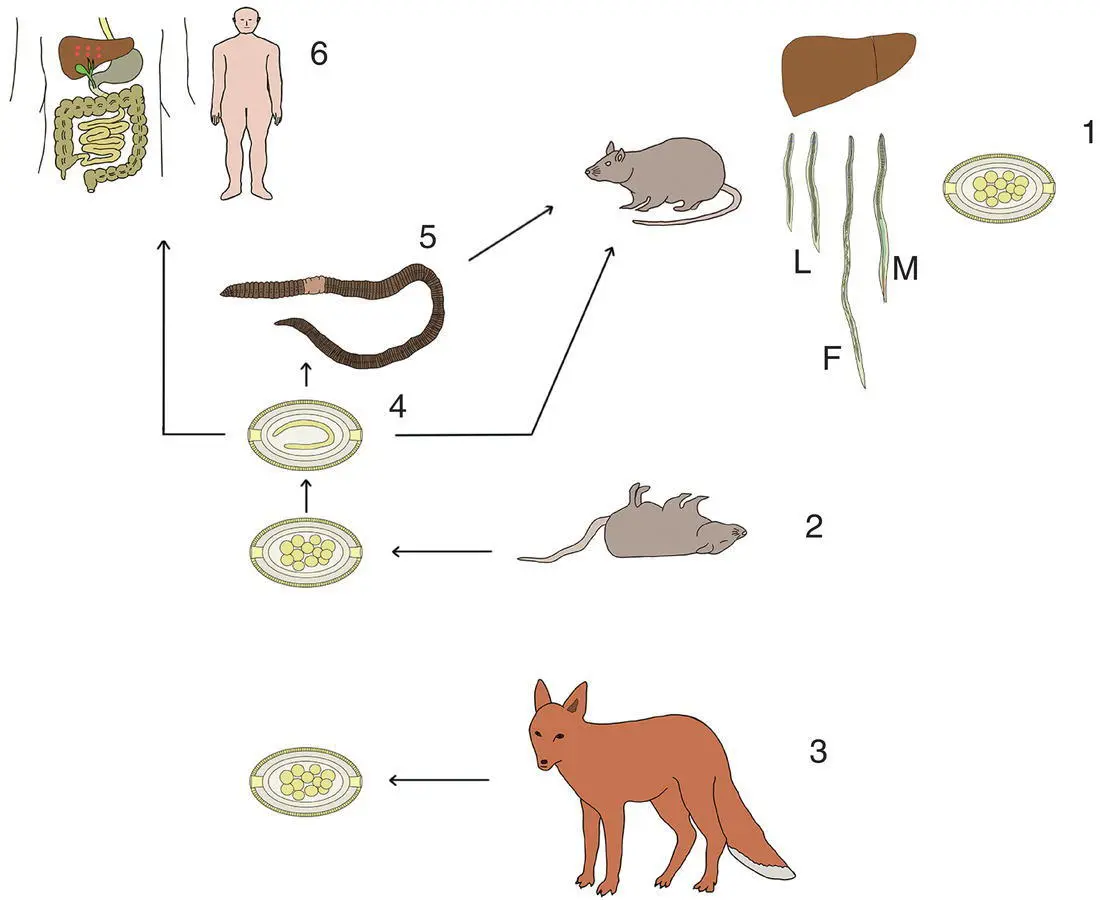
Figure 1.2 Life cycle of the nematode Capillaria hepatica illustrating the role of paratenic hosts in the transmission cycle. Drawings not to scale. 1 = A rodent becomes infected when it consumes embryonated eggs. These hatch in the small intestine, the larvae penetrate the gut, enter the circulation, and reach the liver. The larvae (L) moult become adult male (M) and female (F) worms and commence laying eggs. The unembryonated eggs remain in the liver. 2 = When the rodent dies its body decays and the unembryonated eggs enter the soil. If a scavenger eats the body, the unembryonated eggs pass through the gut and are dispersed. 3 = If a fox or other predator eats a live infected rodent, the unembryonated eggs are passed in its faeces. Scavengers and predators therefore act as dispersal hosts. 4 = The eggs embryonate to the infective stage in the soil. A rodent, human, or other susceptible mammal becomes infected when it consumes the infective eggs. 5 = Earthworms that consume infective eggs act as paratenic hosts if they are subsequently eaten by a rodent (or other susceptible mammal such as a pig). 6 = Humans are accidental, dead‐end hosts within whose liver the parasites can develop to adulthood and produce eggs.
1.4 Zoonotic Infections
A zoonotic infection (zoonosis) is one that is freely transmissible between humans and other vertebrate animals. The transfer of Plasmodium falciparum malaria between two people by a mosquito is therefore not zoonosis because a mosquito is not a vertebrate and P. falciparum only infects humans. By contrast, a mosquito transmitting Plasmodium knowlesi from a monkey to a human would be an example of a zoonosis because the P. knowlesi infects both monkeys and humans and we are both vertebrates. A disease that is only transmitted between humans is called an anthroponosis and a good example would be P. falciparum .
Many of the most important parasites in human and veterinary medicine are zoonotic infections. For example, pigs are the normal intermediate host of the pork tapeworm Taenia solium, and we are its definitive host. Therefore, pigs infect humans, and we infect pigs. Sometimes, humans are just one additional host within a parasite’s life cycle. For example, the blood fluke Schistosoma japonicum has many definitive hosts apart from humans, including dogs, cattle, pigs, and rats. Consequently, all these definitive hosts can shed eggs that will infect the snail intermediate hosts, and the resultant cercariae can infect all of them.
The transmission of zoonotic parasites is usually heavily influenced by the nature of human: animal relationships. Therefore, they can be both simultaneously theoretically simple and recalcitrant to control. This is because their control often depends upon changing human behaviour, and this depends upon a complex mix of culture, religion, tradition, economics, personality, and politics. For example, theoretically, many zoonotic infections might be halted by simple acts of basic hygiene or the cooking of food. However, people are often unable or unwilling to change the way they live their life for all sorts of reasons. Zoonotic infections should not always be considered from the risks that they pose to us. Sometimes, wild animal populations can be threatened by the diseases that we transmit to them. We will consider specific instances of this throughout the book.
Читать дальшеИнтервал:
Закладка:
Похожие книги на «Parasitology»
Представляем Вашему вниманию похожие книги на «Parasitology» списком для выбора. Мы отобрали схожую по названию и смыслу литературу в надежде предоставить читателям больше вариантов отыскать новые, интересные, ещё непрочитанные произведения.










Обсуждение, отзывы о книге «Parasitology» и просто собственные мнения читателей. Оставьте ваши комментарии, напишите, что Вы думаете о произведении, его смысле или главных героях. Укажите что конкретно понравилось, а что нет, и почему Вы так считаете.