Joao Cabral de Melo Neto - Education by Stone
Здесь есть возможность читать онлайн «Joao Cabral de Melo Neto - Education by Stone» весь текст электронной книги совершенно бесплатно (целиком полную версию без сокращений). В некоторых случаях можно слушать аудио, скачать через торрент в формате fb2 и присутствует краткое содержание. Год выпуска: 2005, Издательство: Archipelago Books, Жанр: Поэзия, на английском языке. Описание произведения, (предисловие) а так же отзывы посетителей доступны на портале библиотеки ЛибКат.
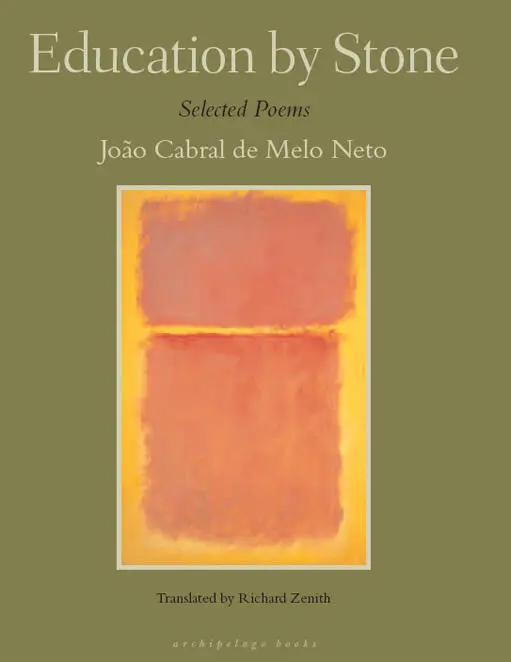
- Название:Education by Stone
- Автор:
- Издательство:Archipelago Books
- Жанр:
- Год:2005
- ISBN:нет данных
- Рейтинг книги:3 / 5. Голосов: 1
-
Избранное:Добавить в избранное
- Отзывы:
-
Ваша оценка:
Education by Stone: краткое содержание, описание и аннотация
Предлагаем к чтению аннотацию, описание, краткое содержание или предисловие (зависит от того, что написал сам автор книги «Education by Stone»). Если вы не нашли необходимую информацию о книге — напишите в комментариях, мы постараемся отыскать её.
Education by Stone — читать онлайн бесплатно полную книгу (весь текст) целиком
Ниже представлен текст книги, разбитый по страницам. Система сохранения места последней прочитанной страницы, позволяет с удобством читать онлайн бесплатно книгу «Education by Stone», без необходимости каждый раз заново искать на чём Вы остановились. Поставьте закладку, и сможете в любой момент перейти на страницу, на которой закончили чтение.
Интервал:
Закладка:
Shortly after his first book was published, João Cabral moved to Rio de Janeiro, and in 1945 he was admitted into the Brazilian foreign service. In that same year he published The Engineer , which set in place his definitive program of poetry as lucid construction. The engineer of the title poem has a dream, but it is of “clear things: / surfaces, tennis, a glass of water” and is surrounded by “light, sun, and the open air.” If poetry in his first book still depended on inspiration from dreams, now it is the fruit of sleepless nights during which the poet agonizes before a blank sheet of paper to generate a mere twenty words to be used
in his efficient machine.
Always the same twenty words
he knows so well: how they work,
their evaporation, their density
less than the air’s.
(“The Lesson of Poetry”)
Those twenty words mark the limits of inspiration; even if the poet produces more words, they still weigh less than air. But Cabral will put them into his poem-machine, where they will become the indispensable components of taut, interlocking verse structures. Eschewing verbal effusion and the piling on of images, he exploited to exhaustion the single word, the single image: water, wind, knife, stone. From their being used so insistently and in such varying formulations, these words acquired functional weight and substance, independent of whatever weight their literal meaning carried.
In “Antiode,” published in 1947, the poet tells how he rejected the word “flower” in favor of the unpoetical “feces.” To rehabilitate the flower for use in poetry, he had to strip away all its lyrical overlay, reducing it to a “verse / inscribed in verse,” an “explosion / made to work / like a machine, / a vase of flowers.” In a process analogous to the Freudian sublimation of sexual energy into the creative forces of civilization, Cabral reined in direct emotion as well as aesthetic or intellectual exaltation, harnessing their energy to generate his smooth-running poetry, which depended not so much on the words — or flowers, emotions, images, ideas — themselves, but on their dynamic arrangement. The machine functioned on its own, with no need for the reader to relate to the man who created it.
This freeing of the poem from the poet has its price. The relationship with the author created by a well-made poetry of personal confession or remembrance will more easily captivate and move the average reader. The resolute impersonality of Cabral’s work — in which the word “I” rarely occurs — puts a heavy burden on technical accomplishment, and demands readers who appreciate that accomplishment. “Impersonal” does not mean “unfeeling,” however. The poet’s rigorous configurations placed words in a state of high tension capable of provoking, at certain moments, emotions of a rare order, and these were by no means an accidental by-product of his art. According to Cabral, his constructivist approach to poetry owed its greatest debt not to any of the writers and painters he admired but to Le Corbusier, whose theoretical works he had read already as a teenager. But if the Swiss architect’s most famous proposal was to see a house as a “machine à habiter” (machine to inhabit), Cabral chose another phrase of Le Corbusier for the epigraph to The Engineer : “machine à émouvoir” (machine for stirring emotion).
In 1947 João Cabral took up his first foreign post, as the Brazilian vice-consul in Barcelona. Over the next forty years he held posts in England, Spain, France, Switzerland, Paraguay, Senegal (where he rose to the rank of ambassador in 1972), Ecuador, Honduras, and Portugal. All left explicit traces in his poetry, but Spain — where he spent a total of fourteen years, in Barcelona, Madrid and Seville — became the second geographical pole around which his poetry flourished. This was not a pole of opposition but one that echoed, in a European register, Cabral’s native Pernambuco. The relative socioeconomic backwardness of Franco-ruled Spain, the arid, harshly lit landscapes of Castile, and the stark essentiality of Andalusia’s cante hondo , the singing style typical of flamenco, had their counterparts in Northeast Brazil, which — perhaps not by chance — was never a theme in Cabral’s poetry until he went to Spain.
The reciprocal relationship of the two regions is demonstrated in Landscapes with Figures (1956), where there is a pendular shift of geographical setting from one poem to the next (in the full-length work). This alternation between Pernambuco and Spain would occur throughout the rest of the poet’s career, sometimes within a single collection and sometimes on a larger scale, with entire books set in or evoking one or the other of the two places. Landscapes also set the technical parameters of Cabral’s most typical machine mold: sixteen of the eighteen poems are built out of quatrains, and perfect or assonantal rhyme (more frequently the latter) is employed throughout in an abcb scheme. And the machine worked. Cabral put almost nothing into it and managed to pull out stunning poems. The landscapes are all bleak or empty — three cemeteries, the “anonymous, plainfaced” sugarcane field, a “place in La Mancha / where the Castilian plain is hardest,” the “almost static” Capibaribe flowing through Recife’s “sclerosis and cement” — and the figures that inhabit them mostly dead or destitute; but the poet was able to find or create life in these desolate scenes.
Uma Faca Só Lâmina (1956; A Knife All Blade) was Cabral’s most technically brilliant poem-machine. Three words, or images, or metaphors — a knife, a clock, and a bullet — weave in and around and in place of each other over the course of 352 verses, divided into eleven sections of eight stanzas with four lines containing seven syllables each. Perhaps because he realized that this poem smacked of an exercice de style , he published it and Landscapes with Figures in a book that also contained a lower-tension, higher-access poetry. Titled Duas Águas (Two Waters) and including both new and older works, the book’s subtitle indicated the two broad divisions of Cabral’s entire poetic output: Poetry of Reflective Concentration and Poetry for Wider Audiences . The latter category encompassed Cabral’s long narrative poems — The Dog without Feathers and O Rio — and the previously unpublished Morte e Vida Severina (Death and Life of a Severino), a verse drama. A staged version of this new work, with music by singer and composer Chico Buarque, won prizes in Brazil and France in 1966 and brought international renown to Cabral. “There are many of us Severinos / all with the very same life,” explains the protagonist, an archetype of the desperate Sertanejo who migrates to Recife from the drought-scourged Sertão.
This, Cabral’s most popular work, was not one he cherished, judging it less well crafted than others. But it served, in his overall production, as an antidote to the danger that “work can become exercise, an activity performed for its own sake” and leading ultimately to “the death of communication.” Cabral followed up this warning, issued in a lecture delivered in 1952, with an indictment of poets who don’t take into consideration their readers, “the essential counterpart to the activity of creating literature.” A poet’s richness, he argued, “can only originate in reality.” Death and Life of a Severino , in keeping with the implied agenda, was grounded in the reality of Pernambuco not only thematically but formally, for it picked up on a local tradition of verse plays accompanied by music and dancing.
Cabral’s more rigorously constructed work, his “poetry of reflective concentration,” reached its highest level of achievement in the 1960s, with the publication of Four Spot (1960), Serial (1961) and Education by Stone (1966). Although the poet claimed to be indifferent to music, the title of the second book recalls the serial technique of dodecaphonic composers, and the arrangement of its component parts lives up to the ideal. Obsessively driven by the number four, the book’s sixteen poems all have four parts consisting exclusively of quatrains. In the first poem each part has two quatrains; in the second poem, four quatrains; in the third poem, six quatrains; in the fourth poem, eight. The series repeats, occurring four times in all. Education by Stone , on the other hand, is a kind of poetic equivalent in verse to Bach’s 48 Preludes and Fugues . Its forty-eight poems — all of which contain either sixteen or twenty-four verses divided into two parts of varying length — are formulated like theorems whose truth is tested by antithesis. Counterpoint abounds, with frequent syntactic and semantic inversions, and the second part of each poem is usually a corollary, an analogue, or mirror version of the first part.
Читать дальшеИнтервал:
Закладка:
Похожие книги на «Education by Stone»
Представляем Вашему вниманию похожие книги на «Education by Stone» списком для выбора. Мы отобрали схожую по названию и смыслу литературу в надежде предоставить читателям больше вариантов отыскать новые, интересные, ещё непрочитанные произведения.






Обсуждение, отзывы о книге «Education by Stone» и просто собственные мнения читателей. Оставьте ваши комментарии, напишите, что Вы думаете о произведении, его смысле или главных героях. Укажите что конкретно понравилось, а что нет, и почему Вы так считаете.