Gabor Maté - In the Realm of Hungry Ghosts - Close Encounters with Addiction
Здесь есть возможность читать онлайн «Gabor Maté - In the Realm of Hungry Ghosts - Close Encounters with Addiction» весь текст электронной книги совершенно бесплатно (целиком полную версию без сокращений). В некоторых случаях можно слушать аудио, скачать через торрент в формате fb2 и присутствует краткое содержание. ISBN: , Издательство: Vintage Canada, Жанр: Психология, на английском языке. Описание произведения, (предисловие) а так же отзывы посетителей доступны на портале библиотеки ЛибКат.
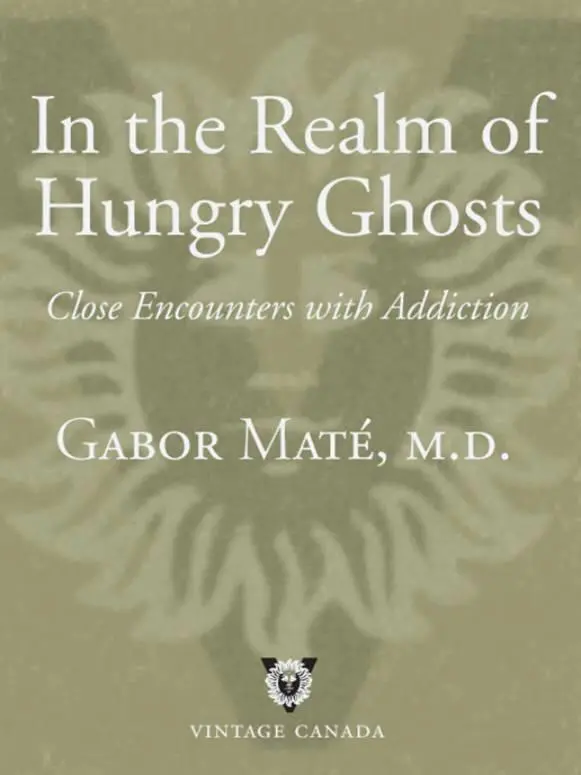
- Название:In the Realm of Hungry Ghosts: Close Encounters with Addiction
- Автор:
- Издательство:Vintage Canada
- Жанр:
- Год:неизвестен
- ISBN:978-0-307-37173-7
- Рейтинг книги:4 / 5. Голосов: 1
-
Избранное:Добавить в избранное
- Отзывы:
-
Ваша оценка:
In the Realm of Hungry Ghosts: Close Encounters with Addiction: краткое содержание, описание и аннотация
Предлагаем к чтению аннотацию, описание, краткое содержание или предисловие (зависит от того, что написал сам автор книги «In the Realm of Hungry Ghosts: Close Encounters with Addiction»). Если вы не нашли необходимую информацию о книге — напишите в комментариях, мы постараемся отыскать её.
In the Realm of Hungry Ghosts: Close Encounters with Addiction — читать онлайн бесплатно полную книгу (весь текст) целиком
Ниже представлен текст книги, разбитый по страницам. Система сохранения места последней прочитанной страницы, позволяет с удобством читать онлайн бесплатно книгу «In the Realm of Hungry Ghosts: Close Encounters with Addiction», без необходимости каждый раз заново искать на чём Вы остановились. Поставьте закладку, и сможете в любой момент перейти на страницу, на которой закончили чтение.
Интервал:
Закладка:
I momentarily permit myself some optimism. If anyone can make it, it’s these two.
October 2004: later that month
Celia does not carry through with the recovery plan. In my office for her next methadone script, she confesses she is still smoking rock.
“It’s almost for sure they will take the baby away,” I remind her. “If you’re using cocaine, they will not consider you a competent mother.”
“That’s one thing I’m going to be stopping. I’m trying my damn hardest. That’s it. I’m stopping.”
“It’s your best chance of keeping the baby—your only chance.”
“I know.”
November 2004
Holding a wet compress to large welt above her right eye, Celia paces from door to window. “I got into a scrap with a girl. I’ll be okay. But, hey, I did the ultrasound. I seen a little hand! It was so tiny.”
I explain that the shadow on the ultrasound screen could not have been a hand: at seven weeks of gestation the limbs are not formed. But I’m moved by Celia’s excitement and her evident bonding with the embryonic life she’s carrying. She tells me she hasn’t done cocaine for over a week.
November 2004: later that month
I don’t know that I’ve ever seen such sadness as I see etched on Celia’s features today. Her long, stringy hair is falling in front of her face as she bows her head and, from behind this veil, she speaks her words with painful slowness. Her voice is a keening, whimpering moan.
“He’s told me to fuck off…. He made it more than clear he doesn’t want anything to do with me anymore.”
I feel dismayed, even irritated, as if Celia owed it to me personally to live out some happy, odds-defying fantasy of redemption. “Were those Rick’s words or your interpretation?”
“No, he packed up all his stuff and didn’t even have the heart to tell me what was going on, where he was, or anything. I ran into him this morning in the street and he screamed out a bunch of bullshit about how I cheated on him, which is complete crap. I have never cheated on him. But he’s bounced. So that’s my reality right now.”
“You’re hurt.”
“I’m devastated. I’ve never felt so unwanted in my whole fucking life.”
Yes, you have, I think to myself. You have always felt unwanted. And desperate as you are to offer your baby what you never experienced—a loving welcome into this world—in the end, you’ll give her the same message of rejection.
It’s as if Celia is reading my mind. “I’m still going to go through with the pregnancy,” she says through pursed lips. “I could have an abortion, but no. This is my child; this is part of me. I don’t care if I’m left standing alone or not. These things happen for a reason. God wouldn’t give me anything more than I could handle. So I just have to have enough faith to believe that it’s all going to come together in the right time. And the way it comes together is the way it’s supposed to come together.”
Celia has a strong spiritual bent. Will it see her through?
“I need to get into recovery. I need to get the hell out of here, tonight, even if it’s just an emergency shelter for now; otherwise, I’m going to end up killing somebody. I just want to disappear…”
Once more, we make phone calls to various recovery homes. In the afternoon, two blocks away from the Portland, Celia jumps out of the cab driving her to the shelter the staff has arranged for her. Next morning she’s back at the Portland, in a cocaine rage.
December 2004
Cocaine-free for a week, Celia is determined to stay clean. “I just can’t incarcerate myself in some recovery place,” she says, “but if I can keep away from the rock, I’ll be all right.” She is cheerful, clear-eyed and optimistic. The pregnancy is developing apace. As she gains weight, her somewhat sharp features fill out and she appears to be suffused by well-being. For obstetrical and HIV care, we’ve hooked her up with Oak Tree, a clinic associated with British Columbia Women’s Hospital.
Seeing her like this, I’m reminded of Celia’s strengths. In addition to her intelligence and her love-seeking nature, she has a sensitive, spiritually vibrant, artistic side. She writes poetry and paints and also has a beautiful mezzo singing voice. Staff members have been moved, hearing her sing her heart out to Bob Dylan and Eagles songs at the Portland music group and even in the hot tub–shower we have for our patients on the same floor as the clinic. If only her life-affirming tendencies could be kept active and in ascendance over her rigid, resigned, anxiety-ridden emotional mechanisms.
“You couldn’t spare me a buck for a couple of cigarettes, could you, Doctor?”
“Tell you what,” I say. “We’ll go down to the corner and I’ll get you a pack. Nicotine is harder to beat than cocaine.”
Celia seems moved. “I can’t believe you’d do that for me.”
“Consider it a baby gift,” I reply, “although it’s not one I ever thought I’d give to a pregnant patient.”
As I pay for the smokes and hand them to Celia, the salesclerk looks at me intently. “This is so great,” Celia says. “I don’t know how to thank you.” Leaving the store, I hear the clerk echo her words in a low, mocking tone: “…so great. Don’t know how to thank you.” I turn around in the doorway and catch his expression. He is smirking. He knows exactly why, here on East Hastings, a reasonably well-dressed, middle-aged male would be buying a pack of cigarettes for a dishevelled young woman.
January 2005
Rick joins Celia for this office visit. They seem at ease, comfortable with each other.
“I can’t keep up with this soap opera,” I joke.
“I can’t keep up with it either,” says Rick, as Celia just hums to herself, a smile playing at the corners of her mouth.
She’s been to the Oak Tree clinic. Her baby is growing, and the blood tests indicate that her immune system is in good shape. Although she’s due in June, she’ll soon be admitted for prenatal care, four months early, to Fir Square, the special unit at B.C. Women’s Hospital for addicted mothers-to-be. Today she’s here for a methadone script and, once more, requests some phone numbers of recovery homes. I provide both.
The two of them leave. Through the open door I see them stepping out the back entrance onto the sunlit porch, looking into each other’s eyes, holding hands, walking calmly and peacefully.
It’s the last time I’ll see them together during the pregnancy.
January 2005: later in the month
One afternoon in late January Celia is voluntarily admitted to Detox, a first step toward entering a recovery program. By evening she’s discharged herself. In the nightmare Celia lives out she is caught in a morass of pain, helpless, punished and utterly alone. She repeats her mantra: “I’ve never felt so abandoned in my whole fucking life.” Her gaze, clouded and unfocused, is directed at the wall somewhere to the left of me. “How am I supposed to deal with it without a mountain of dope?”
Whatever answer I may have given to that question and whatever answers Celia struggled to give herself were not adequate. The remainder of her pregnancy can be summarized as brief episodes of hospitalization and escape; ongoing drug use; the frenzied pursuit of cocaine; and arrests. One arrest was for assault, when Celia spat on the nurses’ desk in the admitting department. Of course, I recalled, she learned something about spitting in her childhood. But finally, she gave birth to a remarkably healthy infant girl who was easily weaned off her opiate dependence. In every other way the baby was fine. Unlike the opiates methadone and heroin, cocaine does not provoke dangerous physiological withdrawal reactions.
Читать дальшеИнтервал:
Закладка:
Похожие книги на «In the Realm of Hungry Ghosts: Close Encounters with Addiction»
Представляем Вашему вниманию похожие книги на «In the Realm of Hungry Ghosts: Close Encounters with Addiction» списком для выбора. Мы отобрали схожую по названию и смыслу литературу в надежде предоставить читателям больше вариантов отыскать новые, интересные, ещё непрочитанные произведения.







Обсуждение, отзывы о книге «In the Realm of Hungry Ghosts: Close Encounters with Addiction» и просто собственные мнения читателей. Оставьте ваши комментарии, напишите, что Вы думаете о произведении, его смысле или главных героях. Укажите что конкретно понравилось, а что нет, и почему Вы так считаете.