Gabor Maté - In the Realm of Hungry Ghosts - Close Encounters with Addiction
Здесь есть возможность читать онлайн «Gabor Maté - In the Realm of Hungry Ghosts - Close Encounters with Addiction» весь текст электронной книги совершенно бесплатно (целиком полную версию без сокращений). В некоторых случаях можно слушать аудио, скачать через торрент в формате fb2 и присутствует краткое содержание. ISBN: , Издательство: Vintage Canada, Жанр: Психология, на английском языке. Описание произведения, (предисловие) а так же отзывы посетителей доступны на портале библиотеки ЛибКат.
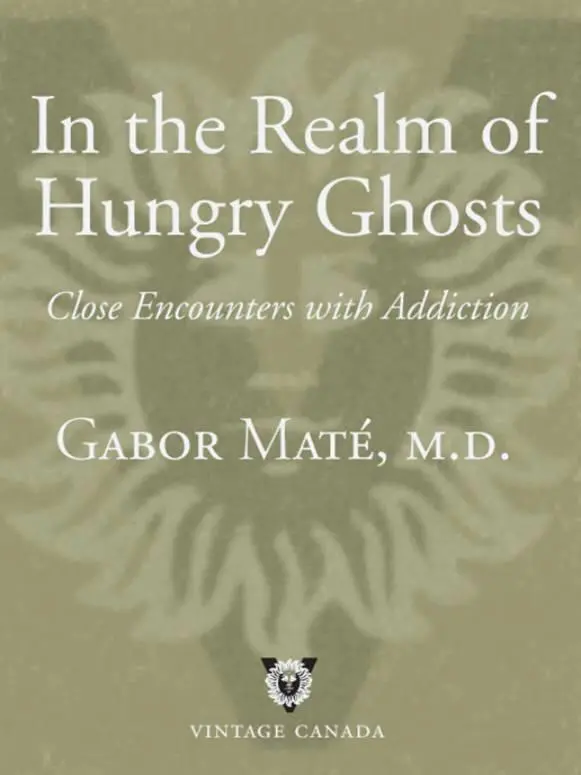
- Название:In the Realm of Hungry Ghosts: Close Encounters with Addiction
- Автор:
- Издательство:Vintage Canada
- Жанр:
- Год:неизвестен
- ISBN:978-0-307-37173-7
- Рейтинг книги:4 / 5. Голосов: 1
-
Избранное:Добавить в избранное
- Отзывы:
-
Ваша оценка:
In the Realm of Hungry Ghosts: Close Encounters with Addiction: краткое содержание, описание и аннотация
Предлагаем к чтению аннотацию, описание, краткое содержание или предисловие (зависит от того, что написал сам автор книги «In the Realm of Hungry Ghosts: Close Encounters with Addiction»). Если вы не нашли необходимую информацию о книге — напишите в комментариях, мы постараемся отыскать её.
In the Realm of Hungry Ghosts: Close Encounters with Addiction — читать онлайн бесплатно полную книгу (весь текст) целиком
Ниже представлен текст книги, разбитый по страницам. Система сохранения места последней прочитанной страницы, позволяет с удобством читать онлайн бесплатно книгу «In the Realm of Hungry Ghosts: Close Encounters with Addiction», без необходимости каждый раз заново искать на чём Вы остановились. Поставьте закладку, и сможете в любой момент перейти на страницу, на которой закончили чтение.
Интервал:
Закладка:
One consequence of spiritual deprivation is addiction, and not only to drugs. At conferences devoted to science-based addiction medicine, it is more and more common to hear presentations on the spiritual aspect of addictions and their treatment. The object, form and severity of addictions are shaped by many influences—social, political and economic status, personal and family history, physiological and genetic predispositions—but at the core of all addictions there lies a spiritual void. In the case of Serena, the Native woman from Kelowna, that void was generated by the unbearable abuse she suffered as a child—a theme I’ll return to later. But for now, suffice it to say that if I hadn’t already sensed Ralph’s secret God-thirst from his Goethe recital, Ralph would, a few months hence, confirm it in so many words. In his soul of souls he longs to connect with the very same feminine quality within himself that his bellicosity and unbridled aggression trample so viciously underfoot.
Soon afterwards, perhaps at the very next visit, we are back to the Arbeit macht frei s, the schmutzige Jude s, the Heil Hitler s. “Stick your morphine up your ass,” Ralph yells in his sandpaper voice. “Give me Ritalin. Give me cocaine. Give me Xylocaine!” He might as well be saying, “Give me liberty or give me death.” Drugs are the only freedom he knows.

Blood-borne bacterial infections are frequent complications of drug use, especially given the poor hygienic state of many Downtown Eastside addicts. Last year Ralph was hospitalized, requiring two months of high-powered intravenous antibiotics to clear a life-threatening sepsis.
Toward the end of his treatment I visit him in his room on one of the medical wards of Vancouver Hospital. There I find a person very different from the enraged, hostile pseudo-Nazi who frequents my office. He’s on his back, reclining on the half-elevated hospital bed, covered with a white sheet up to his midriff. His scrawny chest and upper limbs are bare. His salt-and-pepper hair is now evenly cut, forming a short tonsure above his shaven temples. He waves his left arm at me in greeting.
We begin with his medical status and post-discharge plans. My hope is to help him find housing away from the drug scene. Ralph expresses ambivalence at first but finally agrees that it would be a good idea to stay away from the Downtown Eastside.
“I’m glad you came out,” he tells me. “Daniel came, too. We had a good conversation.” At that time my son Daniel was employed as a mental health worker at the Portland Hotel. A musician and songwriter, he visited Ralph in hospital, and the two taped nearly an hour of Bob Dylan songs together. The recording consists mostly of Daniel strumming and picking along to Ralph’s raw, coarse semi-baritone. As a singer, Ralph has a notably shaky grip on melody, but he has a feel for the emotional resonance of Dylan’s lyrics and music.
“I apologized for what I said to Daniel and I apologize to you, for the Arbeit macht frei crap.”
“I’m curious. What’s that all about for you?
“It’s just supremacy. I don’t believe it anyway. No race is supreme. All people are supreme to God, or nobody is…It doesn’t matter anyway. It’s just stuff that goes through a person’s mind. I grew up affected by National Socialism, as you did also, only you grew up on the other side of the table. It was an unfortunate situation. I apologize for everything I said against you and your son. I really wish to be out of here soon so Daniel and I can make more music.”
“You know, what concerns me most is that it isolates you. I guess the way you learned to get along in the world is to be overly hostile.”
“I guess that’s the way it is.” When Ralph becomes emotionally agitated, as he is now, the skin over his forearm muscles undulates like a bag of rolling marbles. “’Cause people treated me badly and…and you learn to treat them badly back. It’s one of the ways…. It’s not the only way….”
“It’s pretty common,” I say. “And sometimes I can be pretty arrogant myself.”
“Great. All I really want…It was all about drugs. I didn’t want morphine…I wanted Xylocaine. That would have settled all my problems…There’d be nothing I’d be thirsting for, nothing I’d be in quest of. It would have solved everything.”
Ralph embarks on a highly intricate explanation of how Xylocaine, a local anaesthetic, is prepared for inhalation by mixing it with baking soda and distilled water. The cooked product is breathed in through a piece of Brillo. He is very particular about the technique of inhalation, which, according to him, must end with the substance being slowly blown out through the nose. I listen in fascination to this extraordinary lecture in applied psychopharmacology.
“All these people on Hastings Street and Pender Street and all up and down the Downtown Eastside; they all blow it out their mouth. Ridiculous. It doesn’t do anything. To metabolize properly it has to go through your smell glands to the brain. When it goes to the brain, it metabolizes and it freezes the little capillaries that go to the brain cells…”
“What do you feel when you do it?”
“It takes away my pain, my anxiety. It takes away my frustration. It gives me the pure essence of the Homunculus…you know, the Homunculus in Faust. ”
In Goethe’s epic drama the Homunculus is a little being of fire conceived in a laboratory flask. He is a masculine figure, who voluntarily unites with the vast Ocean, the divine feminine aspect of the soul. According to mystical traditions of all faiths and philosophies, without such ego-annihilating submission it is impossible to attain spiritual enlightenment, “the peace of God, which passeth all understanding.” Ralph yearns for nothing less.
“The Homunculus,” he continues, “is the character that represents all I would have been, had it been possible for me to be that way. But it’s not how I turned out. So now I use Xylocaine when I can get it or cocaine when I can’t.”
Ralph hopes to inhale peaceful consciousness through a glass pipe. I cannot be the Homunculus, he says, so I must be an addict.
“How long does that effect last?” I ask.
“Five minutes. It shouldn’t have to cost forty bucks just to kill the pain for five minutes. And for five minutes of respite I slave my guts out up and down Hastings Street, up and down, talking to my buddies, extorting some money out of them. ‘Look buddy, you’ve got to pay up some cash because if you don’t, I’m going to lay a beating on you with my cane.’”
Under the sheet Ralph’s belly, a little fuller after two months of rest and hospital fare, shakes with mirth as he recounts his outlandish bandy-legged banditry. “They laugh, and they lay some coin on me. I’ve got a lot of friends. And I beg, too. But I have to be out there hustling for hours and hours just to kill the pain for five minutes.”
“So you work for hours to get five minutes’ relief.”
“Yes, and then I go out again, and go out again and again.”
“What’s the pain you’re trying to kill?”
“Some of it physical, some of it emotional. Physical for sure. If I had some cocaine, I’d be out of this bed and outside smoking a cigarette right now.”
I accept that Ralph finds some evanescent benefit from his substance use, and I tell him so. But does he not recognize the negative impact on his life? Here he is, two months in hospital, admitted within an inch of dying, to say nothing of his run-ins with the law and multiple other miseries.
“All that time and energy you have to spend chasing those five minutes—is it worth it? Let’s face it, the way you’re talking to me now is very different from the way you present yourself when you’re downtown and using—miserable, unhappy and hostile. You provoke people’s hostility toward you. Maybe it’s not your intention, but that’s what happens. It creates a huge negative impact. Is it worth it for those five minutes?
Читать дальшеИнтервал:
Закладка:
Похожие книги на «In the Realm of Hungry Ghosts: Close Encounters with Addiction»
Представляем Вашему вниманию похожие книги на «In the Realm of Hungry Ghosts: Close Encounters with Addiction» списком для выбора. Мы отобрали схожую по названию и смыслу литературу в надежде предоставить читателям больше вариантов отыскать новые, интересные, ещё непрочитанные произведения.






Обсуждение, отзывы о книге «In the Realm of Hungry Ghosts: Close Encounters with Addiction» и просто собственные мнения читателей. Оставьте ваши комментарии, напишите, что Вы думаете о произведении, его смысле или главных героях. Укажите что конкретно понравилось, а что нет, и почему Вы так считаете.