Paul Thurrott - Windows 8 Secrets
Здесь есть возможность читать онлайн «Paul Thurrott - Windows 8 Secrets» — ознакомительный отрывок электронной книги совершенно бесплатно, а после прочтения отрывка купить полную версию. В некоторых случаях можно слушать аудио, скачать через торрент в формате fb2 и присутствует краткое содержание. Город: Indianapolis, IN, Год выпуска: 2012, ISBN: 2012, Издательство: John Wiley & Sons, Inc., Жанр: Программы, на английском языке. Описание произведения, (предисловие) а так же отзывы посетителей доступны на портале библиотеки ЛибКат.
- Название:Windows 8 Secrets
- Автор:
- Издательство:John Wiley & Sons, Inc.
- Жанр:
- Год:2012
- Город:Indianapolis, IN
- ISBN:978-1-118-20413-9
- Рейтинг книги:5 / 5. Голосов: 1
-
Избранное:Добавить в избранное
- Отзывы:
-
Ваша оценка:
Windows 8 Secrets: краткое содержание, описание и аннотация
Предлагаем к чтению аннотацию, описание, краткое содержание или предисловие (зависит от того, что написал сам автор книги «Windows 8 Secrets»). Если вы не нашли необходимую информацию о книге — напишите в комментариях, мы постараемся отыскать её.
Amazon.com Review
Q & A with the authors of From the Back Cover Microsoft is introducing a major new release of its Windows operating system, Windows 8, and what better way for you to learn all the ins and outs than from two internationally recognized Windows experts and Microsoft insiders, authors Paul Thurrott and Rafael Rivera? They cut through the hype to get at useful information you’ll not find anywhere else, including what role this new OS plays in a mobile and tablet world.
Regardless of your level of knowledge, you’ll discover little-known facts about how things work, what’s new and different, and how you can modify Windows 8 to meet what you need.
Windows 8 Secrets
• • • • • • • • • • • • • • • Windows 8 Secrets Should consumers adopt Windows 8 or Windows RT? Windows RT offers both advantages and disadvantages compared to Windows 8, and which you choose will depend on your needs. The biggest issue with Windows RT, of course, is the lack of desktop application compatibility: Though it comes with most Windows 8 desktop utilities and a version of Microsoft Office, Windows RT is not compatible with any third party or Microsoft desktop Windows applications that are already included. That said, Windows RT should offer much better battery life and amazingly thin and light form factors when compared to similar PCs and devices designed around a traditional PC microprocessor.
What’s best way to upgrade from Windows 7 to Windows 8? Upgrade or clean install? Is an upgrade safe? Generally speaking, you will actually see better results with an upgrade with this version of Windows, which is different than our experience with previous versions. To be safe, backup everything first, perform the upgrade, and if it doesn’t go well, you can always do a clean install afterwards.
One thing to watch during an upgrade, however, is Internet Explorer: If you have configured a different browser as your default browser in Windows 7 and then upgrade to Windows 8, you will actually lose the ability to run the Metro-style version of Internet Explorer 10. You can fix this by configuring IE as your default browser after the fact.
Does Windows 8 really run faster and better than Windows 7 on the same hardware? Yes. But in real world usage, you won’t notice much of a difference in usage. That said, Windows 8 boots, resumes from sleep, and performs other power management functions much, much faster than does Windows 7. You can also use Push Button Reset to refresh or reset a Windows 8 PC in just minutes.
Will all of my Windows 7 apps and drivers work with Windows 8? For the most part, yes. Microsoft claims that if it works with Windows 7, it should work with Windows 8. And in our experience, that has definitely been the case. Even the now-ancient game “Halo: Combat Evolved,” from 2003 installs and runs just fine. That said, you may need to uninstall some applications if you’re upgrading from Windows 7 to Windows 8, and then reinstall them after the fact. And of course there will always be some exceptions.
What are the most important keyboard combinations we should memorize? If you remember just one keyboard shortcut, it should be WINKEY + C, which enables the Charms and access to several key system functions, including Search, Share, Start, Devices, and Settings. Some other useful keyboard shortcuts include WINKEY + D (to navigate directly to the desktop), WINKEY + I (for Settings), and WINKEY + L for lock. And let’s not forget our favorite keyboard combination: WINKEY + X, which displays a power user menu of sorts containing lots of useful shortcuts.
In their introduction, the authors of this book say that “with Windows 8, suddenly, everything is different.” And they are right—with a completely new interface presenting users with a completely new experience, Windows 8 and its device-based cousin Windows RT are arguably the biggest change in Windows ever. But bestselling authors Paul Thurrott and Rafael Rivera have you covered with Windows 8 Secrets, a completely new, written-from-scratch guide to the ins and outs of this new Windows experience. Covering topics both large and small, ranging from how the new immersive experiences and familiar Windows desktop interface coexist to the subtle differences in interacting with Windows 8 via touch, keyboard, or mouse, this book digs in to reveal helpful and advanced insight in all major Windows areas: application management, data backup and security, networking, and much more.
The Insider’s Guide to:
• • • • • • • • • The Secrets series reveals:
• • • • • [Contain tables. Best viewed with CoolReader.]
Windows 8 Secrets — читать онлайн ознакомительный отрывок
Ниже представлен текст книги, разбитый по страницам. Система сохранения места последней прочитанной страницы, позволяет с удобством читать онлайн бесплатно книгу «Windows 8 Secrets», без необходимости каждый раз заново искать на чём Вы остановились. Поставьте закладку, и сможете в любой момент перейти на страницу, на которой закончили чтение.
Интервал:
Закладка:
Given this limitation, let’s look at some of the ways in which you can configure your PC for multi-monitor use in Windows 8.
There are two interfaces you will use to configure a multi-monitor setup. The most basic is the Metro-based Second Screen pane, which replaces the old “presentation” mode from previous Windows versions. You can access this screen, shown in Figure 5-29, in several ways.
Figure 5-29:The Second Screen pane

The simplest, we think, is to use the Winkey + P (where P = “presentation”) keyboard shortcut. However, you can also find this interface via touch or mouse by displaying the Charms bar and choosing Devices and then Second Screen.
While it is clearly aimed at those who need to project a presentation to a secondary screen or projector, the Second Screen pane will meet the needs of many users who have two screens attached to their PC, including laptop or tablet users who dock their device at home or work in order to use a larger screen.
This pane lets you configure the screens as follows:
• PC screen only:In this mode, the second screen is simply ignored and only the PC’s primary display is used.
• Duplicate:In this mode, the second screen duplicates, or mirrors, the primary display. There are some limitations here based on the capabilities of the screen. For example, the mirrored screens will both utilize the resolution of the lowest resolution screen of the pair. This is a common choice for those giving presentations who wish to see the same display as the audience.
• Extend:In this mode, the PC display is extended across the two screens. This common configuration allows you to have a desktop that spans two screens or a configuration in which you use Metro on one screen and the desktop on the other. Unlike with Duplicate, each display will use its own native resolution. Presenters can also utilize this mode with the Presenter mode in recent versions of Microsoft PowerPoint.
• Second screen only:Here, the main PC display (on a laptop or tablet, the display that’s built into the device) will be disabled and only the secondary screen is used. This is a common choice for those with portable computers who wish to use a docked display, keyboard, and mouse while not moving around.
The Second Screen interface is fine for basic usage, but if you have more than two screens or need to configure how the screens work, you’ll need more control. And that comes via a legacy control panel called Screen Resolution. Shown in Figure 5-30, this control panel can be accessed by right-clicking the desktop and choosing Screen Resolution, or via Start Search ( screen resolution ).
A number of configuration options are available here, including the following:
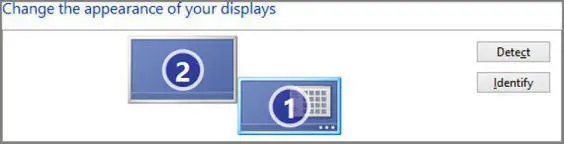
• Visual positioning and orientation of the displays:You can move the graphical representations of the displays in the window to approximate how the physical displays they represent are in fact oriented in real life (Figure 5-31). Because you will need to move the mouse cursor from screen to screen, it makes sense to line up the displays so that they work onscreen as they do in real life.
Of course, anyone using a multi-monitor setup can probably remember a keyboard shortcut, too: Winkey + C. This shortcut opens the Charms bar so you don’t have to use the mouse.
You may recall that Windows 8 utilizes the corners of the primary screen as “hot corners,” which are required by Metro interfaces such as Back, Start, and Charms. Fortunately, Microsoft has configured Windows 8 such that if a corner of the primary display is lined up exactly with a corner of a secondary display, that corner will become “sticky,” and the mouse cursor will hard stop when it reaches such a corner. This feature prevents you from accidently overshooting the hot corner, moving the cursor to the next display, and missing out on the Metro feature you meant to trigger.
Figure 5-30:The Screen Resolution control panel provides more fine-grained control over multiple displays.
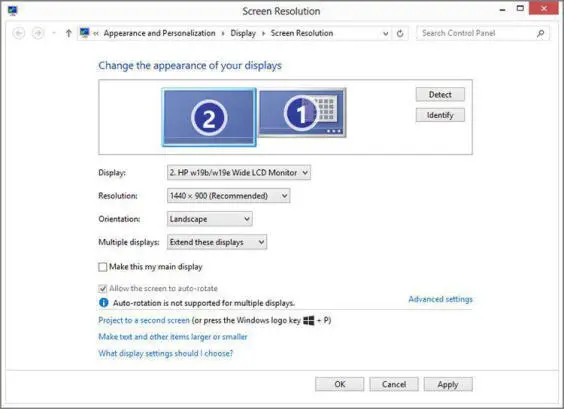
Figure 5-31:You should orient the onscreen displays to mirror how the displays line up in real life.
• Set screen resolutions:Using the Resolution drop-down, you can ensure that the resolution of each display is set correctly to the optimal resolution (generally the highest possible resolution, or the display’s “native” resolution). Select a display in the graphical representation area first and then make sure the resolution is correct.
• Orientation:You can choose between landscape, portrait, landscape (flipped) and portrait (flipped) orientations, which can be handy for those displays that can be rotated.
• Multiple displays:This drop-down works much like the Second Screen pane described in the previous section. It lets you choose between the same four options, though they are annoyingly described somewhat differently: Duplicate these displays (Duplicate), Extend these displays (Extend), Show desktop only on 1 (PC screen only), and Show desktop only on 2 (Second screen only).
OK, you’ve got your multiple displays configured and oriented the way you like. But what about the desktop wallpaper and taskbar? By default, Windows 8 will simply duplicate both the wallpaper and taskbar across two or more displays, even if you’ve chosen the Extend view, which extends the desktop across the multiple displays. Wouldn’t it be nice if you could extend a panoramic wallpaper across the displays, or use a different picture for each display? And what about having the taskbar be unique to each display so that, say, the taskbar on the second display only shows buttons for the windows that are actually open on that display?
Yep, you guessed it. You can configure how each of these features works, too.
To configure the desktop background for multiple displays, you will use the Desktop Background control panel, which is accessible through the Personalize control panel (right-click the desktop, Personalize, and then Desktop Background) or directly from Start Search ( desktop background ). In this interface, shown in Figure 5-32, you can click the Picture location drop-down to choose between a variety of background types.
The Span option lets you span a single image across multiple displays. This works best, of course, with panoramic images, and while you’re free to make your own, Microsoft is stepping up by providing panoramic wallpapers (and even desktop themes, which also include other unique configurations) that are designed specifically for this use.
Some are included in Windows 8. To see what’s available, select Windows Desktop Backgrounds from the Picture location drop-down near the top of this window. There, you’ll find a few panoramic options that, when selected, span nicely across two displays as in Figure 5-33.
Figure 5-32:Desktop Background control panel
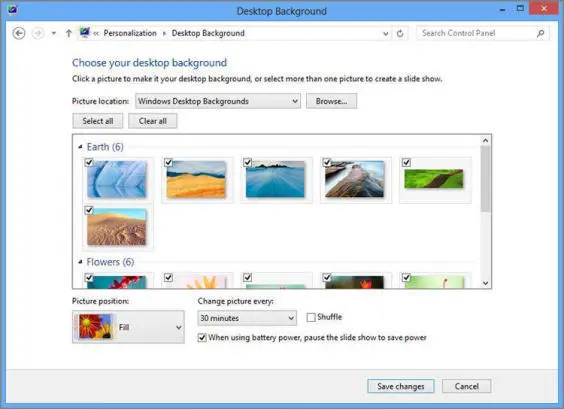
Figure 5-33:With a panoramic background picture, you can create a seamless display across multiple monitors.
Читать дальшеИнтервал:
Закладка:
Похожие книги на «Windows 8 Secrets»
Представляем Вашему вниманию похожие книги на «Windows 8 Secrets» списком для выбора. Мы отобрали схожую по названию и смыслу литературу в надежде предоставить читателям больше вариантов отыскать новые, интересные, ещё непрочитанные произведения.









Обсуждение, отзывы о книге «Windows 8 Secrets» и просто собственные мнения читателей. Оставьте ваши комментарии, напишите, что Вы думаете о произведении, его смысле или главных героях. Укажите что конкретно понравилось, а что нет, и почему Вы так считаете.