Wei-Meng Lee - C# 2008 Programmer's Reference
Здесь есть возможность читать онлайн «Wei-Meng Lee - C# 2008 Programmer's Reference» весь текст электронной книги совершенно бесплатно (целиком полную версию без сокращений). В некоторых случаях можно слушать аудио, скачать через торрент в формате fb2 и присутствует краткое содержание. Город: Indianapolis, Год выпуска: 2009, ISBN: 2009, Издательство: Wiley Publishing, Inc., Жанр: Программирование, на английском языке. Описание произведения, (предисловие) а так же отзывы посетителей доступны на портале библиотеки ЛибКат.

- Название:C# 2008 Programmer's Reference
- Автор:
- Издательство:Wiley Publishing, Inc.
- Жанр:
- Год:2009
- Город:Indianapolis
- ISBN:978-0-470-28581-7
- Рейтинг книги:4 / 5. Голосов: 1
-
Избранное:Добавить в избранное
- Отзывы:
-
Ваша оценка:
C# 2008 Programmer's Reference: краткое содержание, описание и аннотация
Предлагаем к чтению аннотацию, описание, краткое содержание или предисловие (зависит от того, что написал сам автор книги «C# 2008 Programmer's Reference»). Если вы не нашли необходимую информацию о книге — напишите в комментариях, мы постараемся отыскать её.
C# 2008 Programmer's Reference — читать онлайн бесплатно полную книгу (весь текст) целиком
Ниже представлен текст книги, разбитый по страницам. Система сохранения места последней прочитанной страницы, позволяет с удобством читать онлайн бесплатно книгу «C# 2008 Programmer's Reference», без необходимости каждый раз заново искать на чём Вы остановились. Поставьте закладку, и сможете в любой момент перейти на страницу, на которой закончили чтение.
Интервал:
Закладка:
adapter = new SqlDataAdapter(comm);
adapter.Fill(ds);
The three tables loaded onto the DataSet can now be referenced using three DataTableobjects:
DataTable customersTable = ds.Tables[0]; //---Customers---
DataTable ordersTable = ds.Tables[1]; //---Orders---
DataTable orderDetailsTable = ds.Tables[2]; //---Order Details---
The following LINQ query joins two DataTable objects — customersTableand ordersTable— using the query syntax:
//---using query syntax to join two tables - Customers and Orders-
var query1 =
(from customer in customersTable.AsEnumerable()
join order in ordersTable.AsEnumerable() on
customer.Field("CustomerID") equals order.Field("CustomerID")
select new {
id = customer.Field("CustomerID"),
CompanyName = customer.Field("CompanyName"),
ContactName = customer.Field("ContactName"),
OrderDate = order.Field("OrderDate"),
ShipCountry = order.Field("ShipCountry")
}).ToList();
As evident in the query, the Customersand Orderstable are joined using the CustomerIDfield. The result is reshaped using an anonymous type and then converted to a List object using the ToList()extension method. You can now bind the result to a DataGridViewcontrol if desired. Figure 14-8 shows the result bound to a DataGridViewcontrol.
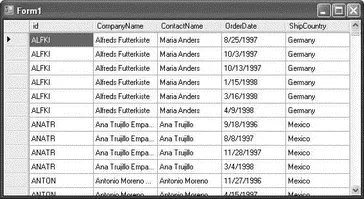
Figure 14-8
You can also rewrite the query using the method syntax:
//---using method syntax to join two tables - Customers and Orders
var query1 =
(customersTable.AsEnumerable().Join(ordersTable.AsEnumerable(),
customer => customer.Field("CustomerID"),
order => order.Field("CustomerID"),
(customer, order) => new {
id = customer.Field("CustomerID"),
CompanyName = customer.Field("CompanyName"),
ContactName = customer.Field("ContactName"),
OrderDate = order.Field("OrderDate"),
ShipCountry = order.Field("ShipCountry")
})).ToList();
The following query joins three DataTable objects — customersTable, ordersTable, and orderDetailsTable— and sorts the result according to the OrderIDfield:
//---three tables join---
var query2 =
(from customer in customersTable.AsEnumerable()
join order in ordersTable.AsEnumerable() on
customer.Field("CustomerID") equals order.Field("CustomerID")
join orderDetail in orderDetailsTable.AsEnumerable() on
order.Field("OrderID") equals orderDetail.Field("OrderID")
orderby order.Field("OrderID")
select new {
id = customer.Field("CustomerID"),
CompanyName = customer.Field("CompanyName"),
ContactName = customer.Field("ContactName"),
OrderDate = order.Field("OrderDate"),
ShipCountry = order.Field("ShipCountry"),
OrderID = orderDetail.Field("OrderID"),
ProductID = orderDetail.Field("ProductID")
}).ToList();
As evident from the query, the Customerstable is related to the Orderstable via the CustomerIDfield, and the Orderstable is related to the Order Detailstable via the OrderIDfield.
Figure 14-9 shows the result of the query.
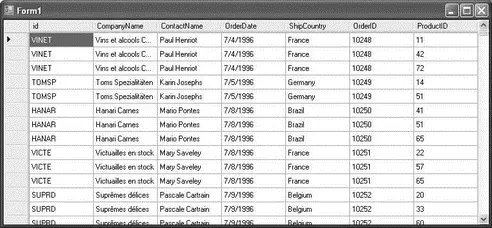
Figure 14-9
Typed DataSet
So far you've used the Field()extension method to access the field of a DataTableobject. For example, the following program uses LINQ to DataSet to query all the customers living in the USA. The result is then reshaped using an anonymous type:
SqlConnection conn;
SqlCommand comm;
SqlDataAdapter adapter;
DataSet ds = new DataSet();
conn = new SqlConnection(@"Data Source=.\SQLEXPRESS;" +
"Initial Catalog=Northwind;Integrated Security=True");
comm = new SqlCommand("SELECT * FROM Customers", conn);
adapter = new SqlDataAdapter(comm);
adapter.Fill(ds, "Customers");
var query1 =
(from customer in ds.Tables[0].AsEnumerable()
where customer.Field("Country") == "USA"
select new {
CustomerID = customer.Field("CustomerID"),
CompanyName = customer.Field("CompanyName"),
ContactName = customer.Field("ContactName"),
ContactTitle = customer.Field("ContactTitle")
}).ToList();
dataGridView1.DataSource = query1;
As your query gets more complex, the use of the Field()extension method makes the query unwieldy. A good way to resolve this is to use the typed DataSet feature in ADO.NET. A typed DataSet provides strongly typed methods, events, and properties and so this means you can access tables and columns by name, instead of using collection-based methods.
To add a typed DataSet to your project, first add a DataSetitem to your project in Visual Studio 2008 (see Figure 14-10). Name it TypedCustomersDataset.xsd.
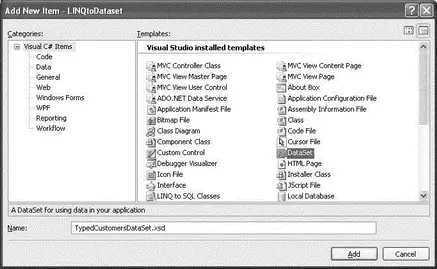
Figure 14-10
In the Server Explorer window, open a connection to the database you want to use (in this case it is the Northwind database) and drag and drop the Customerstable onto the design surface of TypedCustomersDataSet.xsd(see Figure 14-11). Save the TypedCustomersDataSet.xsdfile.
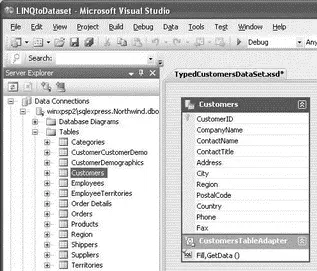
Figure 14-11
Читать дальшеИнтервал:
Закладка:
Похожие книги на «C# 2008 Programmer's Reference»
Представляем Вашему вниманию похожие книги на «C# 2008 Programmer's Reference» списком для выбора. Мы отобрали схожую по названию и смыслу литературу в надежде предоставить читателям больше вариантов отыскать новые, интересные, ещё непрочитанные произведения.












Обсуждение, отзывы о книге «C# 2008 Programmer's Reference» и просто собственные мнения читателей. Оставьте ваши комментарии, напишите, что Вы думаете о произведении, его смысле или главных героях. Укажите что конкретно понравилось, а что нет, и почему Вы так считаете.