Sofia Samatar - A Stranger in Olondria
Здесь есть возможность читать онлайн «Sofia Samatar - A Stranger in Olondria» весь текст электронной книги совершенно бесплатно (целиком полную версию без сокращений). В некоторых случаях можно слушать аудио, скачать через торрент в формате fb2 и присутствует краткое содержание. Жанр: Фэнтези, на английском языке. Описание произведения, (предисловие) а так же отзывы посетителей доступны на портале библиотеки ЛибКат.
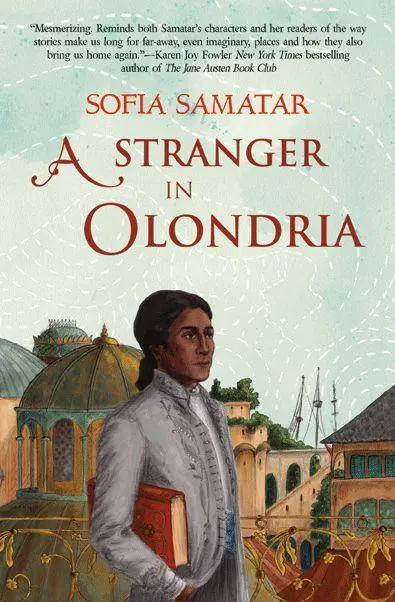
- Название:A Stranger in Olondria
- Автор:
- Жанр:
- Год:неизвестен
- ISBN:нет данных
- Рейтинг книги:5 / 5. Голосов: 1
-
Избранное:Добавить в избранное
- Отзывы:
-
Ваша оценка:
A Stranger in Olondria: краткое содержание, описание и аннотация
Предлагаем к чтению аннотацию, описание, краткое содержание или предисловие (зависит от того, что написал сам автор книги «A Stranger in Olondria»). Если вы не нашли необходимую информацию о книге — напишите в комментариях, мы постараемся отыскать её.
In desperation, Jevick seeks the aid of Olondrian priests and quickly becomes a pawn in the struggle between the empire’s two most powerful cults. Yet even as the country shimmers on the cusp of war, he must face his ghost and learn her story before he has any chance of becoming free by setting her free: an ordeal that challenges his understanding of art and life, home and exile, and the limits of that seductive necromancy, reading.
A Stranger in Olondria — читать онлайн бесплатно полную книгу (весь текст) целиком
Ниже представлен текст книги, разбитый по страницам. Система сохранения места последней прочитанной страницы, позволяет с удобством читать онлайн бесплатно книгу «A Stranger in Olondria», без необходимости каждый раз заново искать на чём Вы остановились. Поставьте закладку, и сможете в любой момент перейти на страницу, на которой закончили чтение.
Интервал:
Закладка:
We spoke. We spoke of nothing, fish and fruit trees and the gossip of Tyom, an old man’s death, a number of betrothals. My father’s wife, loyal to her bitterness, made only comments whose innocence concealed their essential cruelty. She was a dagger thinly sheathed, as always, only slightly subdued by the thought that I, the Ekawi, could send her away. And only this gnawing fear, evident in her strained and watchful pose, made her pitiable and therefore bearable. Her laugh rang out unnaturally, so that Jom whimpered with distress and my mother looked at her co-wife with concern. My mother, incapable of malice, even in self-defense, who humbled herself in order to soothe the first wife: “Look at your son’s clothes,” she said, teasing, and my father’s wife, not unaware of the kindness, sniffed coldly. “Ridiculous attire,” she said. “Even his tutor doesn’t dress like that.” A smirk twisted her iron face in the moonlight.
It was my mother’s genius, this passionate sensitivity that made her capable of knowing others better than they knew themselves. When Lunre was ready to go, we walked with him to the arch of the courtyard, a servant following with a Tyomish lamp, a bowl of oil. The light was florid and agitated, a light by which one could never read, its nervous color bouncing in all directions, lighting up my master’s smile and then, leaning against the wall, the pole which he took in his hand, grasping it firmly. It was a bolkyet , a stick in which a narrow blade was hidden. He twisted the handle, revealing a streak of white. “In case of thieves,” he grinned, snapping it closed, and my mother said approvingly: “Yes, Painted Mountain is far.” I looked at her and saw, by her earnest eyes in the transient light, by the tender curve at the corner of her mouth, that her thoughts were the same as mine: she knew that Lunre would never have occasion to use the bolkyet he leaned upon so proudly. For any islander coming upon my master in the dark, even the most brutal and wayward criminal, would flee from his spectral countenance and supernatural height and from the pallor that indicated a lack of blood. Yet I saw that, since he had moved away, my mother had flattered him for his brusque courage in going armed among the forests, and that Lunre, who would never have admitted to physical vanity, was pleased to be seen as a man to be reckoned with. This glimpse of their new lives, so full of grace and generosity, affected me like the sight of a beautiful painting, like one of those dark and melancholy paintings of Olondria in which only a tiny corner is laden with light. There they stood, surrounded by darkness under a distant moon, lit by the thick and glancing rays from the bowl, the white-haired man with his pale and gentle eyes as changeful as water, and the woman, black-haired, barefoot, lambent with smiles. Then he put his free hand on my shoulder and kissed me on both cheeks, saying in Olondrian: “Welcome, friend of my heart.” He squeezed my shoulder and turned, the servant lighting his way out to the gate, his angular shadow sliding over the path.
“He is a good man,” my mother said when he had gone. “You should be happy that he has found a wife.”
“I am happy,” I said.
She linked her arm through mine, turning with me to walk back to the chairs. “My little mouse…”
The words affected her suddenly; it was clear she had not expected it. I heard the catch in her voice, and she fell silent. Then she laughed tearfully: “How silly I am! And look, Jom’s taken off his vest—it’s getting colder, he’ll be chilled…”
Jom had indeed removed his vest and stood before the orange trees with his powerful chest and shoulders lit by the moon. My father’s wife walked toward me with her brisk, constricted steps and knelt on the flagstones to receive the touch of my hand. I touched her formidable hairstyle, which was barbed like a sea urchin, and she rose, muttered good night, and walked stiffly off to her room. We could hear her scolding one of the servants. Footsteps pattered, a light flashed. Then the house was dark, submerged in silence.
“Jomi,” my mother said. “First One, what have you done with your vest? No, leave him,” she said to me, touching my arm. “He likes it. And he’s only happy because his brother is home. Aren’t you, Jomi. Aren’t you, my little squirrel…”
Her little squirrel, her little mouse. When she spoke to us her voice overflowed with love, a love that was naked, glowing, transparent, the same pure ardor that poured from her eyes when she looked at us, that lit up the curve of her cheek, inexhaustible, never flagging in strength. This love existed only to give itself, an eternal fountain. And now, it seemed to me, that my father was dead, she was free to bestow her love without the fear of being mocked or of exposing us to the danger of his jealousy. Moonlight fell in the courtyard, a white rain, immobile, diaphanous. Jom put his hands into it and rubbed his face. He went through all the motions of washing, scrubbing his hair and the definite, vivid contours of his bricklayer’s physique. Soft moans escaped from him, and his laugh which was quiet and strangely flat, devoid of all but the most private emotion. A laugh like the chuckling call of a dove. He was still far from me, so far, whitening in the moonlight like a statue.
The following morning I rode to Painted Mountain.
My mother had described the secluded spot where Lunre had chosen to live. I rode up through the vivid and varied greenness of Tinimavet, the dark green of the mango trees, the yellow-green of the coffee bushes. The canna lilies, not yet in flower, had leaves of a cool and opaque green; the papayas, throwing their white trunks toward the sky, were crowned with a green that was almost blue. Lunre’s house stood alone at the end of a dusty path, its thatched roof sheltered by an enormous flame tree.
I dismounted in silence, my satchel a weight on my shoulder. The house was small, isolated, looking across the valley, surrounded on all sides by trees and dwarfed by the heavy arms of the flame tree kindling its myriad torches in the shadows. It was strange to see my master emerge smiling from the doorway, stooping to pass underneath the hanging thatch. He clasped my hand and greeted me in Olondrian, and the daylight showed how tanned with the sun he was, how white his hair.
“A beautiful morning,” he said. “As always, here on the edge of the valley! Often I stand here, just looking out, just looking…” And he put his hands on his narrow hips and squinted over the valley where the sunlight poured on the misty green of the farms. “Beautiful!” he repeated. “Sometimes I can see all the way to Snail Mountain. Ah, but come—come in.” He motioned me toward the open door, wearing a bashful, unfamiliar smile. I ducked inside and he followed me, pulling shut a door of unfinished bark.
“A shame to cut off the view,” he said. “But Niahet says it lets in the flies.” The room was dim and cool, with screens of woven reeds on the windows; but even in the poor light I caught the anxious glance he darted at me, his sudden firmness of purpose in saying “Niahet.” I did not know what to do with myself and stood holding my satchel in front of me while Lunre urged me repeatedly to sit down and finally seated himself on one of the woven mats on the swept earth floor, hunched and awkward, all gangly arms and legs. It was clear that he was not yet accustomed to sitting on the floor, but he managed to make himself comfortable by leaning against the wall. I sank down on the mat across from him, my back to the door, the satchel beside me. “So, here I am,” he said.
He smiled at me, his teeth white in the gloom. Flecks of sunlight clung like gold dust to the screens in the three windows. Aside from the mats there was no furniture in the room but the old sea chest, its blue paint peeling, set against one wall. A few books were stacked on top of it and, I saw with a curious throb of the heart, a simple jut , veiled to the waist, its spraddle-legs fashioned of copper. It must belong to the wife. It presided over my master’s books in squat, enigmatic silence: one external soul watching the others.
Читать дальшеИнтервал:
Закладка:
Похожие книги на «A Stranger in Olondria»
Представляем Вашему вниманию похожие книги на «A Stranger in Olondria» списком для выбора. Мы отобрали схожую по названию и смыслу литературу в надежде предоставить читателям больше вариантов отыскать новые, интересные, ещё непрочитанные произведения.






Обсуждение, отзывы о книге «A Stranger in Olondria» и просто собственные мнения читателей. Оставьте ваши комментарии, напишите, что Вы думаете о произведении, его смысле или главных героях. Укажите что конкретно понравилось, а что нет, и почему Вы так считаете.