Sofia Samatar - A Stranger in Olondria
Здесь есть возможность читать онлайн «Sofia Samatar - A Stranger in Olondria» весь текст электронной книги совершенно бесплатно (целиком полную версию без сокращений). В некоторых случаях можно слушать аудио, скачать через торрент в формате fb2 и присутствует краткое содержание. Жанр: Фэнтези, на английском языке. Описание произведения, (предисловие) а так же отзывы посетителей доступны на портале библиотеки ЛибКат.
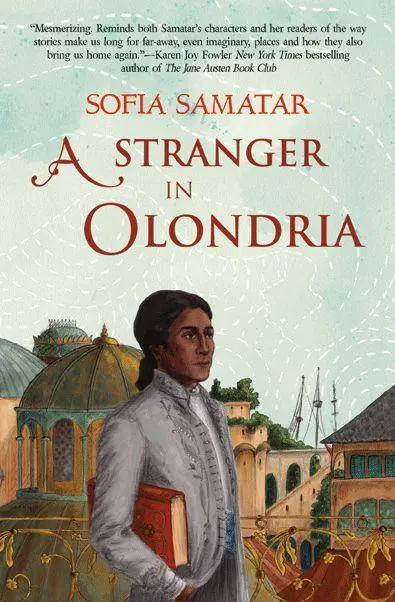
- Название:A Stranger in Olondria
- Автор:
- Жанр:
- Год:неизвестен
- ISBN:нет данных
- Рейтинг книги:5 / 5. Голосов: 1
-
Избранное:Добавить в избранное
- Отзывы:
-
Ваша оценка:
A Stranger in Olondria: краткое содержание, описание и аннотация
Предлагаем к чтению аннотацию, описание, краткое содержание или предисловие (зависит от того, что написал сам автор книги «A Stranger in Olondria»). Если вы не нашли необходимую информацию о книге — напишите в комментариях, мы постараемся отыскать её.
In desperation, Jevick seeks the aid of Olondrian priests and quickly becomes a pawn in the struggle between the empire’s two most powerful cults. Yet even as the country shimmers on the cusp of war, he must face his ghost and learn her story before he has any chance of becoming free by setting her free: an ordeal that challenges his understanding of art and life, home and exile, and the limits of that seductive necromancy, reading.
A Stranger in Olondria — читать онлайн бесплатно полную книгу (весь текст) целиком
Ниже представлен текст книги, разбитый по страницам. Система сохранения места последней прочитанной страницы, позволяет с удобством читать онлайн бесплатно книгу «A Stranger in Olondria», без необходимости каждый раз заново искать на чём Вы остановились. Поставьте закладку, и сможете в любой момент перейти на страницу, на которой закончили чтение.
Интервал:
Закладка:
“Then the Lady smiled and said, ‘That is easily granted.’ And he stood, and the water fell from him in streams. And the Lady admired him greatly, and a blush spread over her cheek; but Naimar said: ‘Now grant that which thou promised.’ ‘Willingly,’ said the Lady. And she plucked a handful of lilies which were growing by the stream, and took the bulbs, and washed them in the water, and she bade the boy to eat them. And taking them in both hands, he did so.
“‘Will I become immortal?’ he asked. ‘Surely thou wilt,’ she said. And as she spoke, the boy cried out, and fell; and the Lady, who was Avalei, looked down at the beautiful corpse that lay on the bank and smiled. ‘Thou art immortal,’ she said.”
In the aftermath of this virulent tale I looked at the priest, aghast. And his red lips parted in his most childlike smile. I sat up straighter, pushed my chair back and turned from the priest to Miros as I spoke, so that both of them could see my face.
“I will tell you the truth,” I said, “and if you think me a wiser man than you, and you listen to me, so be it, and if you do not, so be it. Your prince will be a tyrant. He will not hesitate to burn libraries or palaces or radhui . He will set Olondria aflame.”
Auram inclined his head slightly, a gesture of acceptance. “You may be right. But he will save a future, a way of life. For those who cannot read, he will save the world.”
I knew it was true. A certain world would be saved, but it would no longer contain the Olondria I knew.
No more battles, I thought, no more arguments. I held out my hand to the priest, and he placed his own inside it, white driftwood barnacled with rings. So frail, so cold, with a bandage on the wrist.
His dark eyes questioned me. “Forgiveness?” he said.
“No,” I answered. “Farewell.”
A night of desert stars and silence, poignant as a breath. I sat on the bed and watched the open window. No angel tore the air. The sky was motionless, complete above the sleeping mountains, seamless as a glass. I did not close my eyes, because when I did I saw Miros screaming in battle, blood-streaked mares, Olondria on a pyre. I saw war come, and I saw myself far away, in a courtyard of yellow stone, with no one to bring me messages from the dead.
The heavens turned. A dark blue glow came to dwell on the windowsill. Slowly the shapes in the room emerged from the dark as if rising from the sea. There was the mantelpiece, there the door. There was the wrought-iron table and the stack of books that held the anadnedet . And there was my satchel, rescued by the priest, with all my books inside: Olondrian Lyrics , the Romance of the Valley . The record book where I had scribbled my agony in Bain. And the packets of Tialon’s letters, heavy as two stones.
He had brought them for me. When his Tavrouni allies had killed the soldiers in Klah-ne-Wiy, he had had the presence of mind to collect my things, this precious satchel and the angel’s body, and he had hired a servant and suffered his broken wrist to be tied in place by a local doctor. A group of soldiers met him when he came out of the little mud clinic. Auram smiled at them, his disdain as gray and icy as the sky. They took him to Ur-Amakir, the nearest city, where he was to be tried for treason and the murder of the soldiers. He would be very glad to oblige, he said. News of the Night Market had reached the city; crowds gathered chanting outside the jail where he was held. Realizing that his oration in court might spark riots, the Duke of Ur-Amakir accepted his claim of innocent self-defense and released him.
And he came to Sarenha-Haladli with the body, as he had promised. He was, after all, a man of honor.
I stood. My bones ached with a sorrow older than myself. I went to the table and put my hand on a book to feel something solid. It was Lantern Tales , in which Jissavet’s words murmured like doves. I remembered her telling me: I know what the vallon is . It’s jut. Now she had helped start a war in a far country to liberate those who could not read, the hotun of Olondria. I wondered, for an unguarded moment, what she would have said. But I knew that this was not her war. Nor was it mine.
I packed the books, put on my boots, and set the strap of the satchel on my shoulder. There was already enough light to see the steps. Downstairs in the dining room, where the shadows of the rose trees streaked the windows, Auram’s Evmeni manservant was boiling coffee. Soon Miros came in, supporting the arm of the hooded priest with a new tenderness, a reverence. We sat together in the lightening air. The servant gave me a glass of coffee clouded with white steam. Its flavor was earthy, stinging, coarse: the taste of Tyom.
Difficult, difficult, difficult!
Difficult to carry these blankets
and these curds, threads, skins and splendors
into the Land of Red Sheep.
Maskiha spinning your wool,
spin the sun into blankets for me.
For all night I am lying alone now,
in the shade of invisible spikenards.
I go to where the water is sweet,
and the peaches are of carnelian.
Someone tell me why my road
is eternally strewn with ashes.
And why in the doorways of the sky
there are girls whose palms are rivers of milk,
bursting, flowing, dissolving like snowflakes
over the Land of Red Sheep.
Miros sang as we traveled in the priest’s carriage along the cart-tracks, the country altering slowly, kindling with the sparkle of orchards in flower. Soon the track grew wide and level and bordered with fragments of brick, and there were more sheep and fewer cattle in the fields. Far away to the south waved the blue fringes of a forest. Birds filled the air, geese and swans flocking around the reservoirs. Honeysuckle drowned the balustrades of the country houses, and bildiri villages smoked in clouds of alabaster dust.
The sun brought the color back to Miros’s face; the meals we ate in the villages filled out his frame. He was almost himself again when we reached the southern Tavroun. As we rolled beneath the ancient aqueduct into the town of Tashuef he was singing a vanadel that made the priest’s servant snigger. And when we went out that evening to a tavern called the Swan, he appeared altogether restored, tall and fresh. We ate a Valley meal of kebma , sour cream, and mountain olives, followed by a dish of apricots and quails. After a bottle of insipid wine we began on the white-hot teiva with preserved figs floating thickly in the bottle, and listened to the Evmeni musicians playing their long guitars and violins among the streetlamps and shadows of trees. It was like an evening in the Valley. Only the dryness of the air, the peculiar echoes of the sounds, and the aloof and solemn propriety of the patrons at other tables, made it clear that we were still among the mountains. We removed the tablecloth and marked the little table with chalk, and Miros taught me the elementary rules of londo and promptly won six droi from the purse the priest had given me and shouted to the waiter: “Another bottle. And bring us some chicken livers.”
Turning to me he grinned and said: “I know I owe you my life. But you owe me six droi .”
“You may have the droi ,” I said, “if you will take care of your life.”
His face grew pensive, showing its new hardness under the lamps, a touch of age. “I will care for it, body and spirit,” he said.
Afterward we walked through the stiff brick streets of the town, passing doors where the names of the owners hung in brass, singing vanadiel to the barking of chained mastiffs and the tolling of a bell in the temple of Iva. We saw no rubbish pits or decaying backstreets. All was trim, definite, contained. The shadows lay very straight and black. We compared the town to the nomad camps where refuse fell haphazardly, submitting to the purification of sand.
Читать дальшеИнтервал:
Закладка:
Похожие книги на «A Stranger in Olondria»
Представляем Вашему вниманию похожие книги на «A Stranger in Olondria» списком для выбора. Мы отобрали схожую по названию и смыслу литературу в надежде предоставить читателям больше вариантов отыскать новые, интересные, ещё непрочитанные произведения.







Обсуждение, отзывы о книге «A Stranger in Olondria» и просто собственные мнения читателей. Оставьте ваши комментарии, напишите, что Вы думаете о произведении, его смысле или главных героях. Укажите что конкретно понравилось, а что нет, и почему Вы так считаете.